First Image of a Black Hole!
Based on Veritasium's video on YouTube. If you like this content, support the original creators by watching, liking and subscribing to their content.
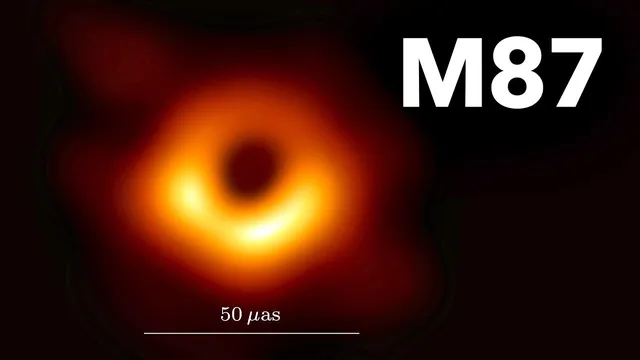
The first black hole image released on April 10, 2019 shows plasma orbiting the supermassive black hole at the center of M87.
Briefing
The first direct image of a black hole—released by the Event Horizon Telescope collaboration on April 10, 2019—shows a glowing ring of plasma orbiting the supermassive black hole at the center of galaxy M87. The bright side marks plasma moving toward Earth at near-light speeds, while the dimmer side corresponds to plasma moving away. That brightness asymmetry comes from relativistic beaming, a consequence of motion close to light speed.
The image also reveals the black hole’s environment in detail: M87’s central object is actively fed by a hot accretion disk, and it launches narrow, collimated jets above and below the disk. Those jets, highlighted in blue, are thought to be powered by extremely strong magnetic fields. One jet appears to be aimed almost toward Earth, and relativistic beaming again helps explain why the approaching jet stands out while the receding one is harder to see. The plasma completes one orbit in roughly two days, giving the system a clock-like dynamical timescale.
A key reason the image looks “fuzzy” is not that the black hole is unclear—it’s that the target is angularly tiny. The black hole in M87 has an estimated mass of about 6.5 billion Suns. Its shadow spans nearly the size of the solar system, but because it lies 53.5 million light-years away, it subtends only about 40 microarcseconds on the sky. That places the observation at the edge of what physics and current instrumentation allow.
Achieving the needed resolution requires an Earth-sized effective telescope because of the diffraction limit. Instead of building a single planet-scale instrument, the collaboration used eight radio telescopes distributed across the globe. They observed M87 simultaneously and combined the data, using Earth’s rotation to effectively synthesize a telescope with the diameter required to reach the target resolution.
The collaboration also targeted Sagittarius A*—the supermassive black hole at the center of the Milky Way—though no image was released in this account. It sits much closer (about 26,000 light-years away) but is far less massive (around four million Suns) and less continuously active, with matter falling in episodically. That likely means longer waits and more variability before a comparable image can be produced.
Beyond the spectacle, the M87 result functions as a high-stakes test: it provides strong observational support for general relativity in the regime of extreme gravity, where the theory’s predictions about light bending and the appearance of a black hole shadow are most difficult to verify. The achievement also reflects the scale of coordination involved—hundreds of scientists working toward an observation that pushed radio astronomy to its practical limits.
Cornell Notes
The Event Horizon Telescope collaboration released the first black hole image on April 10, 2019, showing plasma orbiting the supermassive black hole in M87. The bright and dim sides of the ring come from relativistic beaming: plasma moving toward Earth appears brighter, while plasma moving away appears dimmer. The system’s dynamics imply an orbit time of about two days, and the surrounding accretion disk and jets reveal how matter and magnetic fields behave near the event horizon. The image’s fuzziness is mainly a resolution limit: the shadow is only ~40 microarcseconds across, requiring an Earth-sized effective telescope. Eight globally distributed radio telescopes combined data to synthesize that resolution, and the result strongly supports general relativity’s predictions about light near extreme gravity.
What in the M87 image indicates that plasma is moving toward and away from Earth?
How do scientists infer the direction of rotation and the orbital timescale from the image?
Why was 1.3-millimeter (radio) light used, and what does it allow researchers to see?
What explains the presence of jets and their appearance in the M87 observations?
Why does the black hole image look fuzzy even though the physics is clear?
How did the collaboration achieve the resolution needed without a single planet-scale telescope?
Review Questions
- How does relativistic beaming change the observed brightness of plasma moving toward versus away from Earth, and where does that show up in the M87 image?
- Why does the diffraction limit imply an Earth-sized effective telescope for the M87 black hole shadow, and how did eight telescopes replicate that capability?
- Compare M87’s black hole and Sagittarius A*: how do distance, mass, and activity level affect the prospects for imaging each one?
Key Points
- 1
The first black hole image released on April 10, 2019 shows plasma orbiting the supermassive black hole at the center of M87.
- 2
Brightness differences around the ring come from relativistic beaming: approaching plasma looks brighter than receding plasma.
- 3
The plasma in M87 appears to orbit clockwise with an orbital period of about two days.
- 4
Observations used 1.3-millimeter radio waves because they can probe near the event horizon and pass through disk and dust.
- 5
M87’s active nucleus includes hot accretion and narrow jets, likely driven by strong magnetic fields; jet visibility is also affected by relativistic beaming.
- 6
The image’s fuzziness is largely a resolution issue: the shadow spans ~40 microarcseconds, near the diffraction limit.
- 7
Eight globally distributed telescopes combined simultaneous observations to synthesize an Earth-sized telescope and reach the needed resolution.