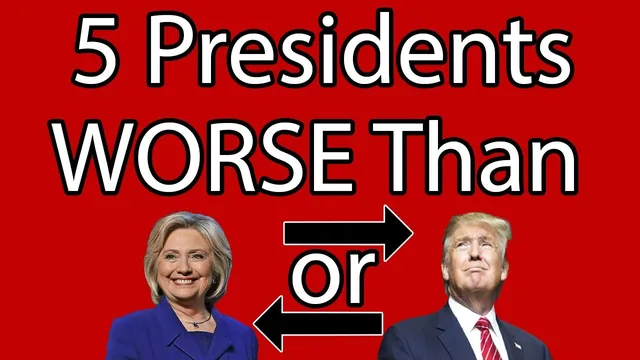
Five Presidents Worse than Donald Trump and Hillary Clinton
Based on Second Thought's video on YouTube. If you like this content, support the original creators by watching, liking and subscribing to their content.
The list is built from an aggregate of scholarly presidential effectiveness rankings dating back to the 1948 Schlesinger poll.
Briefing
The most striking claim in this roundup of “worst” U.S. presidents is that presidential failure often shows up less as a single scandal and more as a pattern: enabling slavery and civil conflict, refusing to act during national crises, or launching costly wars and policies that reshape the country for decades. Using an aggregate of scholarly rankings dating back to the 1948 Schlesinger poll, the list argues that several presidents earned their reputations through inaction at critical moments or decisions that intensified long-running national problems.
Franklin Pierce (1853–1857) is portrayed as an expansionist whose pro-slavery politics helped inflame the road to the Civil War. The transcript highlights his support for the Kansas–Nebraska Act, which repealed the Missouri Compromise by letting Kansas and Nebraska decide whether to allow slavery—an approach described as stoking the fires leading up to war. Pierce’s political downfall is framed as swift and total: he was denied a second term as public and even former supporters’ support collapsed. After leaving office, he is depicted as spending the rest of his life drinking heavily and attacking Abraham Lincoln.
James Buchanan follows, with the central accusation that he “didn’t really do anything” as the Civil War approached. The transcript emphasizes Buchanan’s stance that slavery was of “little practical importance” and that states should decide for themselves. As the country slid toward depression, Buchanan is said to have ignored the accelerating crisis—by the time the war was imminent, seven states had left the Union within three months of his election. Buchanan’s legacy is summarized as a grim prelude to Lincoln rather than a decisive attempt to prevent catastrophe.
Andrew Johnson (1865–1869) is described as the worst kind of post-war leader: a president unwilling to compromise and committed to denying civil rights to Black Americans. The transcript points to his opposition to the Freedmen’s Bureau Bill, the Civil Rights Act of 1866, and the 14th Amendment, arguing these choices prolonged post-war strife and contributed to the failure of Reconstruction to resolve the race problem. It also leans on a counterfactual commonly discussed by historians—suggesting the country would have been better off if Lincoln had not been assassinated.
Warren G. Harding (1921–1923) is framed less as ideologically driven and more as mediocre and corrupt. The transcript cites the “Ohio gang,” a group tied to government fraud charges, and claims Harding engaged in affairs, including one involving a German sympathizer who allegedly tried to blackmail him and was paid off. His policy record is summarized as pro-rich and anti-labor, including tax cuts for the wealthy and opposition to organized labor, with the added claim that his actions laid groundwork for the Great Depression. Harding’s death in 1923 ends his term early.
The final and most contemporary figure is George W. Bush, presented as a likely “worst post-depression” president. The transcript argues Bush failed to prevent the worst attack on U.S. soil since Pearl Harbor despite advance intelligence, then launched two of the longest wars in U.S. history—one under “false pretenses.” It credits Bush’s policies with helping enable the rise of ISIS, notes the shift from an inherited budget surplus to a massive deficit, and links deregulation and the Patriot Act to the conditions behind the 2008 financial crisis and modern domestic surveillance. While acknowledging some problems grew for years, the Iraq War is treated as the decisive indictment, with the “Bush doctrine” described as the biggest foreign-policy shift since the Monroe Doctrine.
Cornell Notes
The transcript ranks five U.S. presidents as among the worst in history by aggregating multiple scholarly polls. The common thread is catastrophic choices or critical inaction: Franklin Pierce’s support for the Kansas–Nebraska Act is tied to escalating tensions before the Civil War; James Buchanan is criticized for doing little as secession accelerated; Andrew Johnson is condemned for opposing Reconstruction-era civil rights measures. Warren G. Harding is portrayed as mediocre and entangled with corruption, while his pro-rich policies are linked to conditions preceding the Great Depression. George W. Bush is argued to be a likely worst post-depression president due to failures around 9/11, the Iraq and Afghanistan wars, deregulation, and the Patriot Act’s expansion of surveillance.
What does the transcript treat as the key reason Franklin Pierce is remembered poorly?
Why is James Buchanan labeled “the worst” in the transcript’s framing?
How does the transcript connect Andrew Johnson’s actions to Reconstruction’s failure?
What combination of personal scandal and policy record is used to criticize Warren G. Harding?
Which failures does the transcript use to argue George W. Bush could be among the worst post-depression presidents?
Review Questions
- Which specific policies or decisions does the transcript link to escalating conflict before the Civil War?
- How does the transcript distinguish “inaction” (Buchanan) from “active obstruction” (Johnson) in shaping outcomes?
- What does the transcript treat as the most decisive indictment of George W. Bush’s presidency, and how is it connected to broader foreign-policy doctrine?
Key Points
- 1
The list is built from an aggregate of scholarly presidential effectiveness rankings dating back to the 1948 Schlesinger poll.
- 2
Franklin Pierce is criticized for supporting the Kansas–Nebraska Act, which repealed the Missouri Compromise and intensified tensions before the Civil War.
- 3
James Buchanan is condemned for failing to act as secession accelerated, including his stance that slavery was of limited practical importance.
- 4
Andrew Johnson is portrayed as undermining Reconstruction by opposing the Freedmen’s Bureau Bill, the Civil Rights Act of 1866, and the 14th Amendment.
- 5
Warren G. Harding is framed as both corrupt and economically damaging, with the “Ohio gang” and pro-rich policies tied to conditions preceding the Great Depression.
- 6
George W. Bush is argued to be a likely worst post-depression president due to failures around 9/11, the Iraq and Afghanistan wars, deregulation, and the Patriot Act’s surveillance expansion.
- 7
The transcript acknowledges that some crises (like the housing market crash) had roots before Bush, but still treats the Iraq War as central to his legacy.