Five puzzles for thinking outside the box
Based on 3Blue1Brown's video on YouTube. If you like this content, support the original creators by watching, liking and subscribing to their content.
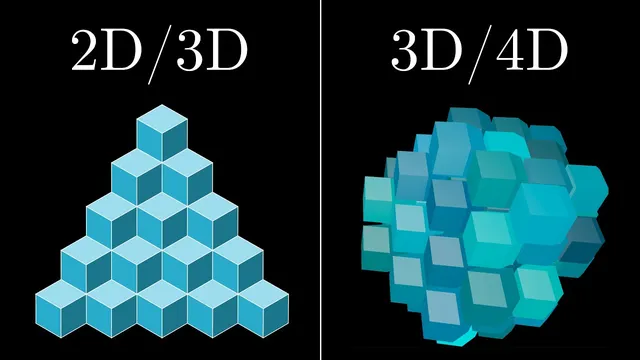
A 60° local rotation in a rhombus tiling corresponds to adding or removing a cube when the tiling is viewed as a projection of an n×n×n cube stack.
Briefing
A chain of geometry puzzles turns on one recurring insight: stepping into a higher dimension can make stubborn 2D questions tractable—and even when the final answer lives in 2D, the “lift” often supplies the missing invariant or counting method. The first half builds from tilings and invariants to a covering problem on a disk, then escalates to a classic tangency theorem and finally to a 4D-inspired tiling move that mirrors cube add/remove operations.
The opening puzzle starts with a rhombus whose angles are 60° and 120°. Such rhombi tile the plane in many ways, including patterns that resemble a pseudo-hexagonal grid. A local move is defined: whenever three rhombi form a small hexagon, rotate those three tiles by 60°. The key question becomes whether any tiling can be reached from any other using only these local rotations. On the infinite plane the answer is no, because some tilings contain no such hexagons at all, so the move cannot be applied in either direction.
To make the problem finite, the puzzle switches to a large hexagon whose side lengths are integers, filled with unit rhombi. Now the move is restricted to the same local 60° rotations of “three-rhombus hexagons” inside the region. The solution strategy uses a 3D reinterpretation: color rhombi by orientation and view the 2D tiling as a projection of a stack of cubes in an n×n×n box. Under this correspondence, the local 60° rotation of a projected hexagon matches the operation of adding or removing a cube from the stack. That translation turns reachability into a simple question about cube configurations: any tiling corresponds to some cube set, and moving between tilings corresponds to changing which cubes are present. The maximum number of moves occurs between the empty configuration and the fully filled one, requiring n^3 steps.
Puzzle two, the Tarski–Planck problem, asks for the minimum possible sum of strip widths when a unit disk is covered by regions between parallel chords. A naive lower bound comes from area: the total area of all strips must at least equal the disk’s area, π. But strip area depends on where the strip sits, so width alone doesn’t directly control area. The fix is another dimensional lift. Project the 2D covering onto a hemisphere in 3D: the projected area of each strip becomes exactly π·d, depending only on its width d. Since the hemisphere’s area is 2π, the sum of widths cannot drop below 2. Parallel strips achieve this bound, so 2 is the minimum.
A third puzzle generalizes a tangency phenomenon: for three circles in the plane, the intersection points of their external tangents always lie on a line. The argument is repaired by moving to 3D using cones rather than spheres, with the “center of similarity” replacing fragile geometric assumptions. The final two puzzles push the theme further: tetrahedron volume can be expressed via a determinant, and a 4D analogue of the cube-add/remove tiling move emerges by projecting a 4D hypercube stack down to a 3D rhombic dodecahedron tiling. In that last construction, the maximum number of moves scales like n^4, mirroring the hypercube count.
Across all five, the through-line is practical: higher-dimensional geometry supplies invariants and counting tools that are hard to see in the original dimension, even if the final answers remain firmly mathematical and exact.
Cornell Notes
The puzzles hinge on a repeated method: reinterpret a 2D configuration as a projection of higher-dimensional structure, so local moves become simple operations on higher-dimensional objects. In the rhombus-tiling problem, a 60° rotation of a small hexagon corresponds to adding or removing a cube in an n×n×n stack, making the maximum distance between tilings equal to n^3 moves. The Tarski–Planck covering problem similarly becomes solvable by projecting strips onto a hemisphere, where each strip’s projected area is π times its width, forcing the total width sum to be at least 2. The tangency-line theorem is made robust by using cones and the center of similarity. The final 4D-inspired tiling move projects a 4D hypercube stack to a rhombic dodecahedron tiling, leading to a maximum move count scaling like n^4.
Why does the local 60° rotation move fail to connect all tilings on the infinite plane, and what changes in the finite hexagon version?
How does the cube-stacking interpretation turn a 2D tiling problem into a counting problem?
What makes the Tarski–Planck problem hard in 2D, and what does the 3D projection fix?
Why does the tangency-line theorem need a “cone” framing rather than “sphere” geometry?
How does the 4D-inspired tiling move relate to adding/removing hypercubes, and why does the maximum scale like n^4?
Review Questions
- In the rhombus tiling puzzle, what invariant or higher-dimensional object corresponds to the ability (or inability) to apply the 60° hexagon rotation move?
- What exact geometric relationship in the Tarski–Planck projection makes the strip area depend only on width, and how does that force the lower bound of 2?
- How does replacing spheres with cones and using the center of similarity repair the tangency-line argument for all circle configurations?
Key Points
- 1
A 60° local rotation in a rhombus tiling corresponds to adding or removing a cube when the tiling is viewed as a projection of an n×n×n cube stack.
- 2
Reachability between finite tilings reduces to cube-set transformations; the maximum move distance is between the empty and full cube stacks, giving n^3 moves.
- 3
The Tarski–Planck minimum-width-sum problem becomes provable by projecting strip coverings onto a hemisphere, where each strip’s projected area equals π·d.
- 4
The lower bound of 2 in the Tarski–Planck problem follows from comparing the sum of projected strip areas to the hemisphere’s total area 2π; parallel strips achieve the bound.
- 5
The “three external tangent intersections are collinear” claim is made robust by lifting to cones and using the center of similarity, avoiding sphere-based edge cases.
- 6
A 4D hypercube projection yields a rhombic dodecahedron tiling in 3D; local moves correspond to changing hypercube presence, so the maximum move count scales like n^4.
- 7
Across the set, higher-dimensional lifts supply invariants and clean proportionalities that are awkward or invisible in the original dimension.