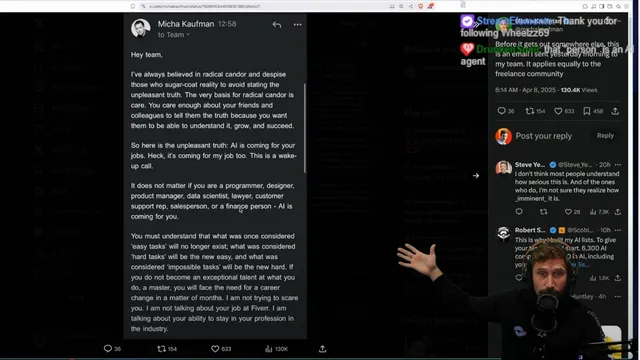
FIVERR CEO Leaks His Own Email
Based on The PrimeTime's video on YouTube. If you like this content, support the original creators by watching, liking and subscribing to their content.
Micah Kaufman’s leaked email frames AI as an imminent disruptor that will automate many routine freelance and professional tasks, raising the bar for employability.
Briefing
Fiverr CEO Micah Kaufman’s leaked email frames AI as an imminent job disruptor for freelancers and professionals—arguing that routine work will be automated, while only “exceptional” talent will remain employable. The message leans on a blunt timeline: tasks once considered easy will become the new baseline, harder tasks will be the new “easy,” and work once labeled impossible will feel hard again unless individuals upgrade their skills fast. Kaufman also ties the threat to urgency—warning that failing to become a master could force a career change within months, not years.
The email’s core claim is that AI will increasingly deliver the kind of output people currently buy on marketplaces like Fiverr: fast, repeatable, and scalable. That creates pressure across roles—programmers, designers, product managers, data scientists, lawyers, customer support, sales, and finance—because many of the tasks those jobs handle can be broken into deliverables that AI can generate quickly. The argument is less about replacing every human activity and more about shrinking the value of “commodity” work. In that view, Fiverr’s model—paying for discrete, short-cycle tasks—maps neatly onto what AI can already do: produce many similar results with less human oversight.
Kaufman’s prescription is practical and productivity-focused. Professionals should study and research AI solutions in their field, test multiple tools to find “superpowers” (more outcomes per unit time with better quality), and involve the most knowledgeable people on their team to accelerate adoption. He also emphasizes time as the most valuable asset and urges organizations not to hire aggressively before they understand how to do more with existing capacity using AI tools.
A major theme is skill adaptation rather than passive fear. The email encourages people to become more effective with AI by learning how to work with it—described in the transcript as “prompt engineering” and using LLMs/GenAI as new basics—while also pushing for proactive career agency: don’t wait for opportunities to appear; create them by pitching ideas and contributing to organizational goals. It also includes a motivational structure that tries to keep the message from turning into pure panic, urging readers to pause, breathe, and then act.
The transcript commentary around the email adds skepticism about the “radical candor” framing and questions whether mastering prompts will stay stable as models evolve. It also challenges the idea that AI will make work “easy,” arguing instead that AI may act as a stopgap—helping people reach the first step faster, then revealing how much deeper expertise is still required. Overall, the leaked message lands as a warning about market compression: AI will automate parts of professional work, but the remaining work will demand higher-level judgment, coherence, and mastery—meaning the competitive bar rises quickly, and staying in the profession will require continuous upskilling.
Cornell Notes
Micah Kaufman’s leaked email warns that AI is poised to automate many freelance and professional tasks, shrinking demand for routine deliverables. The message sets a harsh progression: once-easy tasks become baseline, once-hard tasks become the new easy, and once-impossible tasks become hard again unless individuals become “exceptional” masters. It argues that marketplaces built around quick, discrete work—like Fiverr—are especially exposed because AI can generate similar outputs at scale. The prescription is to study and test AI tools in one’s field, collaborate with knowledgeable teammates, and use AI to increase output quality and speed while organizations avoid unnecessary hiring. The takeaway: job security will increasingly depend on upgrading skills and taking proactive responsibility, not waiting for the market to settle.
Why does the email treat AI as a direct threat to freelance marketplaces like Fiverr?
What does the email mean by “easy tasks” becoming the new baseline and “impossible tasks” becoming hard again?
What concrete steps does the email recommend for professionals trying to stay competitive?
How does the transcript commentary challenge or complicate the “become a prompt engineer” advice?
What does the transcript suggest about AI’s limits—especially around coherence and real expertise?
Review Questions
- How does the email’s “difficulty reclassification” model change what it means to be employable over the next year?
- What practical behaviors does the email recommend to convert AI disruption into personal leverage?
- Why does the transcript commentary argue that AI may reveal deeper knowledge gaps instead of eliminating them?
Key Points
- 1
Micah Kaufman’s leaked email frames AI as an imminent disruptor that will automate many routine freelance and professional tasks, raising the bar for employability.
- 2
The message uses a difficulty-shift model: easy tasks become baseline, hard tasks become the new easy, and previously impossible tasks become hard again without mastery.
- 3
Fiverr-style work is portrayed as especially vulnerable because it often involves discrete, short-cycle deliverables that AI can generate at scale.
- 4
The recommended response centers on upskilling: study and test AI tools in one’s field, find the best workflows, and collaborate with knowledgeable teammates.
- 5
The email emphasizes time as the most valuable asset and urges organizations to improve efficiency with AI before expanding hiring.
- 6
Career resilience is framed as proactive rather than passive—pitch ideas, create learning opportunities, and contribute to organizational goals rather than waiting for invitations.