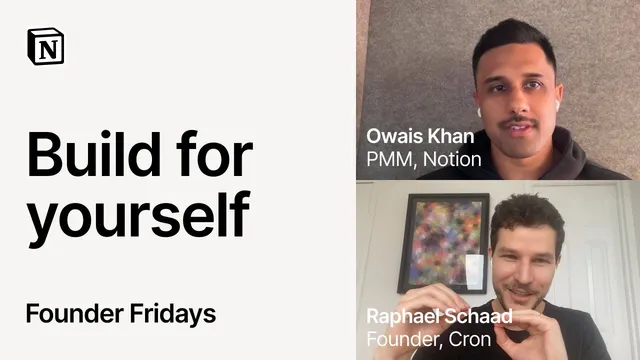
Founder Fridays: Build for Yourself with Raphael Schaad, Founder of Cron and Owais Khan, PMM, Notion
Based on Notion's video on YouTube. If you like this content, support the original creators by watching, liking and subscribing to their content.
Start with a narrowly useful “toy” feature for a real person—often the founder—and treat early usefulness as proof of market resonance.
Briefing
A practical path to scaling a “broad” product category starts with building something sharply useful for one real person—then stacking outsized value on top of existing infrastructure. Raphael Schaad, founder of Cron (acquired by Notion), describes how a calendar market that seems impossible to tackle at scale became manageable by treating the early product as a toy: a small, personal fix that solved a specific annoyance. In his case, that meant collapsing the empty overnight hours in Google Calendar via a Chrome extension. The add-on quickly attracted thousands of users overnight, signaling that the problem wasn’t unique to him and that a focused wedge could grow into a much larger product.
That “build for yourself” approach is paired with a second principle: don’t try to build the whole category at once. Schaad argues that solo founders should apply pressure where value can be created with minimal engineering—adding “1%” features that capture a large share of the experience. For Cron, that meant standing on the shoulders of Google Calendar rather than rebuilding scheduling from scratch. He used Electron to wrap Google Calendar into a desktop environment, then focused on high-leverage workflow improvements during the Zoom era—extracting Zoom links and delivering timely notifications so meetings started on time instead of arriving late through email. The broader lesson: in big markets, the fastest route to traction is often finding the right point in the value stack to deliver a small but meaningful upgrade.
Cron’s early growth also hinged on go-to-market design, not just product quality. Schaad says the launch moment mattered less than what followed, and he pursued a deliberate channel strategy: invest ruthlessly in a small set of channels and become “an 11 out of 10” in them. At the time, that meant email and Twitter, with no LinkedIn and no paid marketing. Email wasn’t treated as generic lifecycle onboarding; it became a product update ritual built around beautiful, regular change logs. Those emails were written in the language users used in bug reports and feature requests, and they were structured to invite replies—no no-reply addresses—so feedback flowed back into the product. Twitter then acted as the amplification loop: change logs linked to tweets and videos, and users responded across both channels, creating a feedback-and-excitement cycle.
The same philosophy shows up in how Notion approaches “release marketing.” Schaad highlights the power of closing loops: when users request features, the founder tracks them and later sends personalized updates when those changes ship. Even at early stages, that kind of non-scalable attention can create “thousand true fans,” and tools (including AI and outbound platforms like Outreach) can help scale personalization without turning the brand generic.
Finally, the conversation connects Cron’s acquisition by Notion to a larger product strategy. Notion’s “Lego blocks for software” metaphor frames Cron as a missing piece around time and calendar, enabling Notion to expand into a connected workspace that now includes email and calendar. Looking ahead, Schaad’s advice for 2025 is to focus on distribution—the scarce resource when AI makes building cheaper—and to keep early execution grounded in fast iteration, thoughtful narrative, and design-level attention from day one.
Cornell Notes
Raphael Schaad credits Cron’s rise to a disciplined wedge: start with a toy-like feature that solves a personal problem, prove it resonates with real users, then build outward. For Cron, that began with a Chrome extension that collapsed empty overnight hours in Google Calendar, quickly reaching 10,000+ users. He then avoided rebuilding the entire calendar category by using Electron to wrap Google Calendar and adding high-leverage workflow value for Zoom-era meetings. Growth depended on go-to-market as a design problem: he invested heavily in email and Twitter, using beautiful, reply-friendly change logs that mirrored user language and created a feedback loop. At scale, he argues for closing loops on shipped features—personalized early, then supported by tools—to preserve brand identity and drive word of mouth.
Why did building “for yourself” help Cron scale beyond one user?
How can a founder tackle a huge category like calendar without building everything from scratch?
What made Cron’s early marketing channels work so well?
How did Cron’s change logs connect to Twitter and user feedback?
What does “closing loops” mean, and why does it matter for retention and word of mouth?
How did Cron fit into Notion’s broader strategy after the acquisition?
Review Questions
- What specific personal problem did Schaad solve first, and what evidence suggested it could scale beyond his own needs?
- How did Electron and the Zoom notification workflow illustrate Schaad’s “value stack” approach to building in big markets?
- Why did Cron’s change logs function as both marketing and product feedback, and what design choices made that possible?
Key Points
- 1
Start with a narrowly useful “toy” feature for a real person—often the founder—and treat early usefulness as proof of market resonance.
- 2
In large categories, avoid rebuilding the whole product; add a small, high-leverage capability on top of existing systems to capture outsized value.
- 3
Channel strategy is a design problem: pick a few channels to own, invest heavily to become exceptional, and ignore the rest.
- 4
Make product update emails bidirectional by inviting replies (no no-reply addresses) and using user language from support and feature requests.
- 5
Use change logs and release marketing to connect shipped work to existing users, turning updates into word-of-mouth fuel.
- 6
Close the feedback loop by notifying users when their requests ship; early personalization builds “true fans,” while tools can later support scale.
- 7
When AI makes building cheaper, distribution becomes the scarce resource—plan for it from day one.