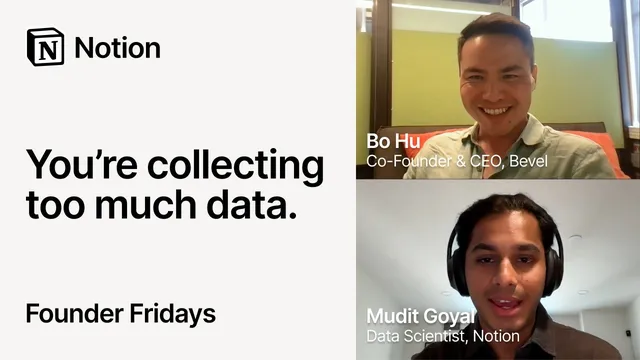
Founder Fridays: Clarity drives progress with Bo Hu, Bevel and Mudit Goyal, Notion
Based on Notion's video on YouTube. If you like this content, support the original creators by watching, liking and subscribing to their content.
Bevel’s mission is to close the data-to-business value gap by delivering usable insights and models fast enough for business teams to act.
Briefing
Bevel is built to close the “data-to-business value gap,” where companies collect and store massive amounts of information but still can’t turn it into usable dashboards, insights, or models for weeks—or even years. The core complaint is operational: data teams face heavy, centralized control processes, while business teams wait too long for answers. Bo Hu frames the problem as a persistent chasm between business value delivery and technical execution, especially in data work, and says Bevel’s mission is to deliver end-user value at the speed of business decisions.
Bevel’s approach differs from traditional BI tools by targeting the entire data lifecycle rather than just making dashboards easier. The product design starts by removing “macro-level steps” that typically slow delivery—so instead of piecemeal work like cleaning, SQL writing, and assembling reports, the system aims to produce end-to-end outputs instantly (for example, generating a full funnel report for “t-shirts sold in the last 60 days”). The second pillar is measurable acceleration: Bevel uses “time to value” (TTV) as a design metric and aims to cut it by 75% or more for key workflows. The third pillar shifts the ideal customer away from technical teams and toward business end users—growth, product, and revenue teams—so they can act directly with sophisticated analytics without needing years of data expertise.
Hu’s founder story centers less on ambition and more on accumulated frustration. After a decade working inside fast-growing organizations—driving change without solving the business/technical gap—he says starting Bevel became a way to relieve the same pain he kept seeing elsewhere. Early on, the most energizing and terrifying realization was that founders are “on your own,” with fewer formal guardrails like HR or legal teams. The safety net becomes different: advisors, other founders, and a network that provides guidance rather than structure.
What keeps him up at night is speed in an AI-driven market. He worries Bevel may not be building fast enough, and he argues that AI’s development has moved from slow compounding to a chaotic “all at once” phase—compressing timelines and making predictions unreliable. That urgency ties back to Bevel’s “last mile data logistics” framing: like Amazon’s last-mile delivery solved the final delivery from warehouse to customer value, Bevel aims to solve the final delivery from centralized data systems to same-day, value-added end-user outcomes.
Operationally, Bevel treats AI as workflow lubricant rather than a replacement for judgment. Hu warns that AI trained on conventional information can only produce conventional thinking; letting it decide everything risks building products that look like everyone else’s. Bevel’s architecture includes an AI layer that orchestrates interactions, while the underlying differentiator remains its data infrastructure, processes, and controls—positioned as harder to replace than a simple “LM wrapper.”
Inside the company, Notion plays a central role: it supports AI-integrated workflows, flexible integrations, and even replaces parts of a CRM by routing inbound leads into Notion, auto-updating records, and enabling enterprise search across notes, Slack, and email. Hu also uses Notion’s AI to generate weekly summaries—sales, product development, production status, and delays—so leadership can quickly decide where to focus. For founders, his advice is to question conventional wisdom, build something impossible, and pursue ceaseless clarity—an “onion” that drives alignment once teams reach an “aha” moment.
Cornell Notes
Bo Hu’s Bevel targets the “data-to-business value gap”: companies gather and control too much data, but business teams wait weeks or years to get dashboards, insights, or models they can use. Bevel’s strategy is to deliver end-user value across the full data lifecycle by removing macro steps, cutting “time to value” (TTV) by 75% or more, and shifting the ideal customer from technical teams to business users. Hu frames the company as “last mile data logistics,” analogous to solving the final delivery from data storage to same-day value. He also emphasizes AI as workflow support—summarizing and accelerating planning—while warning against letting AI replace core judgment and differentiation.
What does “data-to-business value gap” mean in practical terms, and why does it persist?
How does Bevel’s three-pillar system aim to beat traditional BI tools?
What is “last mile data logistics,” and how is it different from building another data platform?
How does Hu think about AI—where it helps, and where it can mislead teams?
Why does Hu treat Notion as a strategic tool inside Bevel?
What advice does Hu give founders about speed, clarity, and conventional wisdom?
Review Questions
- How do Bevel’s “macro step removal,” “time to value” (TTV), and business-end-user focus work together to reduce the data-to-business value gap?
- What risks does Hu associate with letting AI replace judgment, and how does Bevel’s architecture attempt to avoid that?
- In Hu’s framework, what does “ceaselessly seek clarity” look like as a team practice, and how does it create alignment?
Key Points
- 1
Bevel’s mission is to close the data-to-business value gap by delivering usable insights and models fast enough for business teams to act.
- 2
Bevel targets the full data lifecycle, not just dashboard usability, by removing macro steps and automating data preparation at collection time.
- 3
Time to value (TTV) is treated as a design metric, with an explicit goal to cut key workflow timelines by 75% or more.
- 4
Bevel shifts its ideal customer from technical teams to business end users, aiming for layman-friendly analytics that still support sophisticated decisions.
- 5
“Last mile data logistics” reframes data work as a delivery problem: the final step from centralized storage to same-day end-user value.
- 6
Hu argues AI should accelerate and support thinking, not replace it, because AI outputs tend to be conventional unless teams supply judgment and differentiation.
- 7
Hu credits Notion with enabling AI-assisted enterprise search and lightweight CRM-like operations, helping leadership and teams prioritize using weekly summaries.