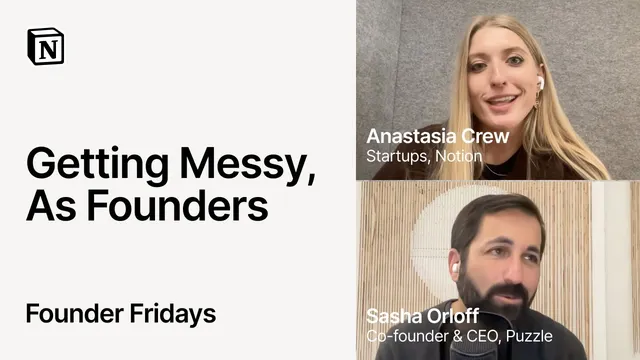
Founder Fridays: Getting investors to yes with Sasha Orloff, Puzzle and Anastasia Crew, Notion
Based on Notion's video on YouTube. If you like this content, support the original creators by watching, liking and subscribing to their content.
Fundraise from strength: show credible growth and readiness rather than raising under cash pressure, which reduces leverage.
Briefing
Getting investors to “yes” comes down to one repeatable advantage: fundraising from a position of strength—backed by credible growth—while building trust through ruthless preparation and honest risk framing. Sasha Orloff, CEO of Puzzle, argues that venture capital runs on power-law outcomes, so investors are effectively betting on whether a company can become a breakout winner. That makes growth the dominant traction signal, especially when it comes with a coherent story about unit economics and defensibility.
Orloff frames early fundraising as a choice between two very different realities: raising because the business is ready versus raising because the company is running out of money. The latter creates weak leverage, leaving founders with little room to negotiate beyond “FOMO” that investors might miss the next big thing. In contrast, when a company can show line-of-sight to building a large business—often through a clear growth graph—fundraising becomes “hard, but less hard.” He also emphasizes that preparation is not optional: investors need clean financials, legally required compliance, and a narrative that helps them understand what’s messy, what the risks are, and why those risks are being actively managed.
A major theme is that founders often waste time building in their own vision rather than in the reality of the market and user needs. Orloff points to a common early mistake: getting distracted by events, social media, and founder “busyness” instead of continuously listening to users. He also highlights the inertia of switching costs—once a company’s direction hardens, changing course becomes harder, so founders must stay grounded in what users actually want.
When discussing how to run the fundraising process, Orloff describes a system built around keeping information organized and pitches continuously iterated. He relies on Notion to manage an investor CRM, diligence checklists, fundraising narratives, and memos—using templates adapted by stage (seed versus later rounds). Puzzle is used to maintain accurate accounting in real time, which he calls a condition of closing for venture funds because financial statements are required for valuation and compliance. ChatGPT and Gmail round out the workflow, but the core message is operational: don’t wait until momentum arrives to clean up the mess.
Investor outreach, in his view, is closer to formal dating than a one-off transaction. Founders should filter for mutual fit—thesis, founder, and market alignment—rather than spam partners with generic asks. He recommends building trust through public work, investing time in the investor memo and pitch materials, and getting to know the partner as a person (including how they publish and what they value). Instead of hiding risks, he suggests leading with them: listing major concerns and explaining why they’re not as dangerous as they appear. That honesty, he argues, builds credibility.
After a round closes, Orloff warns that the “whisper network” is fast and wide. Monthly investor updates (or quarterly at larger scale) keep owners engaged; stopping updates can signal trouble, while never updating leaves investors unaware and less likely to advocate later. He notes that many rounds are preempted by prior conversations—passed-over pitches can return when timing and trust align.
Finally, Orloff situates the advice in today’s AI-driven volatility: expectations are higher, competition is fiercer, and defensibility matters more as copying becomes easier. His practical starting point for 2025 is speed and momentum—maintained through in-person alignment in San Francisco—while staying focused on the core product and its unit economics. The closing advice is simple: stay focused on users, build growth that compounds, do the research, and don’t forget to have fun while the work is hard.
Cornell Notes
Fundraising works best when founders raise from strength: show credible growth, clean financials, and a trustworthy narrative that addresses real risks. Orloff distinguishes two fundraising triggers—readiness versus running out of money—and argues the second option creates weak leverage. He treats investor outreach like long-term partnership matching, emphasizing mutual fit (thesis, founder, market) and honest risk framing rather than generic spamming. Operationally, he recommends building a repeatable system for diligence and outreach, including a disciplined data room, investor CRM, and real-time accounting. After closing, consistent investor updates protect reputation in a fast whisper network and increase the odds of future support.
Why does Orloff put so much weight on growth when explaining “getting to yes” with investors?
What’s the practical difference between fundraising because the business is ready versus fundraising because cash is running out?
How does Orloff recommend founders prepare so diligence and fundraising don’t collapse under “messiness”?
What tools and systems does Orloff use to run fundraising efficiently?
How should founders approach investor outreach to avoid generic, low-trust pitches?
What changes after the round closes, and why do monthly updates matter?
Review Questions
- What two fundraising triggers does Orloff contrast, and how does each affect founder leverage?
- Which traction signals does Orloff say most strongly drive investor “yes,” and how does he qualify growth?
- How does Orloff’s approach to risk framing differ from the idea of hiding weaknesses during fundraising?
Key Points
- 1
Fundraise from strength: show credible growth and readiness rather than raising under cash pressure, which reduces leverage.
- 2
Treat venture capital as power-law betting; growth is the most reliable traction signal, especially when paired with unit economics and defensibility.
- 3
Keep financials and compliance clean before fundraising; missing or messy accounting can block formal rounds and slow diligence.
- 4
Build a repeatable fundraising system (investor CRM, diligence checklist, narrative/memo, and a continuously updated data room) instead of improvising during outreach.
- 5
Match with investors through mutual fit across thesis, founder, and market—avoid generic spamming and personalize outreach.
- 6
Lead with material risks and explain mitigation; honest risk framing builds trust faster than polished optimism.
- 7
After closing, send consistent investor updates (often monthly) to maintain reputation in a fast whisper network and support future fundraising.