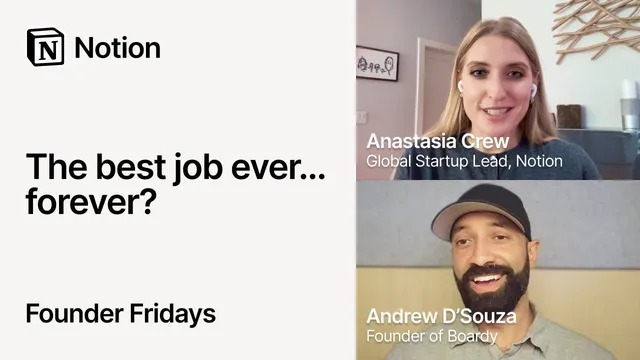
Founder Fridays: Intuition Over Data with Andrew D'Souza, Boardy and Anastasia Crew, Notion
Based on Notion's video on YouTube. If you like this content, support the original creators by watching, liking and subscribing to their content.
D’Souza repeatedly finds better outcomes when founders trust intuition informed by anecdotes and lived experience rather than waiting for perfect external validation.
Briefing
Founder Andrew D’Souza’s through-line is a simple decision rule: when the stakes are high, intuition—fed by lived experience and partial data—beats waiting for perfect external validation. He describes repeatedly regretting moments when he ignored his own signal because it didn’t match what data, advisers, or other people suggested. The practical challenge is separating “noise” from signal, and his answer is less about better analytics and more about better judgment: build relationships with people who share the same time horizon, so advice and collaboration aren’t distorted by mismatched incentives.
That mindset shaped his path from early career work to building Clearco, a revenue-based financing company that scaled globally. D’Souza traces his founder instincts back to school and early jobs, including a realization that he didn’t fit well inside traditional employment. A graduate course on simulating neurobiological systems—modeling how stimuli produce probabilistic outputs and how simple neuron-like units can be stitched together for arithmetic and pattern recognition—left him fascinated by how systems work from the micro level to the global economy. Later, his time at Clearco reinforced the same lesson: when he followed his intuition, he owned the outcome; when he outsourced the decision to external signals, he often felt the result wasn’t truly his.
The pivot from Clearco into AI came through a specific bottleneck: many founders applied for financing too early to qualify. With access to early OpenAI capabilities (via YC partner Sam Altman), D’Souza’s team built an AI coaching product—later referred to as “Clear Angel”—that guided businesses on how to grow from roughly $1,000/month to $2,000–$5,000/month so they could meet Clearco’s thresholds. The coaching model wasn’t just a side experiment; once its capabilities became clear, D’Souza poured significant energy into it. But scaling the financing business demanded a CEO with a different skill set—credit agreements, debt capital, and operational tuning—so he stepped back, hired Andrew Fergus to run Clearco, and kept his attention on AI.
That AI thread now lives in Boardy, an “AI board member” designed to make introductions and help people find the right connections. Boardy’s origin story is grounded in a product fantasy: an always-available board member who knows everyone, opens doors, and carries no social consequences. In practice, Boardy sources both public information and—more importantly—conversational data gathered through ongoing questioning, building a nuanced profile of what a person wants and how they present themselves. D’Souza argues the intro engine can outperform warm emails not only because it reduces cognitive load for investors, but because people feel less emotionally pressured to say yes to an AI-suggested meeting.
Defensibility, he says, comes from personal brand and relationship depth: Boardy’s value depends on how well it “knows” individuals and the intersections across its network. He also emphasizes the “non-obvious” matches—situations where Boardy reframes a problem so the best solution isn’t an investor or a VP hire, but a customer, funder, or partnership.
Finally, D’Souza offers advice for starting in 2025: spend time in “monastery mode” long enough to build without getting pulled into premature public narratives. In an era where capabilities shift every few months, he recommends letting imagination run before committing to what sounds plausible to talk about at parties—because the world is changing fast enough that creativity can’t wait for consensus.
Cornell Notes
Andrew D’Souza credits his best outcomes to intuition—supported by anecdotes and lived experience—rather than waiting for perfect external validation. He learned early that he didn’t thrive as an employee, and later applied the same self-trust while building Clearco and then moving into AI. Clearco’s financing bottleneck (too many applicants were too early) led to an AI coaching product that helped businesses grow into eligibility, using early OpenAI access through YC. After stepping back from Clearco because the CEO job required different skills, he focused on Boardy, an AI “board member” that generates introductions by combining public data with rich conversational profiles. Boardy’s advantage is reduced cognitive load for humans, lower emotional friction in outreach, and defensibility through brand plus relationship depth.
Why does D’Souza treat intuition as a competitive advantage in founder decisions?
How does he propose “networking” should work if the goal is better signal, not more meetings?
What problem at Clearco led to building an AI coaching product?
Why did D’Souza step back from running Clearco even after building it?
What makes Boardy’s introductions different from asking investors for warm intros?
Where does Boardy’s defensibility come from?
Review Questions
- What kinds of external validation does D’Souza say founders over-rely on, and what does he recommend using instead?
- How did Clearco’s eligibility criteria shape the design and purpose of its AI coaching effort?
- What mechanisms does Boardy use to reduce friction in introductions, and why might that change meeting outcomes?
Key Points
- 1
D’Souza repeatedly finds better outcomes when founders trust intuition informed by anecdotes and lived experience rather than waiting for perfect external validation.
- 2
Networking should be judged by shared time horizon and incentives, not by the number of connections or meetings.
- 3
Clearco’s financing bottleneck—many applicants too early for revenue/time thresholds—directly motivated an AI coaching product to help businesses grow into eligibility.
- 4
Scaling Clearco required a CEO skill set focused on credit agreements, debt capital, and operational profitability, leading D’Souza to hire Andrew Fergus and step back.
- 5
Boardy’s intro engine combines public data with conversational data to build nuanced profiles and propose matches that reduce human cognitive load.
- 6
Boardy’s psychological advantage is that AI-suggested intros can lower the emotional cost of saying no, reducing wasted meetings.
- 7
Boardy’s defensibility is tied to personal brand and relationship depth, including the ability to surface non-obvious partnerships and funding paths.