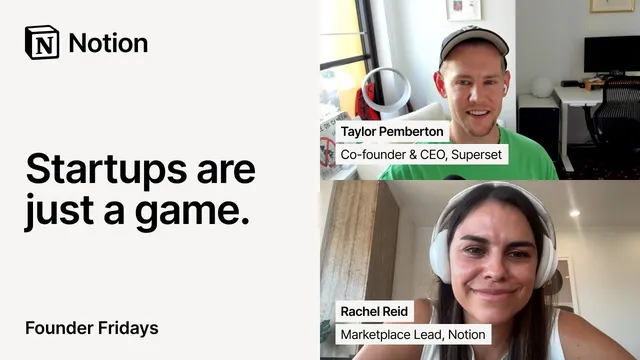
Founder Fridays: Market over product with Taylor Pemberton, Superset and Rachel Reid, Notion
Based on Notion's video on YouTube. If you like this content, support the original creators by watching, liking and subscribing to their content.
Superset’s growth is tied to rapid iteration driven by customer conversations, demos, and observed usage—not long cycles of unvalidated feature work.
Briefing
Superset’s co-founder and CEO Taylor Pemberton credits the company’s momentum to a simple but demanding principle: treat building as a “game” you keep playing—by iterating fast, learning from real customer behavior, and refusing to let design become an afterthought. Superset now powers more than 40,000 workouts per month across 24 countries, growing at about 20% month over month, and the growth is tied directly to how the product reduces friction for both gyms and the people training in them.
Pemberton’s path to that mindset runs through early, scrappy design entrepreneurship and years of competitive athletics. As a teenager, he made money online by emailing Craigslist contacts for logo work, learning the hard lessons of underpricing and mishandling revisions. Later, he scaled a design studio by recruiting friends and applying agency lessons—managing multiple clients, personalities, and scopes—into a smaller operation. The corporate detour through companies like Airbnb, Spotify, and Google sharpened his focus on software as a business challenge, especially because digital products can iterate quickly and demand deeper work on core user experience rather than just brand wrappers.
Competitive sports and gaming shaped his approach to founder life: setbacks are part of the cycle, and progress comes from getting back up and chasing “unlocks.” That framing shows up in how Superset builds. The company prioritizes design and empathy across the team, hiring for creative thinking even when candidates come from engineering or other non-design backgrounds. Pemberton also emphasizes the discipline of deciding what not to build in a V1—using customer conversations to spot patterns, showing prototypes early to keep feedback flowing, and treating feature attempts like a limited budget (aiming to get most of them right). Over-polishing is treated as a risk: it can look impressive while missing the harder, more valuable problem.
AI fits into that workflow as a practical assistant rather than an autopilot. Pemberton uses tools like Claude and ChatGPT to pressure-test UX writing, reorganize pricing and plan copy, and analyze screenshots for better flow structure. The team also uses an end-to-end tool stack—Figma for design, Cursor for development, and AI for writing and critique—while keeping everyone involved in both design and code. For example, Superset’s website was coded internally, with design and engineering work tightly interleaved, then handed off to engineering to integrate and correct issues at the tail end.
Growth strategy follows the same “market before product” logic. Superset leaned on a weekly freebie cadence—launching a new free template every Friday for two years—to build internal growth muscle and identify what resonated organically through email lists, Reddit, and Google search. The best-performing templates were then turned into paid ads, feeding a funnel into premium offerings. For gyms and studios, the pitch centers on business impact: tools like calculators and a fast, drag-and-drop setup that customizes Superset to each facility’s needs.
Asked what he’d do differently starting in 2025, Pemberton would double down on market tailwinds and raise money earlier when circumstances allow. In the AI era, his caution is about staying curious and learning alongside tools—using AI to accelerate work without surrendering the habit of actually understanding what’s being built. The most rewarding milestone, he says, is seeing people work out continuously with Superset—especially those who feel intimidated by gyms—supported by coaches worldwide and powered by the platform’s workout volume at scale.
Cornell Notes
Taylor Pemberton frames entrepreneurship as a “game” where founders keep playing through setbacks, using iteration and customer feedback to unlock better versions of the product. His design-first approach shaped Superset’s culture: design and empathy are treated as company-wide priorities, and the team uses rapid prototyping plus customer conversations to decide what to build (and what to skip) in a V1. AI is integrated as a practical tool for UX writing, flow critique, and copy consistency, not as an autopilot. Growth comes from market-led experimentation: weekly free templates for two years, organic discovery via email/Reddit/search, and then paid ads that promote the best-performing templates into a premium funnel. The payoff is measurable—tens of thousands of workouts monthly—and human—helping people who feel intimidated by gyms train with guidance when they need it.
How did Pemberton’s early design hustle influence the way Superset builds products now?
Why does he say software design is a different kind of challenge than brand or web design?
What does “market before product” mean in Superset’s context?
How does Superset use AI without letting it replace judgment?
What role does design play in Superset’s hiring and day-to-day execution?
Why does the growth strategy rely on free value first?
Review Questions
- What specific mechanisms does Superset use to decide what not to build in a V1, and how do those mechanisms reduce the risk of over-polishing?
- How does Superset’s weekly freebie strategy connect organic discovery to paid acquisition, and what evidence does Pemberton cite for why it worked?
- In what ways does Pemberton treat AI as a collaborator (e.g., devil’s advocate, UX writing), and where does he draw the line to protect learning and judgment?
Key Points
- 1
Superset’s growth is tied to rapid iteration driven by customer conversations, demos, and observed usage—not long cycles of unvalidated feature work.
- 2
Design and empathy are treated as company-wide priorities, with hiring focused on creative thinking even when team members come from non-design backgrounds.
- 3
Feature planning in early stages is constrained like a budget: the team aims to get most of its limited feature attempts right by validating early.
- 4
AI is integrated for UX writing, flow critique, and copy consistency (e.g., screenshot analysis and plan/pricing restructuring), but it’s not used to replace founder judgment.
- 5
Superset’s “market before product” approach shows up in growth experiments: weekly free templates for two years identified what resonated before scaling paid ads.
- 6
Growth relies on a funnel that starts with free value and uses organic channels (email, Reddit, Google search) to surface winners for promotion.
- 7
Gym adoption is accelerated by business-impact tools and fast setup, while the product experience is designed to avoid adding friction to an already challenging habit-forming journey.