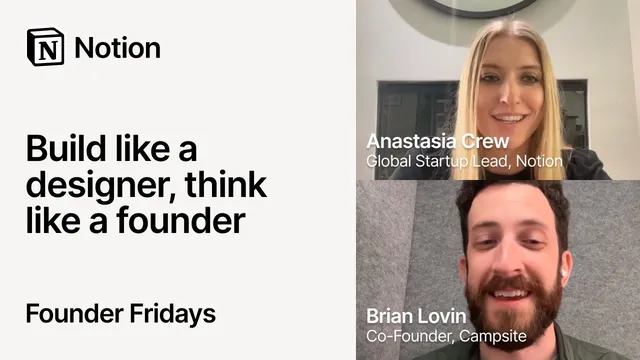
Founder Fridays: Most founders get design wrong with Brian Lovin, Campsite & Anastasia Crew, Notion
Based on Notion's video on YouTube. If you like this content, support the original creators by watching, liking and subscribing to their content.
Design value goes beyond aesthetics; it includes customer discovery, product strategy, and how the product works.
Briefing
Design isn’t just “coat of paint”—it’s a business lever tied to customer feedback, product strategy, and distribution. Brian Lovin’s through line runs from early tinkering with user customization (writing CSS for Neopets profiles) to building tools that make teams collaborate and iterate faster, and the consistent lesson is that defensibility comes less from features and more from a story people want to join.
Lovin traces his interest in software to a feedback loop: build something, watch how people use it, then refine. A music distribution side project sharpened that instinct into product thinking—he stopped caring as much about the music itself and focused on the experience of discovery and downloading. That work became his portfolio and opened the door to his first product design job, even though he didn’t realize “product design” was a formal role until late in college.
Campsite grew out of a specific design culture he saw at Facebook: Pixel Cloud, an internal tool that made past experiments visible and enabled a remix-style timeline of progress. The goal wasn’t to copy a tool, but to externalize the working environment—visibility, iteration, and shared learning—for design teams. Lovin started by trying to build something similar internally at GitHub, then shifted to a public side project. He shared early, gathered interest through a waitlist, and moved full-time once momentum appeared.
Iteration followed a tight rhythm: early on, any feedback mattered—bug reports and messages were signals that people cared. He described a weekly cadence of customer calls early in the week, followed by focused building and testing later, repeating until the product matched how early adopters wanted to use it. That approach also shaped his view of what founders and PMs often get wrong: many treat design as aesthetics only. While visual polish builds maturity and trust, the bigger value is design’s role in customer conversations, strategy, and how the product actually works.
Balancing speed with craft is possible, he argues, because apps rely on a limited set of UI primitives. The key is building composable components so teams don’t reinvent basic interactions each time. That “good by default” foundation lets teams move quickly without sacrificing tactile clarity.
Campsite’s product direction also illustrates the difference between building and adoption. After a year, leaders liked it but individual contributors hesitated to post work-in-progress. The company pivoted toward a more general team communication tool, but Lovin emphasized that distribution and switching costs are a separate battle—especially when competing with platforms like Notion.
At Notion, he describes the challenge of designing for many audiences at once. Instead of vertical, opinionated tools, Notion’s horizontal primitives must feel intuitive for students taking notes and enterprises tracking projects—an abstraction problem with “hundreds” of use cases. His design quality rituals center on small trusted teams, daily visibility, fast shipping, and a remix culture that encourages low-ego riffing on what others build.
For founders hiring their first designer, Lovin recommends an “entrepreneurial designer” who helps answer the strategic questions—what problem to solve, how to interpret scattered feedback, and how to synthesize it into a focused product—rather than someone hired only to apply visual polish. In the AI era, prototypes can be produced quickly, so defensibility shifts toward story and brand connection.
His most concrete “build in public” advice: publish a change log weekly for two years. Customers followed the updates even before they needed the product, and the cadence created confidence that improvements were coming fast—turning ongoing development into a marketing engine and a narrative arc people could join.
Cornell Notes
Brian Lovin argues that design is not just visual polish; it’s a strategic function that shapes how products work, how customers are understood, and how teams iterate. Campsite’s origin came from Pixel Cloud at Facebook, where visibility into past experiments created a remix culture—an environment Lovin tried to externalize. He built Campsite through rapid cycles of customer calls and focused building, then pivoted when adoption lagged among individual contributors. At Notion, the challenge becomes designing horizontal primitives that feel intuitive for radically different audiences. For founders, the first design hire should be entrepreneurial—someone who synthesizes scattered feedback into the right product direction—and “build in public” via frequent change logs to create distribution momentum.
What was the “nugget” behind Campsite, and why did it matter for product design?
How did Lovin structure feedback and iteration while building Campsite?
What design mistake does Lovin think most founders and PMs still make?
Why does Lovin think speed and craft don’t have to conflict?
What did Campsite learn about adoption versus product quality?
What “build in public” tactic did Lovin say created distribution momentum?
Review Questions
- How did Lovin’s experience with Pixel Cloud influence the design goals and culture Campsite tried to replicate?
- What specific weekly feedback/build rhythm did Lovin describe, and how did it affect product iteration?
- Why does Lovin believe a first design hire should be “entrepreneurial,” and how does that connect to synthesizing scattered early feedback?
Key Points
- 1
Design value goes beyond aesthetics; it includes customer discovery, product strategy, and how the product works.
- 2
Campsite’s concept was inspired by Pixel Cloud’s visibility into past experiments and remix culture at Facebook.
- 3
Early iteration worked best with rapid cycles: customer calls early in the week, focused building and testing later, repeated consistently.
- 4
Speed and craft can coexist when teams build composable UI components so basic interactions don’t get reinvented.
- 5
Campsite’s pivot showed that adoption can fail even when leaders like a product, especially when individual contributors feel uncomfortable participating.
- 6
Notion’s horizontal approach creates an abstraction challenge: the same primitives must feel intuitive for both students and enterprises.
- 7
Weekly change logs can function as both narrative and distribution—signaling momentum and building customer confidence over time.