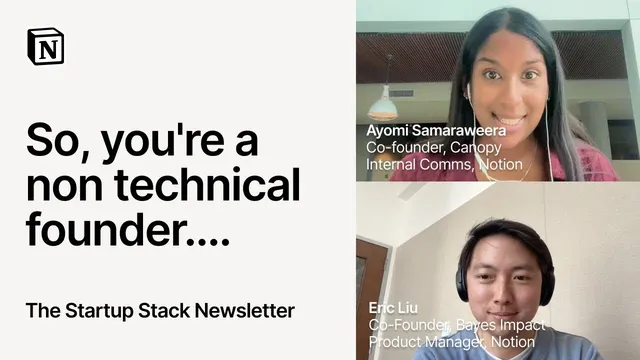
Founder Fridays: Run towards hard conversations - Eric Liu, Bayes Impact & Ayomi Samaraweera, Canopy
Based on Notion's video on YouTube. If you like this content, support the original creators by watching, liking and subscribing to their content.
Bayes Impact’s mission stayed consistent, but its operating model evolved through multiple iterations as it learned what could scale.
Briefing
Building data-driven products often starts with a simple question—who the user is and what problem matters—but both Bayes Impact and Canopy founders say the hardest part is resisting the momentum of execution long enough to correct course. Eric Liu describes Bayes Impact as a data science nonprofit working with government agencies and large nonprofits, built from the ground up through Y Combinator in 2024. The nonprofit’s mission stayed consistent—improving decision-making—but its operating model shifted repeatedly, moving from product development to services and back toward more product-like offerings as it learned what actually scaled.
A key lesson from Bayes Impact’s early days was that “talking to customers and selling” can become a trap if it’s done naively. The team began with a broad, ambitious premise: data science (later framed as AI) could help corporate organizations become more efficient. Without deciding whether the endgame was a software product or a tech-enabled services organization, customer conversations and rapid delivery led to a consulting-style business—complete with a growing engineering bench and high-profile hires. As headcount rose, the reality set in: the company risked becoming a large consulting operation rather than a scalable impact engine. Liu credits a later pivot to the courage to “flip” based on intuition—choosing what would be both meaningful and scalable—even when that meant admitting the current path was drifting.
That pivot required a cultural change as much as a business one. Liu emphasizes building a norm of brutally honest feedback early, especially when everyone is busy executing. He recounts an engineer directly challenging leadership with a blunt question: whether the company wanted to be a consulting business at all. That kind of candor, he says, prevents the team from treating discomfort as background noise.
Ayomi Samaraweeraera’s experience with Canopy highlights a different failure mode: when a founder lacks technical depth, shipping speed and iteration can stall. Canopy aimed to function like a “blind” for the creative economy, helping content creators share pay transparency opportunities and engage with management. As a non-technical solo founder who tried—and failed—to find the right technical co-founder, she struggled to move from customer conversations to implemented changes quickly enough to test adoption. Development timelines stretched, leaving a backlog instead of rapid experiments.
Both founders connect these lessons to a broader future for startups. Samaraweeraera argues that today’s tooling lowers the barrier for non-technical founders to prototype and even “vibe code,” then use that understanding to collaborate more effectively with a technical co-founder. Liu adds that AI shifts architecture and forces companies to assume general capabilities via APIs, while still needing a clear wedge and problem focus for vertical or use-case-driven businesses.
Across both journeys, the recurring theme is disciplined flexibility: keep a clear picture of the user and problem, move fast enough to learn, and create an environment where uncomfortable truths can surface before they harden into the wrong business model.
Cornell Notes
Bayes Impact and Canopy founders describe how early-stage execution can quietly steer companies away from their intended scale. Eric Liu says Bayes Impact’s broad AI/data-science premise and customer-selling approach initially produced a consulting-like business, forcing a later pivot toward a more scalable product/services mix. He credits the turnaround to cultural “brutal honesty” and the courage to follow intuition even when teams are attached to an idea. Ayomi Samaraweeraera’s Canopy experience shows the cost of being too far from the technical work: slow shipping prevented tight customer feedback loops. Together, they argue that clear user/problem focus, fast iteration, and honest internal feedback matter even as AI changes how startups build.
Why did Bayes Impact drift toward a consulting model, and what triggered the correction?
What does “brutally honest feedback” look like in early companies, according to Eric Liu?
What was the core product challenge for Ayomi Samaraweeraera as a non-technical solo founder at Canopy?
How does Samaraweeraera’s view of technical co-founders differ from her earlier approach?
How do both founders connect AI-era startups to their earlier lessons?
Review Questions
- What strategic ambiguity at Bayes Impact made it easy to end up with a consulting-like business, and how was that ambiguity surfaced?
- How did Canopy’s shipping cadence affect its ability to iterate, and what would change if a non-technical founder prototypes earlier?
- In an AI-first environment, what should a vertical startup still treat as non-negotiable: the wedge, the data moat, or the architecture—and why?
Key Points
- 1
Bayes Impact’s mission stayed consistent, but its operating model evolved through multiple iterations as it learned what could scale.
- 2
Starting with a broad AI/data-science promise without choosing a product-vs-services endgame can unintentionally produce a consulting business.
- 3
A culture of brutally honest feedback helps teams surface strategic misalignment early, especially when everyone is busy executing.
- 4
Non-technical founders can struggle to maintain fast customer feedback loops if development timelines prevent rapid shipping and experimentation.
- 5
Modern tooling can reduce the need for a purely “technical” founder by enabling prototyping and upskilling before partnering.
- 6
AI-era startups should assume general capabilities may be accessible via APIs, but still need a clear wedge and user/problem focus.
- 7
Building a company that lasts requires assembling a high-talent team with shared vision, not relying on solo execution indefinitely.