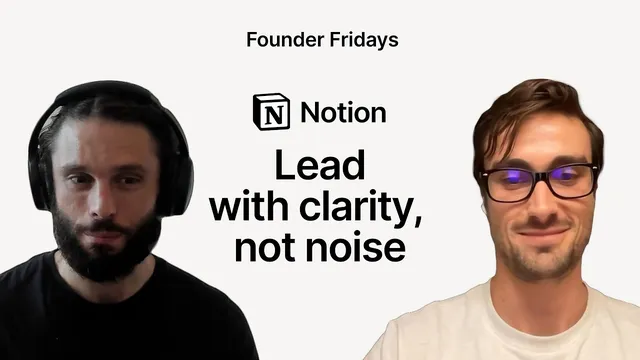
Founder Fridays: Trust, Clarity, Focus - Aleph’s Founder & CEO on removing noise & leading with AI
Based on Notion's video on YouTube. If you like this content, support the original creators by watching, liking and subscribing to their content.
ALF consolidates data from accounting, HR, and CRM systems into a single source of truth for FP&A and planning.
Briefing
ALF is building an AI-native financial planning and analysis (FP&A) platform that turns scattered business data into a single “source of truth,” then lets finance teams—and anyone who lives in spreadsheets—work with that data directly inside Excel and Google Sheets. The pitch is straightforward: connect accounting, HR, and CRM systems, centralize the information, and deliver dashboards plus spreadsheet add-ins so planning and reporting happen where users already work.
The company’s founder journey blends finance fluency with hands-on software building. Albert Gotsy started in finance at Procter & Gamble, later worked at Bain where he was exposed to CFOs and finance teams’ pain points and also built software in rare PM-style roles. He describes a long-standing strength in spreadsheets and a technical bent that let him “hack” solutions when needed. That mix, he says, became the foundation for ALF—especially because the product is designed around how finance actually operates, not just how data is stored.
AI is central to both ALF’s product and its internal operations. On the product side, AI helps interpret meeting transcripts and translate them into actionable CRM context—an approach aimed at understanding deal stages and capturing the “story” behind sales conversations. In day-to-day execution, AI is also used for summarization and briefing workflows, including generating summaries and morning briefs for account executives. Internally, the company pushes an automation mindset across go-to-market, engineering, and operations, hiring people who want to do more with less.
ALF’s team strategy reflects a pragmatic take on remote work. The company is roughly 60 people (give or take two), with hiring continuing steadily. Instead of fully extreme async, ALF operates as a remote team within the Americas, keeping most employees within a four- to five-hour time-zone band—about 70% in the US and the remainder across Canada and Latin America. The goal is to preserve access to top talent while maintaining enough real-time collaboration to keep momentum.
Outside work, Albert Gotsy draws a parallel between endurance running and founding: both require sustained effort, but creativity often arrives when attention isn’t locked to a screen. He runs ultramarathons in Patagonia and uses time away from devices—sometimes even without music—as a mental reset. He’ll then return to work and refine ideas, occasionally using ChatGPT in voice mode to brainstorm.
The advice offered to new founders centers on emotional realism and decision-making discipline: expect difficulty, accept that early success odds are low, and trust one’s gut when data isn’t enough. Data-driven decisions matter as companies scale, but the early stage is described as “flying blind,” where intuition and enjoyment of the day-to-day problem-solving process can be the difference between persistence and burnout. The practical takeaway is to enjoy the work itself—smart people, hard problems, and iterative learning—rather than tying happiness solely to fundraising milestones.
Cornell Notes
ALF is an AI-native FP&A platform that consolidates data from accounting, HR, and CRM systems into a single source of truth, then supports planning and analysis through dashboards and spreadsheet add-ins for Excel and Google Sheets. The company’s founder background pairs finance experience with hands-on software building, shaped by work with CFOs and a strong command of spreadsheets. AI is used broadly: meeting transcripts are analyzed to inform CRM deal context and sales briefings, and automation is emphasized across go-to-market and internal operations. ALF runs as a remote team across the Americas to balance hiring flexibility with enough overlap for collaboration. The founder’s guidance stresses trusting intuition early, recognizing low odds, and enjoying the day-to-day work that builds momentum.
What problem ALF is trying to solve in finance workflows, and how does it fit into existing tools?
Why does the founder emphasize spreadsheets and “gut” decisions even in an AI-driven company?
How is AI used beyond marketing—what concrete workflow changes are described?
What does ALF’s remote strategy look like, and what tradeoff does it try to manage?
What connection does the founder draw between endurance running and building a company?
Review Questions
- How does ALF’s spreadsheet add-in change where FP&A work happens compared with a dashboard-only approach?
- Which AI use cases mentioned in the transcript directly affect CRM deal understanding, and how do they support sales execution?
- What balance does ALF strike with remote work across time zones, and why does that matter for collaboration?
Key Points
- 1
ALF consolidates data from accounting, HR, and CRM systems into a single source of truth for FP&A and planning.
- 2
The platform supports both dashboards/visualizations and spreadsheet workflows via add-ins for Excel and Google Sheets.
- 3
AI is used to analyze meeting transcripts and translate them into CRM deal context, including deal stages and narrative summaries.
- 4
AI-driven briefing workflows help account executives prepare with summaries and morning briefs that capture the “story” of deals.
- 5
ALF emphasizes an automation mindset across go-to-market, engineering, and internal operations, hiring for people who want to do more with less.
- 6
The team operates remotely within the Americas to keep most employees within a four- to five-hour time-zone band rather than relying on extreme async.
- 7
Founder advice centers on trusting intuition early, accepting low success odds, and enjoying the day-to-day work of solving hard problems.