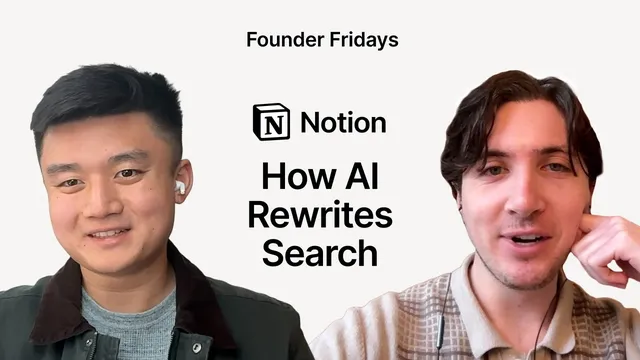
Founder Fridays: Why SEO Isn’t Enough in an AI-First World with Andrew Yan, CEO of AthenaHQ
Based on Notion's video on YouTube. If you like this content, support the original creators by watching, liking and subscribing to their content.
AI search expands the information “surface area” beyond a brand’s own website, pulling from third-party sources like comparator sites, editorial outlets, and social media.
Briefing
Brands can’t rely on traditional SEO anymore because AI search pulls from far more than a company’s own website—and that shift changes both what shows up in answers and how businesses should manage it. Andrew Yan, CEO of AthenaHQ, frames the problem as a new optimization category: “generative engine optimization” (GEO). In his view, GenAI doesn’t just add a new interface to the same discovery process; it expands the “surface area” where information is gathered and reshapes how knowledge and commercial decisions get made.
Yan draws a parallel to the web-to-mobile transition: consumer behavior changed, and the data LLMs consume is “vastly different” from the pre-GenAI world. Search now spans multiple modalities—image search, video search, and interactive question-and-answer experiences—so companies appear across more models, more personas, and more third-party sources. That broader sourcing means outdated or incorrect pages can suddenly become the basis for an AI response. He describes a common surprise for marketers: stale content, forgotten product pages, or old pricing can be surfaced in AI answers, sometimes harmlessly and sometimes in ways that can actively harm trust or revenue.
GEO, as AthenaHQ defines it, is a superset of SEO because it goes beyond on-page content on a brand’s domain. LLM-driven results may incorporate information from comparator sites, editorial sources, social media pages, and a long tail of other websites that influence what AI systems retrieve and synthesize. The practical implication is that brands need more control over how they show up across those many “surface areas,” not just how they rank on a single search engine.
AthenaHQ’s positioning also splits into two jobs: brand management and acquisition performance. Yan emphasizes that GenAI search is both a touchpoint for reputation and a measurable channel for leads and sales. What matters, in his framing, isn’t only visibility into where a brand appears in AI results, but the ability to take action on that information—turning insights into concrete changes that improve outcomes.
The company’s origin story traces back to Yan and co-founder Alan working on AI search applications in healthcare, where institutional resistance slowed adoption. Conversations with prospective users at a healthcare conference in Orlando sparked a broader realization: the same AI search dynamics apply across many industries. From there, AthenaHQ built an MVP, gained early customers, and scaled.
Yan also shares founder lessons from the YC process, treating it less as an end goal than as a forcing function for clarity and iteration speed. He advises founders to interrogate their motivations early because uncertainty tends to surface later as a rut. For product strategy in a crowded AI market, he argues that empathy for end users and customers should cut through feature overload—because the ease of building can tempt teams to dilute focus. Looking ahead, AthenaHQ says it’s expanding its customer base globally, hiring across product, engineering, and post-sales roles in San Francisco, and pushing for more value delivery as it scales.
Cornell Notes
Andrew Yan argues that AI-powered search requires “generative engine optimization” (GEO), because LLMs draw from many sources beyond a brand’s own website. That expanded sourcing can surface stale or incorrect information—such as outdated product lines or pricing—making governance and proactive updates essential. GEO is positioned as a superset of SEO: it accounts for how brands appear across comparator sites, editorial outlets, social media, and other third-party pages that influence AI answers. AthenaHQ’s focus is not only measuring visibility in AI results, but converting those insights into actions that improve business outcomes like leads and sales. The shift matters because consumer behavior and the data LLMs consume have changed, similar to how web-to-mobile reshaped discovery.
Why does AI search make traditional SEO insufficient?
What does GEO add beyond SEO?
What kinds of problems do companies discover when they see their AI search presence?
How does AthenaHQ frame the business value of AI search optimization?
What strategic lesson does Yan offer for founders choosing what to build in an AI-saturated market?
How did AthenaHQ’s origin connect to a broader market beyond healthcare?
Review Questions
- How does GEO’s definition of “surface area” change what a brand must monitor compared with SEO?
- Describe a scenario where stale content becomes a problem in AI search, and explain why it happens under LLM sourcing.
- What does Yan identify as the main risk of building too many features in an AI-first environment, and how should teams counter it?
Key Points
- 1
AI search expands the information “surface area” beyond a brand’s own website, pulling from third-party sources like comparator sites, editorial outlets, and social media.
- 2
GEO is positioned as a superset of SEO because it accounts for how LLMs synthesize answers from many inputs, not just on-page content.
- 3
Outdated or forgotten pages—such as old pricing or discontinued product lines—can surface in AI answers, creating potential reputational and revenue risk.
- 4
GenAI search should be treated as both a brand channel and an acquisition channel, requiring both qualitative visibility and quantitative outcome tracking.
- 5
AthenaHQ’s differentiation centers on turning AI search insights into concrete actions that improve leads and sales, not only measurement.
- 6
Founder clarity and iteration speed matter for YC-style acceleration, and motivations should be stress-tested early to avoid later ruts.
- 7
In AI-saturated markets, customer empathy and focus are critical to prevent feature sprawl from the ease of rapid building.