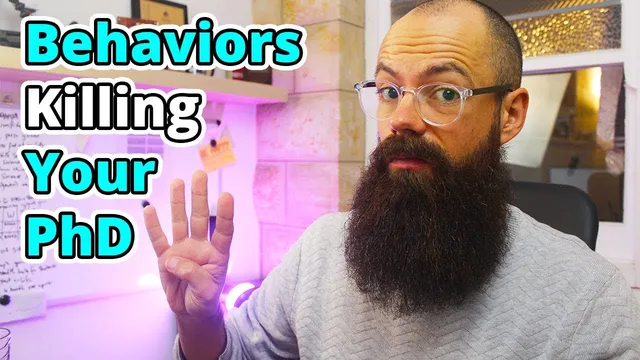
Four behaviors that'll kill your PhD
Based on Andy Stapleton's video on YouTube. If you like this content, support the original creators by watching, liking and subscribing to their content.
Self-sabotage during a PhD often takes the form of avoiding tasks that could fail, which temporarily reduces anxiety but permanently blocks progress.
Briefing
A PhD doesn’t fail only because experiments go wrong—it often collapses under self-inflicted habits that quietly prevent progress. The central warning is that self-sabotage, especially when it takes the form of pessimistic self-talk, inaction, and untested assumptions, can protect a researcher from the pain of failure while also ensuring they never do the work that would produce results.
The first behavior is self-sabotage, which can show up as procrastination, avoiding tasks that might lead to failure, or building protective narratives about who someone is and what they can handle. During a PhD, failure is built into the process—research, ideas, and even conversations involve repeated setbacks. Self-sabotage becomes a way to regain a sense of control in a system that is largely outside an individual’s control, including lab politics and shifting academic pressures. The practical takeaway is blunt: if these patterns appear in day-to-day behavior, they need to be “stamped out,” because the avoidance itself becomes the threat.
Closely tied to that is pessimism that masquerades as “healthy skepticism.” Skepticism is necessary for research—questioning claims, testing whether something could be better, and refusing to accept ideas at face value. But pessimism turns inward, amplifying negative thoughts about one’s abilities (“lazy,” “useless,” or skills that “don’t apply” to the current research). The result is a downward spiral: negativity about research or other people increases burnout, attracts more negative collaborators, and makes it harder to recover. The suggested countermeasures are to change the narratives being repeated, practice self-care, and use tools like gratitude journaling and mindfulness—while still keeping skepticism focused on evidence rather than self-worth.
Another major killer is spending too long in the thinking stage and not acting. Research requires both mental work and execution: collecting data, finding references, running methods, and getting results. Overthinking can feel productive and even clever, but it delays the only way to test ideas—through doing. The advice is to prioritize action, including maintaining a routine that gets the researcher into the lab, office, or research environment on time, and responding to tasks and advice rather than letting them sit.
Finally, making assumptions—about experiments, about what will “not work,” and about other people’s motivations—can stop researchers from testing reality. One example involves a supervisor who relied on thought experiments and assumptions, while another pushed back with a demand for data to confirm whether something fails. The broader point is that assumptions prevent new ground from being broken, and they also distort interpersonal dynamics by treating busy, pressured colleagues as if their actions carry malice. The antidote is to stop assuming, gather evidence, and act.
Taken together, the message is that progress in a PhD depends on resisting protective avoidance: replace pessimistic self-talk with evidence-based skepticism, trade rumination for consistent action, and challenge both experimental and social assumptions with data and direct engagement.
Cornell Notes
The transcript argues that a PhD can be derailed by four self-destructive behaviors: self-sabotage, pessimism disguised as skepticism, excessive thinking without doing, and making assumptions. Self-sabotage protects people from the pain of failure by avoiding tasks that could lead to setbacks, but it also removes the chance to progress. Pessimism turns research skepticism inward, fueling burnout and negative spirals that can isolate collaborators; gratitude journaling, mindfulness, and narrative change are offered as counterweights. Overthinking feels productive, yet only action—data collection, reference searching, lab time, and routines—tests ideas. Assumptions about experiments and people prevent evidence gathering and can block both scientific breakthroughs and healthier collaboration.
How does self-sabotage “protect” someone during a PhD, and why does that protection become dangerous?
What’s the difference between healthy skepticism and PhD-killing pessimism?
Why does “thinking” become a trap in research, even when it feels productive?
How do assumptions derail both experiments and relationships in academia?
What self-management tools are suggested to counter pessimism and burnout?
Review Questions
- Which of the four behaviors—self-sabotage, pessimism, inaction, or assumptions—most closely matches your current research pattern, and what evidence from your routine supports that?
- How would you distinguish “healthy skepticism” from “pessimism” in a specific situation you face (e.g., a failed experiment or critical feedback)?
- What is one concrete action you can take this week to reduce overthinking and test an assumption with data?
Key Points
- 1
Self-sabotage during a PhD often takes the form of avoiding tasks that could fail, which temporarily reduces anxiety but permanently blocks progress.
- 2
Healthy skepticism is evidence-driven and necessary for research; pessimism is identity-driven and can trigger burnout and isolation.
- 3
Negative self-talk can snowball into a downward spiral that affects both research output and collaboration quality.
- 4
Overthinking feels productive, but only action—data collection, reference searching, lab time, and execution—tests ideas.
- 5
Maintaining a strict routine that gets you into the research environment on time helps convert intention into consistent work.
- 6
Assumptions about experiments can prevent necessary testing; assumptions about people can distort collaboration and create unnecessary conflict.
- 7
Counter pessimism with narrative change, self-care, gratitude journaling, and mindfulness while keeping skepticism focused on facts.