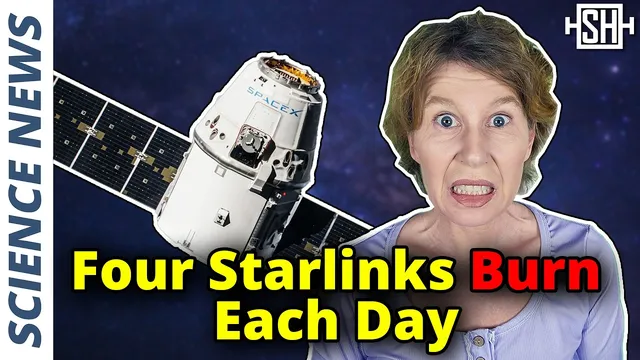
Four Starlink Satellites Fell From The Sky Each Day, Creating New Worries
Based on Sabine Hossenfelder's video on YouTube. If you like this content, support the original creators by watching, liking and subscribing to their content.
Starlink’s daily satellite re-entries are largely intentional retirements that burn up in the upper atmosphere rather than uncontrolled debris falling to Earth.
Briefing
Starlink’s daily satellite drop-off has been framed as a failure, but the underlying mechanism is retirement: SpaceX burns older satellites up in Earth’s upper atmosphere rather than letting debris fall to the ground. Even so, scientists say the chemistry of what re-enters matters. As of early 2025, more than 7,000 Starlink satellites operate in low Earth orbit, with SpaceX already cleared for 12,000 more and seeking approval for more than 40,000 total. Other companies—including Amazon and a Chinese firm referred to as Space Sale—are pursuing competing global internet constellations. At that pace, the decade could bring roughly 100,000 satellites, raising concerns that extend beyond crowding and into atmospheric and astronomical impacts.
A key correction to the “four satellites fell” headline comes from Harvard astrophysicist Jonathan Mcdow: about four to five Starlink satellites re-enter each day, but the process is planned. The worry shifts from “junk raining down” to “what the burn-up releases.” Burning doesn’t erase satellite materials; it disperses them as extremely thin particles in the upper atmosphere. A University of Southern California study estimates that each re-entering satellite releases around 30 kg of aluminum oxide as nanoparticles. The researchers project accumulation at more than 360 metric tons per year, where aluminum oxide can catalyze reactions that release chlorine—an ingredient that can contribute to ozone destruction. The magnitude is described as poorly understood, but potentially significant.
Other atmospheric concerns have also been raised, including the idea that conductive metal dust could affect Earth’s magnetosphere and magnetic field. However, that claim relied on a preprint that has not been published in a journal more than a year later, weakening confidence in the estimate.
Astronomers’ complaints are more immediate. Starlink satellites fly low enough to reflect sunlight, producing long streaks in long-exposure images. SpaceX says it takes those impacts seriously: second-generation satellites are dimmer—about one-fifth as bright—thanks to improved coatings and panel orientation. Yet dimmer satellites still create new interference. They emit radio waves in the 100–200 megahertz range, overlapping with bands used by radio telescopes. For second-generation units, radio emissions are reported as up to 32 times stronger than earlier models, likely due to insufficient shielding. SpaceX has begun testing an interference-avoidance approach in which telescopes share observation schedules and SpaceX directs transmissions away from those targets. A recent study says the method can cut interference by more than two orders of magnitude, with current use limited to a small set of facilities such as the Very Large Array in New Mexico.
Overall, the account concludes that the main risks are being managed through retirement practices and operational mitigation, while uncertainties remain—especially around atmospheric chemistry. The stated takeaway is a low “worry meter” score: roughly 1 out of 10, meaning the concerns are treated as precautionary rather than urgent.
Cornell Notes
Starlink’s “four satellites fell each day” headline is misleading: the satellites are being intentionally retired by burning up in the upper atmosphere. That planned re-entry still disperses satellite materials, and aluminum is a central worry. A University of Southern California study estimates each re-entering satellite releases about 30 kg of aluminum oxide nanoparticles, projecting over 360 metric tons per year, with aluminum oxide potentially catalyzing chlorine chemistry that can harm ozone. Other concerns—like effects on Earth’s magnetosphere—lack strong confirmation because related work hasn’t reached peer-reviewed publication. On the astronomy side, Starlink’s brightness and radio emissions interfere with observations, but SpaceX is testing schedule-based radio avoidance that can reduce interference by more than two orders of magnitude for some telescopes.
Why do reports say four to five Starlink satellites “fall out of orbit” each day, and what’s the correction?
What atmospheric-chemistry mechanism links Starlink re-entries to ozone risk?
How do satellite materials differ from meteorites in this context?
What are the main ways Starlink affects astronomy, and how have satellite generations changed?
How does SpaceX’s radio-interference mitigation work, and how effective is it?
Review Questions
- What does the “four satellites fell each day” claim miss about how Starlink satellites are handled at end-of-life?
- Which chemical pathway involving aluminum oxide and chlorine is cited as a possible driver of ozone damage, and what are the estimated quantities?
- How do optical brightness changes and radio-emission changes differ across Starlink generations, and what mitigation strategy addresses radio interference?
Key Points
- 1
Starlink’s daily satellite re-entries are largely intentional retirements that burn up in the upper atmosphere rather than uncontrolled debris falling to Earth.
- 2
Atmospheric concerns shift from ground impact to dispersed materials, especially aluminum oxide nanoparticles released during re-entry.
- 3
A University of Southern California estimate puts aluminum oxide emissions at about 30 kg per re-entering satellite and over 360 metric tons per year overall.
- 4
Aluminum oxide is described as potentially catalyzing chlorine chemistry that could contribute to ozone destruction, though the scale remains uncertain.
- 5
Second-generation Starlink satellites are dimmer optically (about one-fifth as bright) but can emit stronger radio interference in the 100–200 MHz range.
- 6
SpaceX’s schedule-based radio avoidance can cut interference by more than two orders of magnitude for some telescopes, but current rollout is limited.
- 7
Some additional atmospheric claims (e.g., magnetosphere effects) remain less reliable because related work hasn’t been published in a peer-reviewed journal.