Fourier Transform 22 | Riemann–Lebesgue Lemma for Fourier Series
Based on The Bright Side of Mathematics's video on YouTube. If you like this content, support the original creators by watching, liking and subscribing to their content.
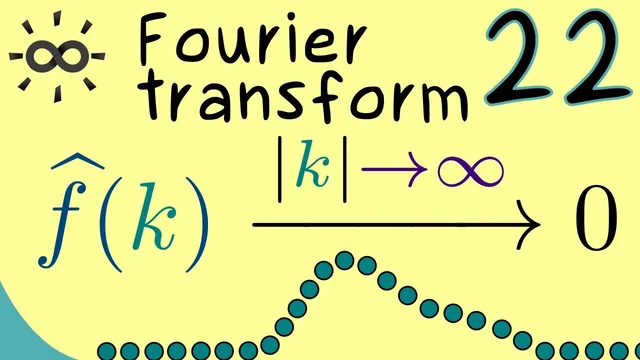
Riemann–Lebesgue lemma states that for every f ∈ L1, the Fourier coefficients f̂(k) satisfy f̂(k) → 0 as k → ±∞.
Briefing
Riemann–Lebesgue lemma pins down a key asymptotic behavior of Fourier series: for any function f in L1, its Fourier coefficients form a sequence that always tends to 0 as the frequency k goes to ±∞. That matters because it guarantees that high-frequency oscillations “wash out” in the Fourier coefficient sense, even when f is not square-integrable—so the result reaches beyond the comfortable L2 setting.
The starting point is the Fourier coefficient formula for an L1 function: the coefficients are defined by an integral and can be packaged as a sequence {f̂(k)} of complex numbers. The lemma asserts that this sequence converges and that its limit is exactly zero. In practical terms, the absolute values |f̂(k)| eventually become arbitrarily small, though the lemma does not quantify how fast the decay occurs.
The proof strategy hinges on a gap: for L2 functions, the conclusion is already known. Parseval’s identity implies that the Fourier coefficients are square-summable, meaning {f̂(k)} lies in ℓ2. Since any square-summable sequence must go to zero at infinity, the lemma follows automatically for f ∈ L2. The real work begins when f is in L1 but not in L2, where f may be unbounded and the square-integrability argument breaks.
To bridge that gap, the argument constructs truncated approximations of f that become square-integrable. For each natural number n, define a 2π-periodic function f_n by “cutting off” the magnitude of f: when |f(x)| ≤ n, keep f(x); when |f(x)| > n, replace it by n (in magnitude). This truncation produces bounded functions, and bounded periodic functions on a finite interval are in L2. As a result, Parseval’s identity applies to each f_n, giving control over the tail of their Fourier coefficients.
Next comes the convergence back to the original f. The proof uses Lebesgue’s dominated convergence theorem: f_n(x) → f(x) almost everywhere as n → ∞, and |f_n(x)| is dominated by |f(x)|, which is integrable because f ∈ L1. Dominated convergence then yields convergence in L1, i.e., ∫|f_n − f| → 0.
That L1 convergence transfers to the Fourier coefficients. For each fixed k, the difference f̂_n(k) − f̂(k) is an integral of (f_n − f) against the complex exponential e^{-ikx}, whose modulus is 1. Taking absolute values and using the triangle inequality shows that |f̂_n(k) − f̂(k)| can be made small uniformly in k once n is large enough.
Finally, the proof combines two tail controls: (1) for large n, the Fourier coefficients of f_n approximate those of f, and (2) for each such f_n, Parseval’s identity forces f̂_n(k) to be small when |k| is large. A careful ε/2 bookkeeping then shows that |f̂(k)| itself becomes smaller than any prescribed ε for all sufficiently large |k|. The lemma is established for complex Fourier coefficients, and the same conclusion follows for real sine/cosine coefficients by standard relationships between the two Fourier representations.
Cornell Notes
Riemann–Lebesgue lemma guarantees that if f is integrable (f ∈ L1), then its Fourier coefficients f̂(k) approach 0 as k → ±∞. The result is immediate for f ∈ L2 because Parseval’s identity makes {f̂(k)} square-summable, and every ℓ2 sequence must vanish at infinity. For f in L1 but not L2, the proof truncates f to bounded functions f_n by capping |f| at n, which puts each f_n in L2. Lebesgue’s dominated convergence theorem shows f_n → f in L1, and that L1 convergence transfers to Fourier coefficients. Combining “approximate by f_n” with “high frequencies of f_n are small” yields f̂(k) → 0.
Why does Parseval’s identity make the lemma automatic for L2 functions?
How does truncating f into f_n help when f is only in L1?
What role does dominated convergence play in the proof?
Why does L1 convergence of f_n − f control Fourier coefficient differences?
How are the two “smallness” steps combined to force f̂(k) → 0?
Review Questions
- What fails when f is in L1 but not in L2, and how does the truncation f_n fix it?
- Where exactly does the modulus |e^{-ikx}| = 1 enter the Fourier coefficient estimate?
- How does the ε/2 argument ensure convergence for both positive and negative k (k → ±∞)?
Key Points
- 1
Riemann–Lebesgue lemma states that for every f ∈ L1, the Fourier coefficients f̂(k) satisfy f̂(k) → 0 as k → ±∞.
- 2
For f ∈ L2, Parseval’s identity implies {f̂(k)} ∈ ℓ2, and ℓ2 sequences necessarily vanish at infinity.
- 3
When f ∈ L1 but not L2, truncating f to bounded functions f_n makes each f_n belong to L2 so Parseval’s identity becomes available.
- 4
Lebesgue’s dominated convergence theorem shows f_n → f in L1 because |f_n| ≤ |f| and f ∈ L1.
- 5
L1 convergence transfers to Fourier coefficients: for fixed k, |f̂_n(k) − f̂(k)| is controlled by ∫|f_n − f|.
- 6
A two-step ε/2 argument combines approximation by f_n with the high-frequency decay of f̂_n(k) to conclude f̂(k) → 0.
- 7
The lemma holds for complex Fourier coefficients and therefore also for real sine/cosine coefficients via standard Fourier-series relationships.