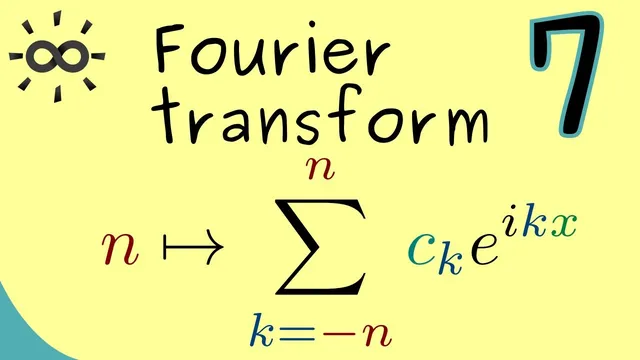
Fourier Transform 7 | Complex Fourier Series
Based on The Bright Side of Mathematics's video on YouTube. If you like this content, support the original creators by watching, liking and subscribing to their content.
Complex Fourier series uses e^{ikx} instead of cos(nx) and sin(nx), simplifying formulas while preserving the same approximation subspace.
Briefing
Complex Fourier series turns the cosine–sine bookkeeping of real Fourier series into a single, cleaner exponential framework—without losing any information. Starting from square-integrable, 2π-periodic functions in an L2 inner-product space, the construction of Fourier series as orthogonal projections remains the same, but the basis functions are swapped from cos(nx) and sin(nx) to the complex exponentials e^{ikx}. The key simplification comes from Euler’s formulas: cos(x) = (e^{ix}+e^{-ix})/2 and sin(x) = (e^{ix}-e^{-ix})/(2i). With these identities, any linear combination of cosines and sines can be rewritten as a linear combination of exponentials with complex coefficients, and vice versa.
An illustrative example shows how coefficients recombine. A combination like a·cos(2x) + b·cos(2x) + c·sin(2x) (with the transcript’s intent being a mix of cosine and sine at the same frequency) becomes a sum of exponentials e^{i2x} and e^{-i2x} with coefficients formed from a, b, and c. The crucial point is that the exponential basis naturally groups the “+frequency” and “−frequency” parts together, so the same trigonometric polynomial can be represented either way. In the complex-valued setting, there’s no structural difference between the cosine/sine description and the exponential description—only a change of coordinates in the same finite-dimensional subspace.
That equivalence extends to the subspaces used for truncation. For a fixed n, the real trigonometric polynomial space is spanned by {1, cos(x), …, cos(nx), sin(x), …, sin(nx)}, giving 2n+1 basis functions. In the complex formulation, the same subspace can be spanned more compactly by exponentials {e^{ikx}} for k = −n, …, n—again 2n+1 functions. The transcript also notes how coefficients transform between the two bases: for k>0, the exponential coefficients C_k relate to the cosine and sine coefficients through factors involving 1/2 and 1/(2i); for k<0, the indices shift to match the sine/cosine pairing; and for the constant term, C_0 matches the constant coefficient directly. The constant basis element is handled more naturally in the exponential setup.
Once the exponential orthonormal system is in place, the Fourier series becomes a single projection formula. The orthonormality uses the inner product ⟨f,g⟩ = (1/2π)∫_{−π}^{π} f(x)·conj(g(x)) dx, where complex conjugation matters. The complex Fourier series of f is then written as a sum over all integers k from −n to n of C_k e^{ikx}, with coefficients given by
C_k = (1/2π)∫_{−π}^{π} f(x) e^{−ikx} dx.
This one formula works for every k, including k=0, eliminating the need for separate cases. Even when f is real-valued, the complex series still yields a result whose imaginary part cancels in the full sum. The practical payoff is straightforward: fewer formulas, one coefficient rule, and a basis that’s easier to write and manipulate—setting up the next step in approximating functions with Fourier series.
Cornell Notes
Complex Fourier series replaces the cosine–sine basis with complex exponentials while keeping the same underlying L2 projection idea. For 2π-periodic, square-integrable functions, the truncated Fourier space spanned by {1, cos(x)…cos(nx), sin(x)…sin(nx)} is exactly the same as the space spanned by exponentials {e^{ikx}} for k = −n,…,n. Euler’s formulas show how cos(x) and sin(x) can be rewritten using e^{ix} and e^{−ix}, so coefficients in one basis can be converted to the other. With the exponential orthonormal system, the Fourier series becomes a single sum ∑_{k=−n}^{n} C_k e^{ikx}, where C_k = (1/2π)∫_{−π}^{π} f(x)e^{−ikx} dx. This one integral formula works for all k, including k=0.
Why does switching from cos(nx), sin(nx) to exponentials e^{ikx} not change what functions can be represented?
How do Euler’s formulas drive the coefficient recombination between sine/cosine and exponential forms?
What is the orthonormality inner product used for complex Fourier coefficients, and why does conjugation matter?
What is the single coefficient formula for the complex Fourier series, and what does the minus sign in e^{−ikx} do?
How does the constant term (k=0) fit into the complex formulation without special case handling?
Review Questions
- In what sense are the cosine/sine span and the exponential span “the same,” and how many basis functions does each contain for a given n?
- Write the complex Fourier coefficient C_k for a 2π-periodic function f and explain where the e^{−ikx} factor comes from.
- If f is real-valued, why can the complex Fourier series still produce a real-valued approximation even though coefficients and basis functions are complex?
Key Points
- 1
Complex Fourier series uses e^{ikx} instead of cos(nx) and sin(nx), simplifying formulas while preserving the same approximation subspace.
- 2
Euler’s formulas convert cosine and sine terms into exponentials, enabling coefficient regrouping at each frequency.
- 3
For a fixed n, the real trigonometric polynomial space with 2n+1 basis functions matches the exponential space spanned by {e^{ikx}} for k = −n,…,n.
- 4
The complex inner product ⟨f,g⟩ = (1/2π)∫_{−π}^{π} f(x)·conj(g(x)) dx is crucial for orthogonality and coefficient extraction.
- 5
With the exponential orthonormal system, the Fourier series is a single sum ∑_{k=−n}^{n} C_k e^{ikx}.
- 6
All Fourier coefficients follow one rule: C_k = (1/2π)∫_{−π}^{π} f(x)e^{−ikx} dx, including k=0.
- 7
Even for real-valued f, the complex representation can yield a real-valued result because imaginary parts cancel across conjugate frequency terms.