Fractals are typically not self-similar
Based on 3Blue1Brown's video on YouTube. If you like this content, support the original creators by watching, liking and subscribing to their content.
Fractals are better defined by non-integer fractal dimension—an indicator of persistent roughness—rather than by perfect self-similarity.
Briefing
Fractals aren’t defined by perfect self-similarity. The more useful idea is that many rough shapes behave as if they have a non-integer “fractal dimension,” a number that stays roughly the same across a range of zoom levels—capturing how detail persists rather than how neatly patterns repeat.
A common misconception treats fractals as shapes that reproduce exactly when magnified, like the Von Koch snowflake or the Sierpinski triangle. Those examples are indeed self-similar, but Mandelbrot’s broader goal was pragmatic: build models that reflect the roughness found in nature, where zooming in doesn’t produce perfectly identical copies. That shift matters because calculus often assumes smoothness at sufficiently small scales; fractal geometry pushes back by treating roughness as a fundamental feature, not a rounding error.
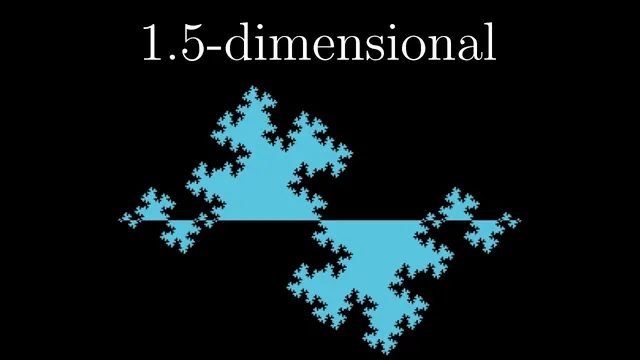
The key technical tool is fractal dimension, introduced through scaling laws. For simple self-similar objects, “mass” (or measure) changes predictably when the object is scaled down. A line scaled by one half has half the mass; a square scaled by one half has one quarter; a cube scaled by one half has one eighth. The exponent in these relationships is the ordinary dimension. The same logic extends to self-similar fractals: the Sierpinski triangle is made from three smaller copies scaled down by one half, so its mass scales like (1/2)^d = 1/3. Solving gives d ≈ 1.585. That means the Sierpinski triangle is not 1-dimensional like a curve and not 2-dimensional like a filled region; it behaves like a 1.585-dimensional object. Similar calculations yield the Von Koch curve at about 1.262 dimensions, and a right-angled variant at exactly 1.5.
But self-similarity is too strict to describe most real-world shapes. To handle non-self-similar roughness, the discussion turns to box counting: overlay a grid, count how many boxes the shape touches, then see how that count grows as the grid is refined (equivalently, as the shape is scaled). For a shape with fractal dimension D, the number of touched boxes scales roughly like S^D. Taking logarithms turns this into a linear relationship on a log-log plot, letting the slope—estimated via regression—serve as an empirical dimension.
This framework explains why the coastline of Britain is often quoted around 1.21: as the measurement scale changes, the coastline’s apparent length increases in a way consistent with a dimension near 1.21. The same approach can be applied to other jagged natural boundaries, such as Norway’s coastline (about 1.52), and even to ocean surfaces, where calm conditions may sit just above 2 while storms can approach 2.3.
Finally, assigning a single dimension can be scale-dependent. A winding object in 3D may look line-like at one scale, tube-like at another, and line-like again when finer details emerge. In practice, applied “fractal” labeling usually means the measured dimension stays approximately constant over a meaningful range of scales. Perfect self-similarity remains a clean mathematical toy, but roughness that persists across scales is what makes fractal dimension a powerful way to quantify the natural world—and to distinguish natural forms from man-made ones that tend to be smoother.
Cornell Notes
Fractal dimension replaces the idea of “perfect self-similarity” with a quantitative measure of roughness. For self-similar shapes, scaling rules for how “mass” changes lead to non-integer dimensions: the Sierpinski triangle comes out to about 1.585, the Von Koch curve about 1.262, and a right-angled Koch variant exactly 1.5. For shapes that aren’t exactly self-similar, box counting estimates dimension by counting grid boxes a shape touches as the grid is refined; the slope on a log-log plot gives the dimension. In real settings, a shape is treated as fractal when the measured dimension stays roughly constant across a range of scales, not necessarily in the limit of infinite zoom.
Why does the Sierpinski triangle end up with a dimension of about 1.585 instead of 1 or 2?
How does box counting assign a fractal dimension to shapes that aren’t perfectly self-similar, like a coastline?
What does it mean when fractal dimension “stays rough” even as you zoom in?
Why can the measured dimension of a 3D object change with scale?
How do the Von Koch curve and its variants illustrate the scaling-to-dimension method?
What practical examples connect fractal dimension to “how jagged” something is?
Review Questions
- How does the exponent in a scaling law for mass relate to dimension for both ordinary shapes and self-similar fractals?
- What steps turn box counting into an estimate of fractal dimension using a log-log plot?
- Why might the same geometric object yield different effective dimensions at different zoom levels?
Key Points
- 1
Fractals are better defined by non-integer fractal dimension—an indicator of persistent roughness—rather than by perfect self-similarity.
- 2
Self-similar fractals yield dimension by matching how “mass” scales with the magnification factor; the exponent becomes the dimension.
- 3
The Sierpinski triangle has dimension ≈ 1.585, the Von Koch curve ≈ 1.262, and a right-angled Koch variant exactly 1.5, all derived from scaling relationships.
- 4
Box counting estimates dimension for non-self-similar rough shapes by counting grid boxes touched as the grid is refined and extracting the slope on a log-log plot.
- 5
In applied contexts, a shape is treated as fractal when the measured dimension stays roughly constant across a range of scales, not only at an infinite-zoom limit.
- 6
Measured dimension can shift across scales when an object transitions between line-like, tube-like, and detail-dominated regimes.
- 7
Fractal dimension provides a quantitative way to compare roughness in nature, such as coastlines and ocean conditions.