Fractions! | Mini Math Movies | Scratch Garden
Based on Scratch Garden's video on YouTube. If you like this content, support the original creators by watching, liking and subscribing to their content.
Fractions represent equal parts of a whole created by dividing something into matching sections.
Briefing
Fractions become intuitive when parts of a whole are created by repeatedly dividing equal sections. The core idea is that splitting one whole “me” into two equal halves produces fractions, and further dividing those halves into equal parts creates new fraction names—fourths (or quarters). The lesson matters because it links fraction vocabulary directly to what’s happening visually: one half is made of two equal halves, one quarter is one of four equal parts, and four quarters make a whole again.
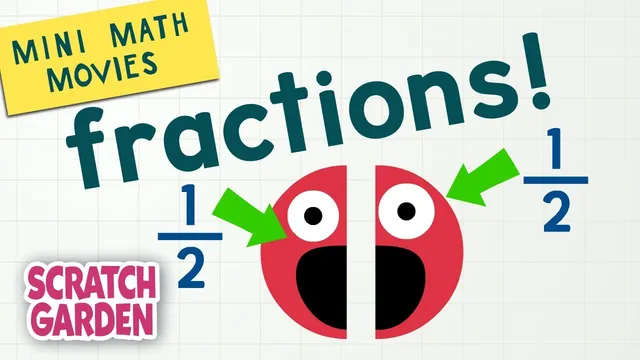
The explanation starts with a single whole “me.” When the whole is divided into two equal parts, there are two halves—one half on the left and one half on the right. Putting the two halves together reconstructs the original whole, so each half is a fraction of the whole. The lesson then escalates: each half is divided again into halves, creating four equal parts. Those parts are called fourths, and each fourth can also be called a quarter. The video emphasizes equivalence by showing that combining four quarters (or four fourths) returns to one whole “me.”
To make the relationships stick, the lesson reviews common fraction benchmarks using the same “me” model. One fourth (one quarter) is one of the four equal parts. Two fourths (two quarters) equals one half. Three fourths (three quarters) is three of the four parts, and four fourths (four quarters) equals one whole. This sequence turns fraction names into a clear ladder of size: quarters build up to halves, and halves build up to wholes.
The second half shifts from the “me” model to fair sharing. When cookies are distributed among four Kevins, the starting point is whole numbers: with eight cookies, each Kevin gets two cookies. As cookies disappear, the distribution forces fractions. With six cookies left, each Kevin gets one cookie and two extra cookies remain; those extras must be split so everyone gets the same amount, resulting in each Kevin receiving one and one half cookies. When only one cookie remains, fairness requires breaking it into four equal parts, so each Kevin receives one quarter (one fourth) of a cookie. The message is practical: fractions are a tool for dividing quantities evenly when whole-number sharing no longer works.
Cornell Notes
Fractions are introduced as equal parts of a whole created by dividing something into matching sections. Splitting one whole “me” into two equal parts produces halves; splitting again produces four equal parts called fourths or quarters. The lesson connects fraction names through equivalences: two fourths equal one half, and four fourths equal one whole. It then applies the same idea to sharing cookies fairly among four Kevins, showing how leftover amounts force splitting into halves and quarters. The takeaway is that fraction vocabulary matches the number of equal parts and helps solve real “fair sharing” problems.
How does dividing a whole into equal parts lead to the idea of fractions?
What changes when each half is divided again?
Why are two fourths equal to one half in the lesson’s model?
How does the cookie-sharing scenario show fractions in a real context?
What does “one fourth” mean compared with “one whole” in the lesson?
Review Questions
- If a whole is divided into 8 equal parts, what fraction name would match one equal part (and how would you justify it using the “equal parts” idea)?
- In the “me” model, what fraction of the whole is represented by three of the four equal parts, and how does that compare to one half?
- In the cookie-sharing scenario with four Kevins, what happens to the distribution when the remaining cookies can’t be shared as whole cookies anymore?
Key Points
- 1
Fractions represent equal parts of a whole created by dividing something into matching sections.
- 2
Dividing one whole into two equal parts produces halves; combining both halves makes one whole.
- 3
Dividing each half again creates four equal parts called fourths or quarters.
- 4
Two fourths equals one half, and four fourths equals one whole.
- 5
Fraction names correspond to how many equal parts make up the whole (e.g., quarters come from four parts).
- 6
Fair sharing often forces fractions when leftover amounts can’t be distributed as whole units.
- 7
Splitting a remaining quantity into equal parts ensures everyone receives the same fraction of the original amount.