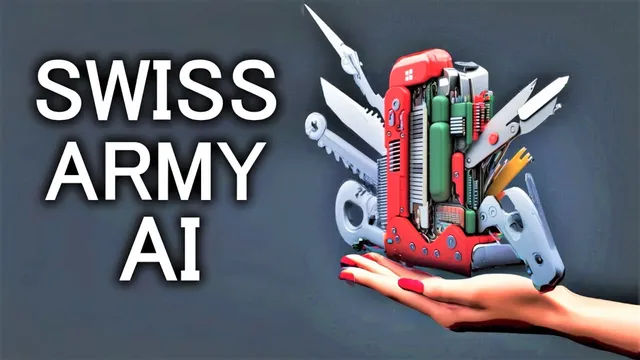
Free NEW "Swiss Army AI Model" - Versatile Diffusion Text to image Explained!
Based on MattVidPro's video on YouTube. If you like this content, support the original creators by watching, liking and subscribing to their content.
Versatile Diffusion is a unified multi-modal diffusion framework that supports text-to-image, image variation, image-to-text, and text variation in one place.
Briefing
Versatile Diffusion positions itself as a “Swiss Army AI” for generative media by bundling multiple capabilities—text-to-image, image variation, image-to-text, and text variation—into one unified multi-modal diffusion framework. The practical payoff is that creators can switch workflows without changing tools: start from a text prompt, remix an existing image, or even run a reverse step where an image is converted into a prompt-like description. It’s also offered for free to test via Hugging Face, though server load can slow access.
The model’s core promise is breadth. In addition to the familiar text-to-image pipeline associated with systems like Stable Diffusion, it adds image variation that keeps key visual traits while altering composition and style. It also attempts image-to-text, generating a descriptive prompt from an input image—something the transcript notes is rare among major text-image models. A further experimental layer, text variation, takes a text prompt and produces multiple rewritten/expanded prompt variants, which can then be used to generate new images.
Early results suggest Versatile Diffusion is strongest at image variation. With a lemon-themed reference image, variations preserved recognizable identity cues—such as background blur, hair color, facial features, and overall structure—while still producing meaningful changes. The output was described as competitive with Dolly 2–style variation quality, especially when the reference image was clear and the target concept was consistent. Harder prompts (like an abstract lemon character doing a dance) produced weaker coherence, and a dog-to-different-breed attempt resulted in a “mixed” breed outcome—realistic textures and coherence, but not the intended species specificity.
Text-to-image works, but it lands closer to the mainstream baseline than to top-tier fine-tuned or premium systems. A lemon prompt produced coherent scenes with the expected elements (lemon character, tropical beach), and the results were compared to Stable Diffusion outputs—sometimes similar, sometimes more coherent. More complex prompts (like a nebula or a village in China) looked usable, and a simple “cute kitten” prompt generated photogenic results, though not necessarily at the level of the best specialized models.
The transcript also highlights three experimental controls that shape how variations behave. Disentanglement splits variation into more semantic changes versus more stylistic changes, letting users dial from logic-like realism to stylized, artistic outputs. Dual guided blends an input image with a text prompt using a “guidance mixing” slider, enabling hybrid results—like a cyberpunk-styled Mercedes—while still retaining the original image’s visual character. Latent editing uses a text-driven instruction to modify an image through a text-to-image/latent pipeline (e.g., removing “White House” and adding a “tall Castle”), with mixed success so far and clear signs of ongoing experimentation.
Overall, Versatile Diffusion is presented as a versatile, free-to-try framework whose most reliable strength today is remixing images while maintaining identity. Image-to-text and text variation are intriguing but less dependable, and the transcript repeatedly flags experimental limitations. Still, the unified approach—one model for multiple generative directions—makes it a compelling sandbox for prompt engineering and creative iteration, with future plans for additional modalities like speech, music, video, and 3D.
Cornell Notes
Versatile Diffusion is a free, unified multi-modal diffusion framework that supports text-to-image, image variation, image-to-text, and text variation. The strongest and most consistent results come from image variation, where reference images can be remixed while preserving key identity cues like facial features and overall composition. Text-to-image produces coherent, usable images, often comparable to Stable Diffusion-style outputs, but not positioned as a clear leap beyond top fine-tuned or premium systems. Experimental controls such as disentanglement (semantic vs stylized), dual guided (image-text mixing), and latent editing (text-driven changes in latent space) add creative control, though some tasks remain hit-or-miss. The model matters because it reduces workflow fragmentation: creators can move between directions without switching separate tools.
What makes Versatile Diffusion feel like a “Swiss Army AI” compared with typical text-to-image tools?
How did the transcript’s tests evaluate text-to-image quality?
Why was image variation considered the model’s most reliable capability?
What does disentanglement control, and what did the tests show when dialing it from semantic to stylized?
How does dual guided work, and what was the practical effect of changing guidance mixing?
What is latent editing trying to do, and why were results described as mixed?
Review Questions
- Which Versatile Diffusion mode produced the most consistent results in the transcript, and what specific visual traits were preserved?
- How do disentanglement and dual guided differ in what they control during variation?
- What kinds of failures were observed in image-to-text and latent editing, and what does that imply about current limitations?
Key Points
- 1
Versatile Diffusion is a unified multi-modal diffusion framework that supports text-to-image, image variation, image-to-text, and text variation in one place.
- 2
Image variation was the most dependable capability, often preserving identity cues like facial features and color while still changing composition.
- 3
Text-to-image outputs were coherent and usable but frequently compared to Stable Diffusion-style results rather than clearly surpassing top fine-tuned or premium systems.
- 4
Disentanglement provides a semantic-to-stylized dial, enabling more realistic variations at one end and more artistic transformations at the other.
- 5
Dual guided blends an input image with a text prompt using a guidance mixing slider, producing hybrid results that may or may not fully match the text concept.
- 6
Latent editing attempts concept replacement via text instructions in latent space, but results were mixed and flagged as experimental.
- 7
The model is available to test for free via Hugging Face, though server congestion may slow access after release.