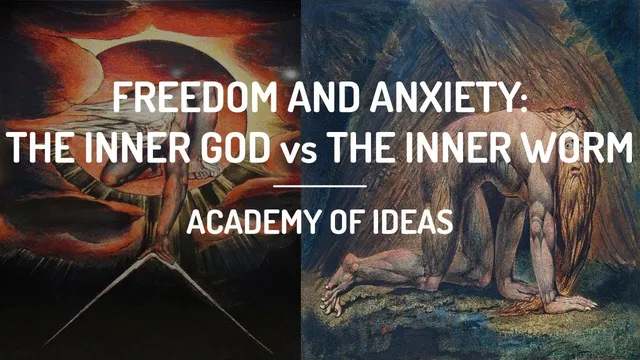
Freedom and Anxiety - The Inner God vs The Inner Worm
Based on Academy of Ideas's video on YouTube. If you like this content, support the original creators by watching, liking and subscribing to their content.
Psychological freedom requires imagining constructive possibilities and acting on them, but it also introduces uncertainty that can trigger anxiety.
Briefing
People are pulled between two inner forces: an “inner god” that fuels imagination and symbolic awareness, and an “inner worm” that fears psychological freedom and narrows life into familiar, limited routines. The central claim is that many people don’t merely struggle with this tension—they end up letting fear govern. Psychological freedom means seeing constructive possibilities and acting on them, but the ability to imagine the future also makes uncertainty unavoidable. That uncertainty is where anxiety attaches, turning the pursuit of the possible into a source of dread rather than liberation.
The transcript links freedom and anxiety directly: anxiety follows freedom “as its shadow.” When people project forward, they become aware of better ways to live—yet they can never know whether their choices will lead to salvation or suffering. Lacking omniscience, they face a choice without guarantees. That gap between desire and dread produces an inner conflict, described through Kierkegaard as the essence of anxiety. Rollo May’s framing reinforces the idea that the mind tries to protect itself from this discomfort, especially when freedom requires responsibility for outcomes.
To manage that anxiety, Erich Fromm argues that people use “mechanisms of escape.” These strategies reduce the burden of choice by seeking submission—often in ways that look moral, respectable, or socially sanctioned. Fromm’s concept of masochism is central here, particularly “moral masochism,” a form of self-betrayal that can involve longing for humiliation, belittlement, and suffering. The transcript treats this not as a sexual fixation but as a psychological maneuver: submission to a powerful other—an external god, church, nation, state, leader, ideology, company, partner, drug, or inner compulsion—becomes a way to hand over the “reigns” of one’s soul.
The consequences are both personal and political. Fromm describes moral masochism as ruinous to psychological health because dependency infantilizes people and normalizes “chains.” Rollo May adds that societies can form around the same fear of freedom, making authoritarian rule feel like the only escape. The transcript also highlights a subtler route: obedience to the tyranny of the majority. By identifying so thoroughly with what society calls normal, people avoid committing to their own principles and values. The result is a loss of self and the rise of automatons who punish deviation and enforce the status quo.
The proposed remedy is to rebuild the capacity to bear anxiety without fleeing into submission. Kierkegaard’s prescription is to recognize that pursuing the possible always involves risk, and that choosing venturing into the unknown is better than clinging to safety. By repeatedly taking that risk, people expand their comfort zone, develop resilience after failure, and cultivate courage, self-reliance, independence, and self-respect. The transcript closes with a stark choice: embrace the inner god through courageous venturing, or let the inner worm drive people toward cowardice and the search for a master—because the greatest suffering falls not on the bold, but on those who refuse to act.
Cornell Notes
The transcript frames human life as a tug-of-war between an “inner god” and an “inner worm.” The inner god supports imagination and symbolic awareness, enabling people to envision possibilities and experience psychological freedom. Anxiety arises because freedom requires acting without certainty: people can imagine better futures but cannot guarantee outcomes. To escape that anxiety, Erich Fromm argues that people adopt “mechanisms of escape,” including moral masochism—submitting to a powerful other or to social norms like obedience to the majority. The alternative is to “reignite the god within” by venturing into the unknown, accepting risk, and building courage and self-respect through resilient action.
Why does psychological freedom trigger anxiety instead of relief?
What are “mechanisms of escape,” and how do they relate to moral masochism?
How does moral masochism harm individuals and societies?
What does “obedience to the tyranny of the majority” look like in practice?
What does the transcript recommend as a path out of the cycle of fear and submission?
Review Questions
- How does the transcript connect uncertainty about outcomes to the experience of anxiety after imagining possibilities?
- In what ways can “mechanisms of escape” operate without an obvious authoritarian leader?
- What personal skills or virtues does the transcript say develop through repeated “venturing” into the unknown?
Key Points
- 1
Psychological freedom requires imagining constructive possibilities and acting on them, but it also introduces uncertainty that can trigger anxiety.
- 2
Anxiety is portrayed as inseparable from freedom because people can’t know whether their choices will lead to salvation or suffering.
- 3
Erich Fromm’s “mechanisms of escape” describe how people reduce the stress of choice by seeking submission to a powerful other.
- 4
Moral masochism is framed as a psychological strategy for avoiding the anxieties of freedom, not merely a sexual phenomenon.
- 5
Submission can be overt (to leaders, states, ideologies) or covert (through obedience to the tyranny of the majority).
- 6
Both dependency and social conformity erode selfhood, weaken independence, and can enable authoritarian or status-quo enforcement.
- 7
The proposed remedy is to “venture” into the unknown—accepting risk to build resilience, courage, and self-respect rather than fleeing into a master.