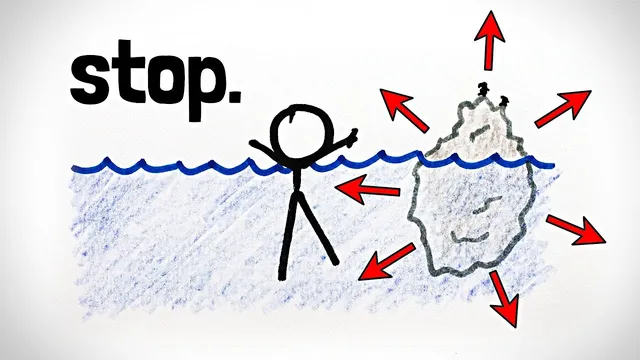
Freezing water expands. What if you don't let it?
Based on minutephysics's video on YouTube. If you like this content, support the original creators by watching, liking and subscribing to their content.
Freezing water in a rigid container raises pressure because ice expands relative to liquid, and that pressure feeds back on phase stability.
Briefing
Freezing water inside a rigid, super-strong container doesn’t create a true “freeze-or-melt” paradox—it drives the system along water’s phase diagram, where pressure rises as ice forms and eventually changes which solid phase can exist. The key idea is that freezing generates pressure because ice expands relative to liquid water; if the container can’t bulge, that expansion compresses the remaining liquid. Compression, in turn, favors melting at sufficiently high pressure, so the process self-regulates instead of flipping endlessly between solid and liquid.
At ordinary atmospheric pressure, cooling water below 0°C turns it from liquid to solid. But water’s phase behavior is pressure-dependent: the phase diagram shows that at around −4°C and atmospheric pressure, water is solid, yet increasing pressure can push solid water back toward a liquid state. That sets up the apparent contradiction: if water is cooled below 0°C while trapped under extreme pressure, the liquid should freeze; but once ice forms and expands, the pressure should rise enough to melt it again—suggesting it can’t settle.
The resolution comes from recognizing that freezing can proceed only until the pressure generated by expansion becomes large enough to stop further freezing at that temperature. As the container cools, a small fraction of the water freezes first. Those newly formed ice regions expand, pressurizing the container. When the pressure reaches the threshold indicated by the liquid–solid boundary on the phase diagram, additional liquid can no longer freeze at that same temperature. If the container is cooled further, more of the water can freeze, again expanding and again raising pressure until the new equilibrium point is reached. In effect, the system tracks a path of colder temperatures and higher pressures, with the fraction of ice increasing step-by-step as cooling continues.
Whether the container ever becomes completely solid depends on the phase diagram at sufficiently high pressure. At low enough temperature and high enough pressure, the remaining liquid doesn’t just freeze into ordinary ice; it can transform into a different high-pressure solid called ice III. Ice III contracts and becomes denser when it freezes, which reduces the space it occupies compared with the liquid. That density change allows the container to accommodate more solidification, ultimately permitting the entire sample to freeze solid—though the final mix may include both normal ice (ice Ih) and ice III.
So the “non-binary” behavior isn’t that water alternates between freezing and melting forever. Instead, the equilibrium phases shift continuously with temperature and pressure, and the material can end up fully solid once the pressure is high enough to access new ice structures. The paradox dissolves into phase transitions governed by thermodynamics, not a simple one-to-one rule of “cooling means freezing” or “expansion means melting.”
Cornell Notes
Cooling water in a rigid, non-expanding container forces pressure to rise as ice forms, because freezing involves expansion. Higher pressure can favor melting, so freezing stops partway through: only the fraction of water that can freeze without exceeding the liquid–solid pressure threshold at that temperature will solidify. As the container cools further, more ice forms, and the system follows the phase boundary toward colder temperatures and higher pressures. At sufficiently high pressure, the remaining liquid can freeze into a denser high-pressure phase, ice III, allowing the sample to become fully solid (with a mixture of ice Ih and ice III).
Why does freezing water in a rigid container not immediately lead to runaway melting or runaway freezing?
How does the phase diagram resolve the “freeze while compressed” contradiction?
What determines the fraction of ice vs liquid during gradual cooling?
Does the container necessarily end up completely frozen?
Why does ice III matter for full solidification?
Review Questions
- If a rigid container prevents volume change, what physical quantity rises as ice forms, and how does that affect the next increment of freezing?
- How does following the liquid–solid boundary on water’s phase diagram explain why freezing can proceed only partially at a given temperature?
- What role does ice III play at high pressure, and why is it different from ice Ih in terms of density/volume change?
Key Points
- 1
Freezing water in a rigid container raises pressure because ice expands relative to liquid, and that pressure feeds back on phase stability.
- 2
High pressure can favor melting of solid water at certain subzero temperatures, so freezing stops once the pressure reaches the liquid–solid equilibrium threshold.
- 3
As cooling continues, the ice fraction increases while the system tracks the liquid–solid boundary toward colder temperatures and higher pressures.
- 4
Complete solidification becomes possible only when pressure and temperature are high enough to access a denser high-pressure solid phase.
- 5
At sufficiently high pressure, the remaining liquid can freeze into ice III, which contracts on freezing and allows the sample to solidify fully.
- 6
The outcome is not an endless flip between freezing and melting; it’s a sequence of equilibria with changing ice phases.