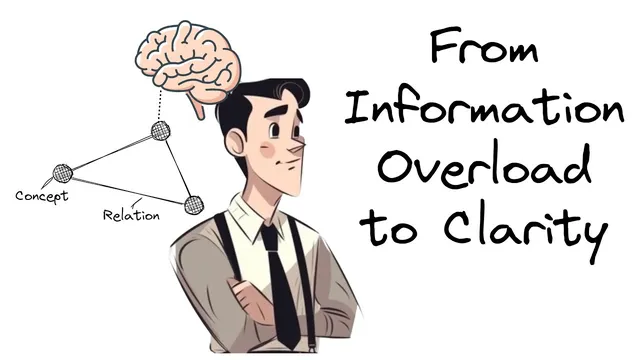
From Information Overload to Clarity: How Visual Thinking Can Help You Organize Your Thoughts
Based on Zsolt's Visual Personal Knowledge Management's video on YouTube. If you like this content, support the original creators by watching, liking and subscribing to their content.
Visual thinking helps manage information overload by converting language-heavy inputs into external concept maps and drawings.
Briefing
Visual thinking turns information overload into clarity by forcing the mind to externalize ideas as simple concept maps and drawings—making complex relationships easier to understand, remember, and communicate. In the story, Joe works in a high-pressure environment where emails, messages, calls, and back-to-back meetings constantly bombard him. His brain keeps converting incoming streams of words into propositions—building interconnected mental maps that form a “web of knowledge.” That mental mapping helps him make sense of what he reads and hears, but the volume quickly becomes overwhelming.
The turning point comes when Joe uses visual thinking to offload that internal web onto paper. Instead of trying to hold everything as abstract language, he sketches diagrams that capture key concepts and their connections. The result is faster comprehension and deeper understanding, because the relationships between ideas become visible rather than buried in sentence-by-sentence processing. The next day, while talking with his friend Sarah at Starbucks, Joe demonstrates the approach by quickly drawing a simple diagram on a napkin to explain a difficult concept from an online course. Sarah’s reaction—impressed by how clearly Joe can translate complexity into a visual—reinforces the practical payoff: visual summaries make learning stick and make explanations easier.
That clarity then feeds directly into Joe’s work life. He anticipates using visual aids to present complex information to his team, helping others understand and retain important details. The story frames visual thinking as both a productivity tool and a creative one: it reduces cognitive strain, strengthens connections between new and existing knowledge, and gives people a repeatable way to communicate ideas.
The transcript also shifts from the comic-book narrative to a behind-the-scenes account of how the creator built the video using AI tools. The workflow begins with finding an existing explanation of visual thinking and using its script as a starting point, then rewriting it for readability and originality. AI-assisted steps include generating a comic-style outline, producing multiple title options, and drafting the final script. Because proposition theory can be prone to errors, the creator performs fact checking before finalizing the script.
For visuals, the creator generates a consistent character using Midjourney by first creating a character sheet and then splitting it into multiple images to place the character across different scenes. Image editing tools like Lunapic and PhotoRoom are used for background removal and cropping, while Excalidraw assembles the final layout. Animation is created with a slideshow workflow, and design elements are added using tools such as a color picker and icon assets.
Overall, the message lands on two linked ideas: visual thinking helps people manage cognitive overload by turning language into structured visuals, and AI can support that creative process when treated as a tool rather than something to blindly follow. The transcript promotes a “visual thinking workshop” cohort that teaches participants to build “a book on a page” summaries—aimed at applying the method to any topic.
Cornell Notes
The core claim is that visual thinking reduces information overload by converting streams of language into external concept maps and drawings. In the story, Joe’s brain naturally builds “propositions” and a web of interconnected ideas, but the volume becomes overwhelming. Sketching diagrams lets him externalize those relationships, improving comprehension, memory, and the ability to explain complex concepts quickly. The transcript then adds a practical layer: the creator used AI-assisted drafting, fact checking, and image generation to produce a comic-style explanation, arguing that AI boosts creativity and efficiency when used intentionally. The workshop pitch ties the method to a concrete deliverable: building “a book on a page” summaries for any topic.
What mental mechanism does the transcript use to explain how people make sense of information?
Why does visual thinking help when proposition-based understanding becomes overwhelming?
How does the napkin-diagram moment function as evidence for the method?
What changes in Joe’s work life after adopting visual thinking?
What AI-assisted workflow details are included, and what purpose do they serve?
What warning about AI use is emphasized alongside the visual thinking message?
Review Questions
- How does proposition theory connect to the idea of building a “web of knowledge,” and where does overload enter the process?
- In what ways does externalizing ideas as drawings change comprehension compared with relying on internal language processing?
- Which specific production steps in the transcript rely on AI, and how do those steps support the final comic-style explanation?
Key Points
- 1
Visual thinking helps manage information overload by converting language-heavy inputs into external concept maps and drawings.
- 2
Proposition theory is used as the underlying model for how meaning forms: subject–predicate relationships become interconnected propositions.
- 3
Externalizing ideas makes relationships between concepts easier to see, which improves comprehension and memory.
- 4
Clear visuals also improve communication, enabling faster explanations of complex topics to others.
- 5
The transcript links the learning method to a workshop goal: producing “a book on a page” summaries for any topic.
- 6
AI is presented as a practical production accelerator—useful for drafting, outlining, and generating visuals—when paired with fact checking and human editing.
- 7
Blindly following AI is discouraged; intentional use is framed as the difference between creative leverage and passive dependence.