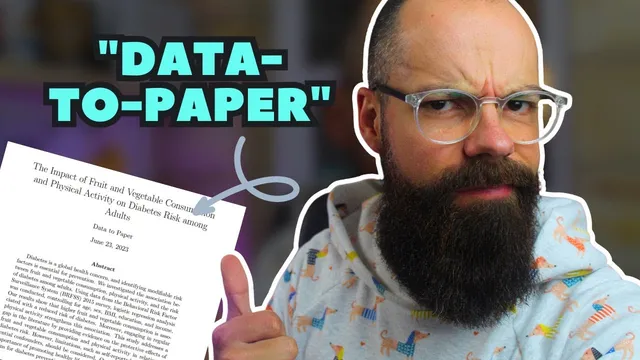
Fully Autonomous AI research: Data to paper with ChatGPT?
Based on Andy Stapleton's video on YouTube. If you like this content, support the original creators by watching, liking and subscribing to their content.
The “fully autonomous” framing overstates what’s described: code generation required error correction and outputs needed close human monitoring to avoid false claims.
Briefing
A widely shared claim that “data to paper” autonomous AI research is already real—complete with multiple reproducible papers generated end-to-end—collides with the messy reality of novelty, citations, and statistical integrity. The diabetes-focused study credited to AI automation looks credible on the surface, but it largely reproduces well-known findings, offers limited and sometimes outdated referencing, and raises concerns about how easily errors, hallucinations, and selective reporting could slip through.
The chain-of-prompts workflow described for the project uses a large language model (via ChatGPT) plus Python to move step-by-step from analysis outputs to tables, narrative explanations, and paper sections such as the introduction and literature review. The team reportedly worked from a dataset of 253,000 survey respondents tied to diabetes health indicators, then produced five “transparent reproducible” papers. Yet the details don’t match the tweet’s impression of fully hands-off autonomy. The code reportedly required iterative correction after an initial attempt produced errors, and the researchers acknowledged the need for close monitoring to avoid “complete lies.”
When the resulting paper is examined, it reads like a standard epidemiology write-up—introduction, methods, descriptive statistics, results tables, discussion, and supplementary material including data exploration and code outputs. But the substance appears thin relative to what would be expected for a system supposedly capable of outperforming human researchers. The paper’s framing emphasizes protective effects of fruit and vegetable consumption and physical activity, but it doesn’t surface surprising or novel relationships. A comparison to a typical 2019 paper in the field highlights the gap: the AI-generated work uses only 10 references, while a conventional paper uses more (and tends to include more up-to-date citations).
Citations are another weak point. A citation-checking pass suggests the reference list contains poorly cited items, journal bias, and several older sources—consistent with the limitations of ChatGPT’s knowledge cutoff (September 2021) and its tendency to hallucinate plausible-sounding papers. Even if the citation list is “mostly okay,” the risk remains that unverifiable or fabricated references could pass initial screening unless every citation is checked.
Finally, the approach increases the temptation for p-hacking. With large datasets and many possible hypotheses, it becomes easier to run numerous tests and report only the statistically significant ones, inflating false positives. That means editors and peer reviewers would need to be especially vigilant when AI-assisted analysis is involved.
Overall, the “fully autonomous” promise appears overstated. AI can function as a capable co-pilot—helping clean data, draft sections, and accelerate research writing—but the path from data to a peer-review-ready, genuinely novel paper still depends on human oversight, domain intuition, and rigorous verification of results and references.
Cornell Notes
The diabetes study credited to “data to paper” autonomy uses a stepwise ChatGPT + Python prompting workflow on a dataset of 253,000 survey respondents. While the output looks like a normal epidemiology paper and includes code and supplementary material, it offers limited novelty and relies on only 10 references—many of them older. Citation quality is inconsistent, with risks tied to large language model knowledge cutoffs and hallucinated references. The workflow also raises statistical integrity concerns, especially p-hacking, because large datasets make it easier to test many hypotheses and selectively report significant results. The takeaway: AI can accelerate research writing and analysis, but peer-review-grade autonomy still requires careful human checking.
What does “data to paper autonomous AI research” claim, and what workflow details contradict full autonomy?
Why does the diabetes paper look publishable at first glance, yet still fall short for peer review?
How do reference count and recency affect credibility in this case?
What specific citation problems are highlighted, and why do they matter?
How does p-hacking become more likely in AI-assisted analysis of large datasets?
Where does the argument land on AI’s role in research—replacement or co-pilot?
Review Questions
- What evidence suggests the workflow required human oversight rather than true end-to-end autonomy?
- Which weaknesses—novelty, citation quality, or statistical integrity—pose the biggest risk to peer review, and why?
- How does the combination of large datasets and rapid hypothesis generation increase the likelihood of p-hacking?
Key Points
- 1
The “fully autonomous” framing overstates what’s described: code generation required error correction and outputs needed close human monitoring to avoid false claims.
- 2
The diabetes paper’s structure looks standard, but it appears to deliver limited novelty rather than surprising, field-shifting findings.
- 3
A low reference count (10) and apparent lack of recent sources reduce the paper’s competitiveness against typical peer-reviewed epidemiology work.
- 4
Citation errors and the risk of hallucinated references mean every citation must be checked manually before submission.
- 5
Large-dataset, AI-assisted workflows increase the risk of p-hacking because many hypotheses can be tested and only significant results reported.
- 6
AI is best treated as a co-pilot for accelerating analysis and writing, not as a replacement for domain expertise and rigorous verification.