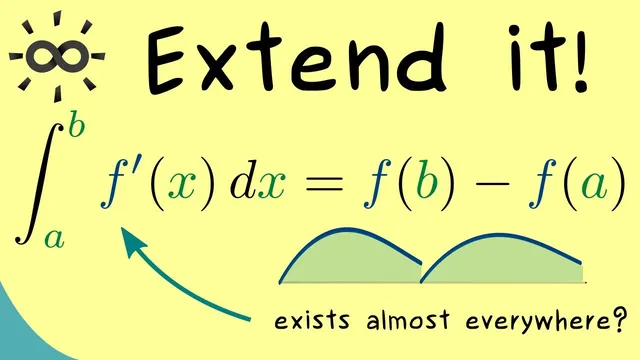
Fundamental Theorem of Calculus | Expansion of the Theorem
Based on The Bright Side of Mathematics's video on YouTube. If you like this content, support the original creators by watching, liking and subscribing to their content.
The classical identity ∫_a^b f′(x) dx = f(b) − f(a) requires more than continuity and almost-everywhere differentiability.
Briefing
The fundamental theorem of calculus can be extended far beyond continuously differentiable functions—but only up to a precise boundary. For functions that are merely continuous or even “almost everywhere differentiable,” the usual integration–differentiation identity can fail. The key takeaway is that the theorem holds exactly for absolutely continuous functions, which sit between continuous and continuously differentiable in strength.
Start with the classical setting: if a function f is continuously differentiable on a compact interval [a,b], then the integral of f′ from a to b equals f(b) − f(a). The transcript emphasizes why this works: integration and differentiation “cancel” in the sense that an antiderivative turns the integral into a boundary term. It also notes that the same conclusion survives when using the Lebesgue integral (often written as the LEC/LEC integral in the transcript) instead of the Riemann integral, since both agree whenever the Riemann integral exists.
From there, the assumptions get weakened in stages. First, f′ need not exist everywhere: because changing a function on a set of measure zero does not affect the Lebesgue integral, it is enough for f′ to exist almost everywhere (i.e., the set of points where it fails has measure zero). A simple counterexample shows why this still isn’t enough: take a step function that equals 0 up to x=1 and jumps to 1 afterward. Its derivative exists almost everywhere and is 0 where defined, so the integral of f′ from 0 to 1 is 0. But f(1) − f(0) equals 1, so the fundamental theorem fails.
Even continuity doesn’t rescue the situation. The transcript describes a “Cantor-function”-type construction: a function that is continuous, monotonically increasing, and differentiable almost everywhere with derivative 0 almost everywhere, yet still rises from 0 to 1. That combination forces the integral of f′ to stay 0 while the boundary difference is 1—again breaking the theorem. The lesson is sharp: continuity plus almost-everywhere differentiability is not sufficient.
The next improvement is to require more regularity of the derivative. Piecewise continuous differentiability is enough: split [a,b] into finitely many subintervals where f is continuously differentiable, apply the classical theorem on each piece, and the resulting expressions telescope. This yields the same boundary identity because only the first and last terms survive, while interior terms cancel.
Finally, the transcript pushes to the maximal extension. It frames the fundamental theorem as an equivalence condition: for a given f, if the identity ∫_a^c f′(x) dx = f(c) − f(a) holds for every c in [a,b] (with the integral of f′ existing), then f must be absolutely continuous. Conversely, every absolutely continuous function satisfies the theorem. Under this characterization, the Cantor-function example fails precisely because it is not absolutely continuous, even though it is continuous and differentiable almost everywhere.
Cornell Notes
The classical fundamental theorem of calculus holds for continuously differentiable functions: ∫_a^b f′(x) dx = f(b) − f(a). Weakening the hypotheses quickly breaks the identity. A step function has f′ = 0 almost everywhere, yet f(b) − f(a) is nonzero, so the theorem fails. A Cantor-function-type example is continuous and differentiable almost everywhere with derivative 0 almost everywhere, but it still increases from 0 to 1, again contradicting the theorem. The identity does hold under stronger “piecewise C¹” conditions and, in the maximal form, holds exactly for absolutely continuous functions—those for which the boundary identity works for every subinterval endpoint c.
Why does “f′ exists almost everywhere” still not guarantee the fundamental theorem of calculus?
How can a continuous, monotone function still violate the theorem even when f′ = 0 almost everywhere?
What additional structure makes the theorem work again?
What is the “maximal extension” criterion described for when the theorem holds?
Why does the maximal criterion lead specifically to absolutely continuous functions?
Review Questions
- Give an example of a function that is differentiable almost everywhere but still fails the fundamental theorem of calculus. What goes wrong?
- Explain why the Cantor-function-type example breaks the theorem despite having derivative 0 almost everywhere.
- What does it mean for the fundamental theorem to hold “for every c in [a,b],” and why is that stronger than checking a single endpoint?
Key Points
- 1
The classical identity ∫_a^b f′(x) dx = f(b) − f(a) requires more than continuity and almost-everywhere differentiability.
- 2
Lebesgue integration allows f′ to fail on measure-zero sets without changing ∫ f′, so “a.e. existence” alone is not enough.
- 3
A step function shows the theorem can fail: f′ can be 0 almost everywhere while f(b) − f(a) is nonzero.
- 4
A Cantor-function-type example shows continuity plus f′ = 0 almost everywhere can still produce a nonzero boundary change.
- 5
Piecewise C¹ regularity restores the theorem because applying it on finitely many subintervals yields a telescoping sum.
- 6
The maximal characterization: the fundamental theorem holds exactly for absolutely continuous functions, equivalently when ∫_a^c f′ = f(c) − f(a) for every c in [a,b].