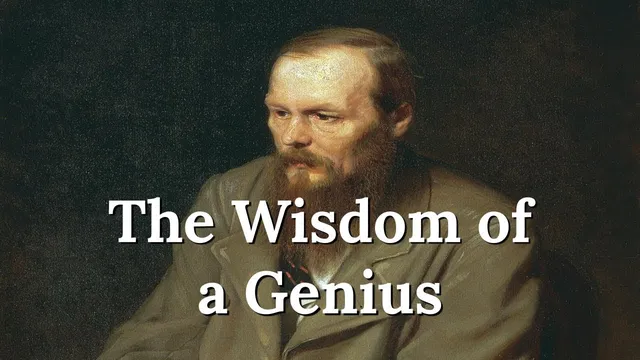
Fyodor Dostoevsky – The Wisdom of a Genius
Based on Academy of Ideas's video on YouTube. If you like this content, support the original creators by watching, liking and subscribing to their content.
Dostoevsky’s psychological realism is tied to lived experience: arrest, solitary confinement, a mock execution, and four years in Siberia.
Briefing
Fyodor Dostoevsky’s breakthrough into unmatched psychological realism traces back to a five-year descent that stripped him of comfort, then rebuilt his inner life through terror, confinement, and brutal observation of human nature. Arrested in 1849 after the Petrashevsky Circle—an intellectual debate group that Russia’s government increasingly treated as a threat—was infiltrated and cracked down on, Dostoevsky endured solitary confinement in the Peter and Paul Fortress, a mock execution, and a four-year Siberian prison sentence. The ordeal didn’t just change his circumstances; it gave him direct, lived knowledge of how people behave when death is near, when power becomes corrupting, and when meaning and hope are stripped away.
Before the arrest, Dostoevsky had tasted fame with Poor Folk, but critics and the public largely dismissed his later work. The Petrashevsky Circle, named after its host, discussed political and social ideas shaping Russia and Europe. As revolutions spread across Europe in 1848, the Russian ruling class tightened control over speech. The circle was infiltrated by secret police, and in April 1849 members were rounded up. Dostoevsky was held in solitary confinement for six months, where he learned to adapt to conditions he initially believed would kill him. In prison letters, he described “infinite reserves” of toughness and vitality—an idea that later became central to his understanding of resilience.
In September 1849, the inquiry concluded the group showed opposition to the government and a desire to change the existing order. Dostoevsky and fourteen others were taken to Semenovsky Square and sentenced to immediate death by firing squad. In shock, he told a condemned atheist, “We shall be with Christ.” Moments later, the sentence was commuted—after the condemned had already been made to experience the machinery of execution. The psychological impact became a template for his fiction, including the “mystic terror” he later dramatized in The Idiot, where a man facing death divides his final minutes between farewell, inward meditation, and a last look at the world.
Siberia deepened the lessons. Dostoevsky observed that humans acclimate to even the harshest conditions, encapsulated in his prison writing Notes from a Dead House: “Man is a creature who gets used to everything.” He also learned that physical crowding can coexist with profound psychological solitude, forcing an intense self-scrutiny that he came to value. Prison life sharpened his view of evil: guards who began as “normal decent men” were warped by the unlimited power they held over prisoners, turning tyranny into habit and cruelty into something that can become “sweet to the mind.” Yet the same environment revealed goodness too—beneath rough exteriors, prisoners could display moral integrity and sudden, involuntary flashes of compassion and understanding.
Beyond character and cruelty, prison taught him the psychology of meaning. He argued that pointless labor can crush sanity; he even offered a thought experiment about forcing prisoners to perform utterly useless tasks. Decades later, a Nazi camp survivor described exactly that kind of “sand to and fro” work, where the lack of purpose drove people toward breakdown, violence, and death. Hope mattered as well: when prisoners lost belief in a better future, despair could tip into madness or self-destructive martyrdom.
Dostoevsky’s ordeal also intersected with his lifelong nervous disorders—social anxiety, hypochondria, and panic—yet he later claimed the prison experience cured his neurotic tendencies. The central takeaway is stark: suffering, when it strips away ease and forces confrontation with adversity, can refine a person’s capacity for endurance, moral perception, and psychological insight—making the later novels possible.
Cornell Notes
Dostoevsky’s most influential psychological insight is rooted in a five-year ordeal that began with his arrest in 1849 and culminated in four years of Siberian imprisonment. After the Petrashevsky Circle was targeted by Russia’s secret police, he faced solitary confinement, a mock execution, and a death sentence commuted at the last moment. In prison, he learned how quickly humans adapt to harsh conditions, how power corrupts into cruelty, and how meaning and hope are essential to mental survival. He also connected the experience to his own nervous disorders, later claiming the ordeal cured his earlier anxieties. Those lessons became the emotional and moral engine behind works like Crime and Punishment and The Brothers Karamazov.
What chain of events led to Dostoevsky’s arrest in 1849?
How did the mock execution and commutation shape Dostoevsky’s psychological understanding?
What did prison teach about human nature—both evil and goodness?
Why did Dostoevsky treat meaning and hope as psychological necessities?
How did the ordeal relate to Dostoevsky’s nervous disorders?
Review Questions
- Which specific experiences in 1849–1854 most directly informed Dostoevsky’s later depiction of fear, adaptation, and moral transformation?
- How does Dostoevsky connect power to cruelty, and what mechanism turns authority into a “habit”?
- What role do meaning and hope play in his account of psychological survival, and how do the examples illustrate that claim?
Key Points
- 1
Dostoevsky’s psychological realism is tied to lived experience: arrest, solitary confinement, a mock execution, and four years in Siberia.
- 2
Russia’s crackdown on the Petrashevsky Circle followed broader European revolutions and a shift toward censorship and secret-police infiltration.
- 3
The commuted death sentence produced a lasting psychological pattern—“mystic terror”—later reflected in his fiction.
- 4
Prison revealed two linked truths: people acclimate to harsh conditions, and power can corrupt ordinary men into cruelty.
- 5
Dostoevsky argued that pointless labor and the removal of meaning can drive people toward madness, a claim echoed by later accounts from Nazi camps.
- 6
Hope and purpose function as mental lifelines; when they collapse, despair can turn into violence or self-destructive martyrdom.
- 7
After Siberia, Dostoevsky claimed the ordeal cured his earlier nervous disorders, suggesting suffering can refine resilience rather than only destroy it.