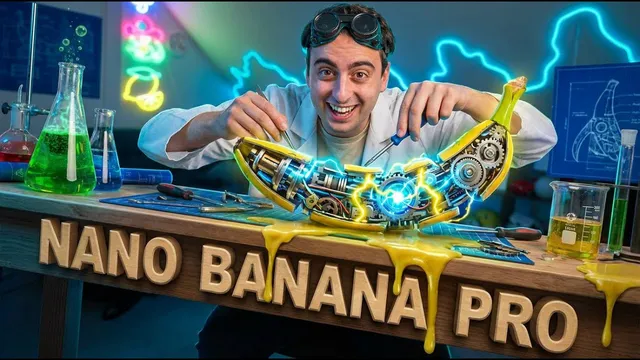
Gemini 3 Is Cool… But Nano Banana Pro Is TERRIFYING
Based on MattVidPro's video on YouTube. If you like this content, support the original creators by watching, liking and subscribing to their content.
Invido offers unlimited Nano Banana Pro generations for one year if a user subscribes to any plan within seven days.
Briefing
Nano Banana Pro (Nano Banana 2) is being pitched as a step-change in AI image generation—especially for consistency, reference handling, and high-detail output—while also arriving with a limited-time “unlimited free generations for one year” offer via Invido. The practical hook is simple: subscribe to an Invido plan within seven days to unlock unlimited access to Nano Banana Pro, potentially enough prompts to bridge the gap until Nano Banana 3. The larger claim is that this model is more consistent than competing image generators, better at honoring references (characters, styles, and text), and capable of producing both cinematic realism and highly stylized, never-before-seen graphics.
Early testing highlights how well Nano Banana Pro follows complex prompts that mix style, characters, and scene logic. In one example, Mario and Sonic play ping-pong in outer space with associated visual motifs—flaming paddle energy, rings, and coins—despite those details not being explicitly requested. The model also handles “earthy” cinematic realism, producing purposeful lighting and believable texture work in scenes like an overgrown, old-fruit-and-crates environment. Where other models might drift, Nano Banana Pro is described as understanding references and maintaining character identity across generations, with only minor imperfections when zoomed in.
Creativity is another major theme. The model can generate steampunk “time machine” diagrams with named components (including a flux-capacitor-like element) and coherent visual storytelling. It also produces sci-fi “perpetual motion” concepts (even when the premise is physically impossible), and it can translate a chaotic, security-camera-style GTA 5 aesthetic into a Shrek-and-Donkey robbery scene—complete with period-appropriate framing and unprompted mission-style text like “mission failed.” At the same time, the model’s tendency toward literal interpretation shows up in a tourist-selfie example: when asked for a selfie vibe, it inserts a phone-holding pose rather than the intended “taking the picture” moment, implying users must specify such details carefully.
Resolution and workflow improvements are tested through 4K generations. The model can output images that download as large files (around 22MB in one case), with sharpness that the tester says is “absolutely worth it,” especially for fine environmental detail like mushroom textures and small moving elements (snails). Text quality, however, does not meaningfully improve at 4K; it still renders text in a typical way, suggesting the model’s strength is imagery fidelity rather than typography.
Reference-based editing and character fidelity also get attention. Uploading a photo of a one-armed man is said to preserve the defining feature, and uploading a cat image is used to demonstrate lens-distortion correction—expanding to the requested aspect ratio while fixing wide-angle bowing. The model is further framed as a foundation for downstream AI video creation: build scenes in Nano Banana Pro, then animate them with image-to-video tools.
Finally, community outputs are showcased as proof points: sprite sheets for 2D animation, pixel-art Pokémon-style screenshots, “burger test” ingredient cutaways, and infographic-style explanations (including a Fermy paradox breakdown). The overall takeaway is that Nano Banana Pro is positioned as a new benchmark for image generation—strong on coherence, detail, and consistency—while still constrained by filters around copyrighted or celebrity-like content. The tester’s closing message: the limiting factor is increasingly imagination, not capability, and the model’s current access window makes it a practical time to experiment before Nano Banana 3 arrives.
Cornell Notes
Nano Banana Pro (Nano Banana 2) is presented as a major leap in AI image generation, with standout performance in character/style consistency, reference handling, and high-detail output up to 4K. Testing emphasizes that it can follow complex prompts—mixing cinematic realism, specific franchises’ visual cues, and even diagram-like sci-fi concepts—while sometimes being overly literal (e.g., inserting a phone-holding pose when “tourist selfie” is requested). 4K improves sharpness and environmental detail, but text quality doesn’t noticeably get better. The model also supports image-based workflows, including correcting lens distortion from an uploaded photo and preserving distinctive features like a one-armed subject. Community creations suggest it can feed into animation and infographic use cases, making it a versatile “scene builder” for later video generation.
What makes Nano Banana Pro feel different from other image generators in day-to-day use?
How does the model handle complex, multi-part prompts (and where does it fail)?
What does 4K change, and what doesn’t it fix?
How well does Nano Banana Pro work with uploaded images and edits?
What community-created outputs suggest about the model’s broader potential?
Why do filters matter even when the model is highly capable?
Review Questions
- When would you need to add extra prompt detail because Nano Banana Pro is likely to interpret something literally?
- What improvements does 4K provide according to the testing, and why might text still look weak at higher resolution?
- How do uploaded-image workflows (like lens distortion correction) change the kinds of results you can reliably produce?
Key Points
- 1
Invido offers unlimited Nano Banana Pro generations for one year if a user subscribes to any plan within seven days.
- 2
Nano Banana Pro is described as more consistent than other image generators, with stronger character and reference handling.
- 3
Complex prompts can combine cinematic realism, franchise-like visual cues, and diagram-style sci-fi components in a single generation.
- 4
The model’s literal interpretation can surprise users (e.g., “tourist selfie” producing a phone-holding pose), so action/pose details may need to be explicit.
- 5
4K output significantly increases sharpness and environmental detail, but text quality does not noticeably improve.
- 6
Uploaded references can be used for feature preservation (e.g., one-armed subject) and for editing tasks like wide-angle lens distortion correction.
- 7
Community examples suggest the model can support sprite-sheet animation workflows and infographic-style explanations, not just standalone images.