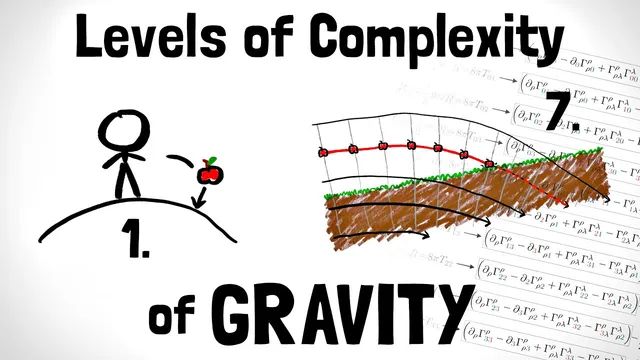
General Relativity Explained in 7 Levels of Difficulty
Based on minutephysics's video on YouTube. If you like this content, support the original creators by watching, liking and subscribing to their content.
General relativity treats gravity as the curvature of spacetime caused by matter and energy, not as a standalone force.
Briefing
General relativity reframes gravity not as a conventional force but as the geometry of spacetime: matter and energy shape spacetime’s curvature, and objects move along the “straightest possible” paths in that curved geometry. The payoff is practical as well as conceptual—Einstein’s equations generate precise predictions for real systems, from Mercury’s orbit to black hole mergers—while also offering a clear explanation for why gravity feels like a pull on Earth.
At the core is the idea that space and time form a single four-dimensional structure called spacetime, described mathematically as a pseudo-Riemannian manifold with Lorentzian signature. In this picture, spacetime is locally flat in small regions, meaning it obeys the rules of special relativity: the speed of light is finite, time dilation and length contraction occur, and velocities combine in the special-relativistic way. The “curving” that matters is global—how spacetime’s geometry changes from place to place—much like a globe looks flat only when you’re close enough.
Gravity emerges when two ingredients work together. First, spacetime curvature is real and constrained: it must be compatible with local special-relativistic physics. Second, matter and energy don’t just sit inside that geometry; they follow motion laws that make free-fall trajectories correspond to straight lines through curved spacetime. That combination is what distinguishes general relativity from a purely geometric story.
The link between what’s inside spacetime and how spacetime bends is encoded in the Einstein Field Equations. These are ten nonlinear, second-order differential equations that must be solved to predict both (1) how spacetime curves and (2) how matter, radiation, pressure, energy, momentum, and particles move in response. For isolated massive objects—like the Sun, Earth, or black holes—solutions describe gravitational behavior such as orbital motion with high accuracy. The same framework scales up to the universe as a whole, enabling models of cosmic history and evolution.
The theory’s success shows up across a wide range of tests. Observations include Mercury’s orbital precession, the Moon’s gradual orbital drift, gravitational lensing and redshift of starlight, time dilation measured with atomic clocks, and gyroscope precession around Earth. Cosmological and extreme-field checks add measurements of the cosmic microwave background polarization, gravitational-wave detections from black hole mergers, and direct imaging of the Milky Way’s central black hole.
On Earth, the everyday “force” feeling is explained through the equivalence principle. An object’s natural inertial path is the straightest route it can take—toward Earth’s center—while the ground accelerates you away from that path. The sensation of weight is the resistance to maintaining your inertial trajectory. In free fall or orbit, there’s no such acceleration relative to the local inertial motion, so the experience becomes “0 g.”
General relativity also has a major unresolved challenge: it doesn’t naturally incorporate quantum mechanics in extreme regimes. For more than 90 years, physicists have tried to reconcile the two, and while progress exists, a complete unified framework remains out of reach.
Cornell Notes
General relativity replaces gravity-as-a-force with gravity-as-geometry. Spacetime is treated as a pseudo-Riemannian manifold, locally flat like special relativity, but globally curved by matter and energy. The Einstein Field Equations—ten nonlinear, second-order differential equations—connect the energy-momentum content of spacetime to the curvature of spacetime and determine how objects move along “straight” paths in that geometry. This framework produces precise predictions verified by experiments and observations, including Mercury’s orbit, gravitational lensing, atomic-clock time dilation, gyroscope precession, cosmic microwave background polarization, gravitational waves, and black hole imaging. The theory still faces a major gap: it doesn’t fully mesh with quantum mechanics in extreme conditions.
What does it mean that gravity is “curvature of spacetime” rather than a traditional force?
Why must curved spacetime still look like special relativity locally?
How do the Einstein Field Equations connect matter/energy to spacetime curvature and motion?
How does general relativity explain the sensation of weight on Earth?
What kinds of observations have validated general relativity across very different scales?
What remains unsolved about general relativity?
Review Questions
- How does local flatness in curved spacetime preserve the predictions of special relativity?
- What is the role of the energy-momentum tensor in the Einstein Field Equations?
- Why does free fall feel like “0 g” even though gravity is present?
Key Points
- 1
General relativity treats gravity as the curvature of spacetime caused by matter and energy, not as a standalone force.
- 2
Spacetime is modeled as a pseudo-Riemannian manifold with Lorentzian signature, where local regions are flat enough to obey special relativity.
- 3
Objects in free fall follow straightest-possible trajectories through curved spacetime, corresponding to inertial motion.
- 4
The Einstein Field Equations are ten nonlinear, second-order differential equations that determine both spacetime curvature and motion of matter and energy.
- 5
Predictions match a broad set of observations, including Mercury’s precession, gravitational lensing, atomic-clock time dilation, gyroscope precession, cosmic microwave background polarization, gravitational waves, and black hole imaging.
- 6
The equivalence principle explains weight on Earth as the sensation of acceleration away from inertial free-fall paths.
- 7
A full reconciliation of general relativity with quantum mechanics remains an open problem in extreme regimes.