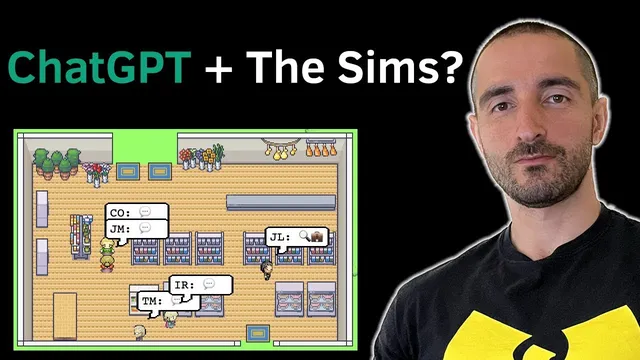
Generative Agents: Simulating Human Behavior with ChatGPT
Based on Venelin Valkov's video on YouTube. If you like this content, support the original creators by watching, liking and subscribing to their content.
Generative agents can produce believable individual routines and emergent social coordination in a shared sandbox without hand-scripting every action.
Briefing
Generative agents built on ChatGPT can simulate believable, goal-driven human behavior inside a small virtual town—without hand-scripting every character action. In a sandbox inspired by The Sims, 25 autonomous agents share a shared environment, maintain memory of what happens, periodically reflect on that experience, and then plan and carry out concrete actions. The result is not just lifelike individual routines, but also emergent social dynamics such as coordination, relationship-building, and group scheduling.
A key demonstration starts with a single user-specified intent: one agent wants to organize a Valentine’s Day party. Over the next two in-game days, the agents autonomously spread invitations, form new acquaintances, ask others out, and coordinate so they arrive at the party at the right time. That chain of events matters because it shows how complex social outcomes can arise from simple starting goals when agents can remember, interpret, and act within an interactive world.
The system’s core architecture is organized into three repeating loops. First comes a memory stream: each agent records observations and events with timestamps. Second comes reflection: agents synthesize recent experiences into higher-order “reflections,” generated periodically when the importance of new events crosses a threshold. Third comes planning and action: agents use those reflections to produce a future sequence of steps—complete with a vocation, start time, and duration—then execute those steps in the environment. This structure is designed to keep behavior consistent over time while still allowing agents to adapt as their circumstances change.
The virtual world is a compact town with places like houses, a college dorm, a grocery store, a park, a bar, and a café. Each agent has an initial identity prompt (occupation, relationships, and seed memories) and then communicates with other agents in natural language. Rather than relying on rigid scripting, the architecture decides whether an agent walks by or engages in conversation based on context. In one example exchange, Tom Moreno and Isabella Rodriguez discuss local politics and personal views, illustrating how agents can sustain dialogue that feels grounded in their established relationships.
A “day in the life” demo follows Isabella Rodriguez, who wakes up early to prepare for the Valentine’s party at Hops Coffee. The timeline shows her running morning routines, working at the café, inviting others, shopping for supplies, creating a checklist, decorating, and setting up music—while other agents pursue their own schedules. The demo ends before the party’s outcome, but the setup demonstrates how memory, reflection, and planning translate a social goal into coordinated real-world-like preparation.
Overall, the approach frames interactive artificial societies as something more than scripted NPCs: it’s a system where agents can remember, reinterpret, and plan, producing both believable daily behavior and emergent group coordination from minimal instructions.
Cornell Notes
Generative agents combine ChatGPT-style language modeling with a structured loop of memory, reflection, and planning to produce human-like behavior in a small sandbox town. Each agent records events in a timestamped memory stream, periodically generates higher-order reflections from important recent experiences, and then plans time-bound actions (including vocation, start time, and duration). Agents also start with identity seed prompts describing occupation and relationships, and they communicate in natural language with nearby agents. A central test begins with one goal—organizing a Valentine’s Day party—and the system produces invitation spreading, new acquaintances, date requests, and coordinated arrival over two in-game days. This matters because it demonstrates complex social outcomes emerging from simple initial intents when agents can remember and adapt.
How does the system turn a single goal into coordinated social behavior over multiple days?
What are the three main components in the generative agent architecture, and what does each do?
How is the virtual world structured, and how does that affect what agents remember?
What role do identity prompts and seed memories play in agent behavior?
How do agents interact with each other—do they follow scripted dialogue?
What does the Isabella Rodriguez demo show about day-to-day planning?
Review Questions
- Explain how memory, reflection, and planning interact to produce consistent behavior over time.
- In the Valentine’s party example, what mechanisms allow invitations and coordination to emerge from a single initial goal?
- Describe how identity seed prompts influence agent conversations and relationships in the sandbox town.
Key Points
- 1
Generative agents can produce believable individual routines and emergent social coordination in a shared sandbox without hand-scripting every action.
- 2
A timestamped memory stream records observations, while periodic reflections synthesize important recent events into higher-order context.
- 3
Planning uses reflections to generate time-bound action sequences (vocation, start time, duration), helping behavior stay coherent across a simulated day.
- 4
Agents begin with natural-language identity prompts and seed memories that define occupation, relationships, and conversational context.
- 5
Agents communicate in natural language and decide dynamically whether to engage or walk by based on local context.
- 6
A single goal—organizing a Valentine’s Day party—can trigger multi-day invitation spreading, relationship formation, and coordinated arrival.
- 7
The demo of Isabella Rodriguez illustrates how a persistent social objective drives shopping, decorating, and scheduling actions across the day.