Geosynchronous Orbits are WEIRD
Based on minutephysics's video on YouTube. If you like this content, support the original creators by watching, liking and subscribing to their content.
Geosynchronous orbits match a satellite’s orbital period to a planet’s rotation period, making the satellite appear fixed relative to the ground.
Briefing
Geosynchronous orbits look like “floating” satellites from Earth because their orbital period matches Earth’s rotation period, locking them in place relative to the ground. That odd combination—moving fast in space while appearing stationary overhead—comes straight from Kepler’s third law: farther orbits take longer, closer orbits take less time. Since orbital period changes continuously with distance, there’s always a radius where the orbital period equals one Earth day, letting a satellite hover over the same patch of sky (with the caveat that only geostationary orbits are perfectly fixed; geosynchronous orbits can drift slightly in latitude/longitude).
The usefulness of this arrangement is practical as well as strange. A satellite that stays above roughly the same region maintains a consistent line of sight for most of the side of the planet it can “see,” reducing the need to constantly retarget antennas. That stability is why geosynchronous (and especially geostationary) orbits became central to communications and broadcasting: one satellite can cover a large fraction of the hemisphere, and even when mountains block direct paths for ground stations, the satellite’s high altitude helps preserve clear viewing angles.
But geosynchronous orbits are not guaranteed to be available or useful. The first constraint is whether the required orbital radius exists outside the planet. For a rapidly spinning planet, the radius that matches the spin period can fall so close that it would lie inside the planet itself—an impossibility for a satellite. The transcript notes that for objects held together by internal tension forces (like a hypothetical solid steel ball), a 1-meter-radius sphere spinning once per hour would place its geosynchronous orbit inside its material. For real planets held together by gravity, rotation can’t increase without limit: at the maximum spin rate, the geosynchronous orbit would coincide with the surface. Below that limit, geosynchronous orbits exist at some altitude above the ground.
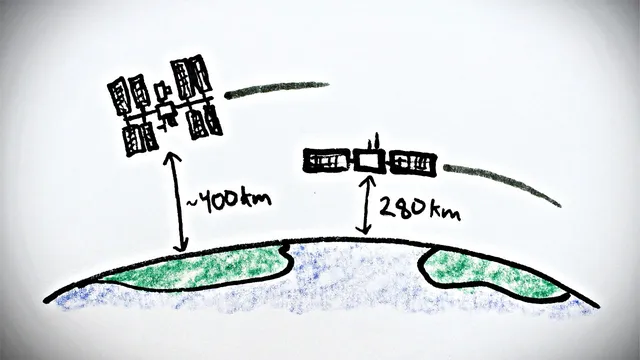
The second constraint is visibility and engineering. If a planet spins too fast, the geosynchronous orbit sits low, potentially limiting what the satellite can see. The example given imagines Earth spinning once every 90 minutes; then geosynchronous altitude would be about 280 kilometers—below the International Space Station—and a satellite could view only about 2% of Earth’s surface at once, making communications coverage poor.
If a planet spins too slowly, the orbit moves far away. Coverage might improve, but signal handling gets harder: antennas must be more powerful, and latency grows because radio waves take time to travel. The transcript illustrates this with Venus, where a “venusynchronous” orbit would be about four times farther than Earth–Moon distance, producing roughly a 10-second round-trip delay—enough to break satellite TV expectations. Around the Sun, a “helio-synchronous” orbit would be near Mercury’s distance, with nearly a three-minute round-trip delay.
In short, geosynchronous orbits are weird because orbital mechanics can make a satellite appear to hover, but they’re only valuable when a planet’s rotation rate places that orbit at a workable altitude for both coverage and communication timing. The coincidence that Earth sits in a “Goldilocks” range for both life and satellite TV is presented as the punchline.
Cornell Notes
Geosynchronous orbits occur when a satellite’s orbital period matches a planet’s rotation period, making it appear fixed in the sky to observers on the ground. Kepler’s third law implies that orbital period increases with distance, so there is a radius where the timing matches the planet’s day. These orbits are useful because a satellite can maintain a stable line of sight over a large region, supporting communications and broadcasting. However, fast rotation can push the needed orbit inside the planet, while slow rotation can place it so far away that latency and antenna requirements become impractical. Earth’s rotation rate is highlighted as unusually well-suited for both existence and usefulness of geosynchronous communications.
Why do geosynchronous satellites appear stationary to people on the ground?
How does Kepler’s third law guarantee a “matching” orbit exists for a planet like Earth?
What happens if a planet spins so fast that the geosynchronous orbit would be inside it?
Why might geosynchronous orbits be useless even when they exist?
How do geosynchronous orbits improve communications compared with satellites in other orbits?
Review Questions
- What physical relationship between orbital radius and orbital period makes synchronization with a planet’s day possible?
- How do fast vs. slow planetary rotation rates change both the altitude of geosynchronous orbits and the resulting communication tradeoffs?
- Why does geostationary differ from geosynchronous in how a satellite appears to drift over time?
Key Points
- 1
Geosynchronous orbits match a satellite’s orbital period to a planet’s rotation period, making the satellite appear fixed relative to the ground.
- 2
Kepler’s third law implies a radius exists where orbital timing equals the planet’s day, because orbital period increases with distance.
- 3
Geosynchronous orbits are useful for communications because they provide stable coverage and line-of-sight geometry over a large region.
- 4
If a planet spins too fast, the synchronized orbit can fall inside the planet, making it physically impossible for a satellite to occupy.
- 5
If a planet spins too fast, the orbit may be too low for broad visibility, shrinking the fraction of the surface that can be seen.
- 6
If a planet spins too slowly, the orbit becomes so distant that signal latency and antenna/communication requirements become impractical.
- 7
Earth’s rotation rate is presented as unusually well-suited for geosynchronous communications—neither too fast nor too slow for workable altitude and delays.