German Election System - Bundestag 2025 - New Voting System Explained
Based on The Bright Side of Mathematics's video on YouTube. If you like this content, support the original creators by watching, liking and subscribing to their content.
Each voter casts two votes: a first vote for a district candidate and a second vote for a party list; the second vote determines party seat shares.
Briefing
Germany’s Bundestag election hinges on a mixed system that uses two different votes to balance proportional party strength with direct constituency representation. Voters cast exactly two ballots: a “first vote” for a specific candidate in their electoral district and a “second vote” for a party list. The second vote ultimately determines how many seats each party receives in the Bundestag, making it the decisive driver of proportional representation—while the first vote decides which individuals from each district get those seats.
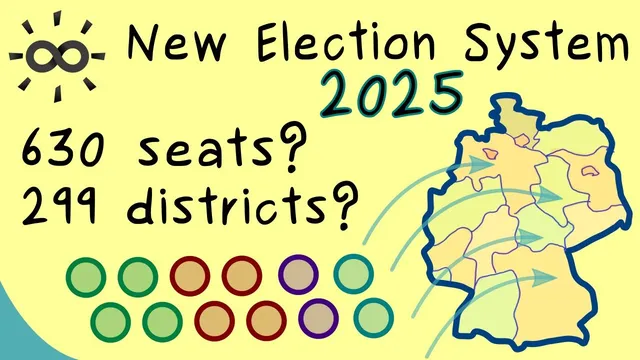
The Bundestag is capped at 630 members. Germany is divided into 16 federal states, and for this election those states are further split into 299 electoral districts. Each district has its own contest for the first vote, producing one district winner based on who receives the most first votes. Those district winners then feed into the seat-filling process, but the overall number of seats a party gets still comes from the nationwide total of second votes.
On the second vote, voters choose one party from a state-specific party list (the list can vary by state depending on which parties participate there). Parties must clear an electoral threshold to earn seats: generally, they are excluded if they fall below 5% of valid second votes. The main escape hatch is winning at least three districts, which can keep a small party in the Bundestag even without reaching 5%. National minority parties are exempt from the threshold; Germany currently has one such party.
Once eligible parties are identified, seat totals are calculated using the Webster method (also called the Sainte-Laguë method), with rounding handled to reach the target of 630 seats. After the party-level seat totals are fixed, the system repeats the proportional logic at the state level: for each party, seats are distributed across the 16 states based on how that party’s second votes performed in each state.
Finally comes the personnel allocation. Each state party list is ordered, and seats are filled by taking candidates in priority order—starting with district winners belonging to that party, then moving down the list. Priority among district winners is tied to how strongly they performed in their districts, measured by the candidates’ share of first votes. This creates three practical outcomes. In the best case, district winners and top list candidates all fit into the party’s seat entitlement, giving high list positions and district victories both strong advantages. In another case, if a party wins too many districts relative to its overall second-vote share, the “worst” district winners (by their district first-vote percentages) miss out because there are not enough seats. A third, rarer scenario occurs if a state party list is too short to fill the seats assigned to that party—leaving some seats unoccupied. Conversely, seat totals can exceed 630 if one party is strong enough that its second-vote share implies more than half the seats; additional seats would then be added to match proportionality.
Overall, the system is designed so that second votes set the party balance, while first votes ensure local representation—producing a Bundestag that reflects both proportional party strength and direct constituency outcomes.
Cornell Notes
Germany’s Bundestag election uses a mixed-member proportional system with two votes per voter. The second vote for a party list determines each party’s overall seat share in the Bundestag (up to 630 seats), while the first vote for a district candidate determines which individuals win local seats. Germany is split into 16 states and 299 electoral districts; each district winner is chosen by the most first votes. Parties generally need at least 5% of valid second votes to enter the Bundestag, unless they win at least three districts; national minority parties are exempt. After seat totals are computed with the Webster/Sainte-Laguë method, seats are allocated by state and filled using district winners first and then ordered state party lists.
Why does the second vote carry more weight than the first vote in determining Bundestag composition?
How do the 299 electoral districts and the 16 states interact with the two votes?
What are the main rules that decide whether a party earns seats at all?
How are seats assigned to parties and then to states once eligibility is established?
What happens when a party wins more district seats than its second-vote entitlement allows?
Under what conditions could the Bundestag end up with fewer or more than 630 seats?
Review Questions
- How do the first and second votes play different roles in determining both party seat totals and which individuals take those seats?
- What eligibility conditions (including the 5% threshold and the three-district exception) determine whether a party earns Bundestag seats?
- Describe the sequence from nationwide second votes to state seat allocation and then to candidate selection using district winners and ordered party lists.
Key Points
- 1
Each voter casts two votes: a first vote for a district candidate and a second vote for a party list; the second vote determines party seat shares.
- 2
The Bundestag has 630 seats, with seat totals computed from second votes using the Webster (Sainte-Laguë) method.
- 3
Germany’s election uses 16 states and 299 electoral districts; district winners come from first votes, while party list eligibility and second-vote proportionality operate at the state level.
- 4
Parties generally need at least 5% of valid second votes to enter the Bundestag, unless they win at least three districts; national minority parties are exempt.
- 5
After party seat totals are set, seats are distributed across states for each party using the same proportional method applied to state-level second votes.
- 6
Seats are filled by prioritizing district winners for the party, then moving down the ordered state party list; district winners can be excluded if a party wins too many districts.
- 7
Seat totals can deviate from 630 if a state party list is too short (leaving seats empty) or if one party’s strength implies additional seats to maintain proportionality.