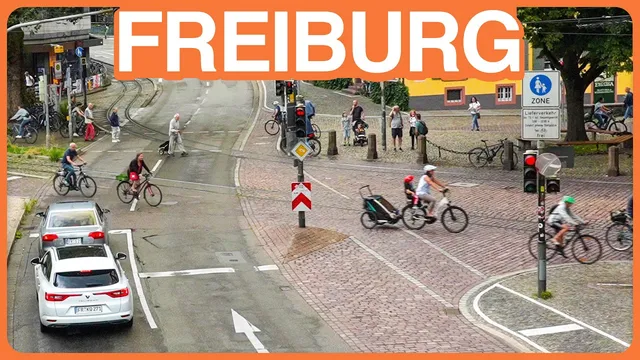
Germany's "Green" City (with more bikes than cars!)
Based on Not Just Bikes's video on YouTube. If you like this content, support the original creators by watching, liking and subscribing to their content.
Freiburg im Breisgau’s sustainability model centers on a tram-first mobility system paired with widespread cycling and a pedestrianized core.
Briefing
Freiburg im Breisgau has become a European benchmark for sustainable city life by making trams and cycling—not cars—the default way to move. The city pairs a dense, pedestrian-friendly core with extensive bicycle networks and a tram system that runs on priority signals and separated track segments, helping keep streets calm while still supporting everyday mobility. The result is visible in daily life: students and families cycle widely, trams thread through the center, and the old town’s streets feel lively without being dominated by traffic.
A key reason Freiburg looks the way it does is political and planning choices made across decades, not a single “green” moment. In 1972 the city voted to preserve its tram network, and it later expanded that network through the 1980s and 1990s while many other European cities dismantled theirs. That decision helped shape the city’s growth pattern: the center was pedestrianized starting in 1973, and once cars were pushed out, the area evolved into a functioning business district with an active market that still anchors the cathedral square. Environmental pressure also mattered—protests in the 1970s helped keep development compact and protected the neighboring Black Forest.
Freiburg’s postwar rebuilding adds another layer. While much of the city was destroyed in World War II, the reconstruction of the core aimed to restore the historic street fabric rather than rebuild for automobiles. Much of what visitors see in the old town is therefore relatively recent—under 75 years old—but it retains the look and feel of earlier Freiburg. Outside the center, however, car-oriented planning left scars: the “Ring Road” replaced a narrower street lined with beer gardens and restaurants, and some neighborhoods still reflect the 1960s-era push to destroy older streets to make room for roads.
The city’s sustainability story extends beyond mobility into housing and energy. In the early 2000s, Vauban—built on a former military base—was designed for high energy efficiency, with solar panels common on roofs and balconies. Many residents live in housing cooperatives or social housing, and car ownership has fallen over time: after the tram line opened in 2006, the city reports only about 170 motor vehicles per 1,000 inhabitants. Vauban also uses modal filters to keep cars out of many walking and cycling routes, creating safer streets for children; some streets are designated as play streets.
Even with clear strengths, Freiburg isn’t portrayed as perfect. Some bicycle infrastructure remains less protected than it could be—especially at major intersections—so there are still opportunities to upgrade safety. Still, the tram network is framed as the city’s most powerful asset: Freiburg even uses a distinct term for trams (“Stadtbahn”), emphasizing separated tracks, traffic-light priority, and higher average speeds. Planning rules reinforce the system by requiring new housing to be within walking distance of tram lines.
Overall, Freiburg’s model is presented as replicable: a compact city, prioritized transit, and street designs that make everyday life safer and more pleasant. Urban planners from across Europe visit to study it, and the city’s influence is positioned as a practical path toward more human-scaled development—one that reduces reliance on wide roads and car-first infrastructure while keeping mobility efficient for everyone.
Cornell Notes
Freiburg im Breisgau has built a sustainable urban model around trams and cycling, backed by long-term planning decisions rather than short-lived “green” branding. Preserving and expanding the tram network starting in 1972 helped enable pedestrianization of the city center in 1973 and supported a thriving business district and market area. The city’s Vauban neighborhood shows how housing design, energy efficiency, and car-reduction policies can reinforce each other: modal filters limit through-car traffic, tram access supports low car ownership, and many residents live in cooperatives or social housing. While some bicycle infrastructure—especially at major intersections—still needs safer upgrades, Freiburg’s transit-first approach keeps streets calmer and more accessible for daily life, including for children and students.
Why is Freiburg’s tram network treated as the city’s central sustainability lever?
How did pedestrianization of Freiburg’s center connect to earlier transit decisions?
What makes Vauban a standout example of sustainable neighborhood planning?
How do modal filters change street behavior in Vauban?
What bicycle-infrastructure gaps remain despite Freiburg’s strong cycling culture?
How does Freiburg’s rebuilding history affect what visitors see today?
Review Questions
- Which policy decision in the early 1970s is most directly linked to Freiburg’s later pedestrianized city center?
- How do modal filters contribute to child safety and car reduction in Vauban?
- What specific shortcomings in Freiburg’s cycling infrastructure are highlighted at major intersections?
Key Points
- 1
Freiburg im Breisgau’s sustainability model centers on a tram-first mobility system paired with widespread cycling and a pedestrianized core.
- 2
Preserving the tram network in 1972 and expanding it in the following decades helped enable the 1973 pedestrianization of the city center without collapsing local commerce.
- 3
Postwar reconstruction of the historic core prioritized restoring the old street fabric rather than rebuilding for automobiles, keeping the old town visually cohesive.
- 4
Vauban demonstrates integrated sustainability: high energy-efficiency building standards, solar installations, cooperative/social housing, and car-reduction policies reinforced by tram access.
- 5
Modal filters in Vauban restrict car through-traffic while allowing walking and cycling, creating safer streets and play-street environments for children.
- 6
Despite strong cycling culture, some bicycle infrastructure—especially at major intersections—remains insufficiently protected, leaving room for safety upgrades.
- 7
Freiburg’s planning rules tie new housing to tram accessibility, making transit-oriented development a default rather than an exception.