Get Answers in Slack 24/7 with this Custom Agent
Based on Notion's video on YouTube. If you like this content, support the original creators by watching, liking and subscribing to their content.
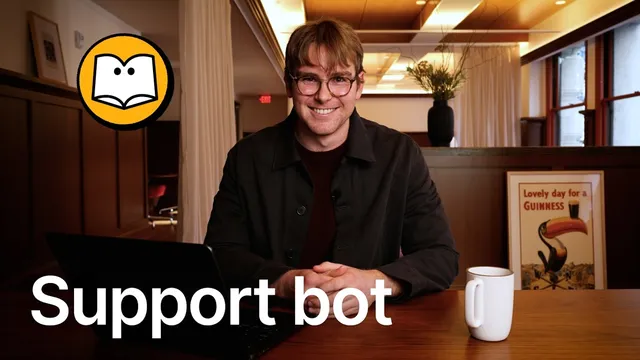
The customer support bot lives in Slack and answers questions by searching connected documentation.
Briefing
A custom “customer support bot” built as a Notion custom agent now handles Slack questions automatically—answering from the company’s documentation, citing the exact source, and routing unanswered questions into a documentation update workflow. The practical payoff is speed and consistency: support teams can get answers in seconds for common, hard-to-find issues, while every unanswered question becomes a structured prompt to improve the knowledge base.
In Slack, the bot sits in a dedicated channel (e.g., “customer support ask”) and responds when someone posts a question. For a documented product query—such as how to store prior versions of a page—the bot searches the knowledge base, posts an answer in the thread, includes a citation (in this case pointing to the relevant “page settings” content), and marks resolution with a thumbs up/down. When the question is already covered, the bot’s response can be verified directly by opening the cited page, where the underlying “version history” information is visible.
When a question has no matching documentation, the bot doesn’t guess. Instead, it reports that it couldn’t find anything in the help center and creates a new knowledge base update request. That request becomes a ticket in a database (example: “Next big user conference date”), complete with suggested title and suggested content, plus a concrete implementation plan for how the documentation should be updated. A green check mark indicates the thread is resolved even when the outcome is “create a documentation update,” turning gaps in coverage into actionable work.
Behind the scenes, the agent is configured inside a Notion workspace under an “agents” sidebar area. The setup is organized into four main components: triggers (what events start the agent, such as a message in a Slack channel or a reaction), instructions (the agent’s operational “brain,” including what to do when answers are found vs. not found), tools and access (what the agent can view, edit, or create), and the model (the AI model used, with the option to choose from available leaders and update as offerings change).
The instructions are intentionally prescriptive. At a high level, they define the bot’s responsibility, the resources it should search (specific documentation pages), the exact behavior for answer-found versus answer-not-found paths, and how to handle Slack reactions and thread context. The agent also follows style and tone rules for how responses should read. Notably, creating a new custom agent can bootstrap its own prompt structure—so the initial configuration is generated in a familiar format rather than requiring a fully manual build.
Finally, the approach is presented as reusable across teams. Any group that fields questions in Slack—people operations, sales, product management—can build similar agents that search internal docs, cite sources, and open structured update requests when information is missing. The core idea is simple: automate retrieval and triage in Slack, then continuously improve the documentation based on real questions from the business.
Cornell Notes
A Notion custom agent powers a Slack-based customer support bot that answers questions by searching internal documentation and posting thread replies with citations. When a question is covered, the bot marks it resolved and points users to the exact page (e.g., version history details under page settings). When no answer exists, it creates a structured knowledge base update request, generating a ticket with suggested title, suggested content, and implementation guidance. The agent is configured with triggers (Slack events), instructions (search and response logic), tools/access (what it can edit or create), and a selectable model. This turns every support interaction into both immediate help and a feedback loop to strengthen the knowledge base.
How does the Slack support bot handle a question when the answer exists in documentation?
What happens when a user asks something that isn’t found in the help center?
What are the main configuration sections of the custom agent behind the scenes?
Why are the agent’s instructions described as “super prescriptive”?
How does the system encourage continuous documentation improvement?
Review Questions
- What signals indicate that a Slack thread was resolved, and how do those signals differ between “answer found” and “answer missing” outcomes?
- Describe the decision path an agent follows when it searches documentation: what actions occur in each branch?
- Which agent configuration components control (1) when it runs, (2) what it does, (3) what it can access, and (4) which AI model it uses?
Key Points
- 1
The customer support bot lives in Slack and answers questions by searching connected documentation.
- 2
Successful answers include citations to the exact documentation page and mark the thread as resolved.
- 3
When documentation lacks an answer, the bot creates a knowledge base update request instead of guessing.
- 4
The update request becomes a ticket in a database with suggested title, suggested content, and implementation guidance.
- 5
The agent is configured with triggers, instructions, tools/access, and a selectable model within a Notion workspace.
- 6
Instructions define both the “answer found” and “answer not found” workflows, plus Slack reaction handling and response style.
- 7
The same agent pattern can be applied to other teams (people, sales, product) that rely on Slack Q&A backed by internal docs.