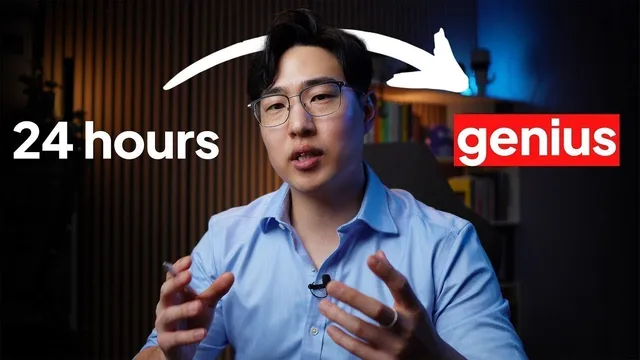
Give me 14 minutes, And I'll Turn You Into An Academic Weapon
Based on Justin Sung's video on YouTube. If you like this content, support the original creators by watching, liking and subscribing to their content.
Academic improvement depends on diagnosing “learning baggage”—autopilot cognitive habits that sabotage learning execution.
Briefing
Becoming an “academic weapon” isn’t about collecting more study hacks—it’s about fixing the hidden habits that quietly sabotage learning. The core claim is that most students fail to improve because of “learning baggage”: invisible, autopilot cognitive processes that determine how well information sticks and how accurately it can be recalled under pressure. Quick tips may feel helpful, but they often don’t change a student’s academic trajectory—where challenges get easier over time for high performers and harder for everyone else.
The transcript frames learning as a chain of mental processes that must be intentionally triggered. Some processes—like deeper learning mechanisms tied to long-term memory—are beneficial, but the brain won’t reliably run them on its own. Students instead adopt techniques haphazardly from friends or online, and over time those techniques become habits. The problem is that habits can lock in harmful patterns: even when a student uses a technique that works for top performers, their automated cognitive habits can make them execute it incorrectly, producing weaker results and reinforcing the belief that “studying isn’t working.” This invisibility keeps students stuck because they can’t pinpoint what’s wrong—only that outcomes are bad.
The proposed solution is “visible process mapping,” a method designed to make the invisible visible by recording a student’s entire learning flow from first exposure to eventual exam use. The process map starts with baseline performance metrics—such as confidence to recall facts versus confidence on curveball questions, time spent studying, and how much time is wasted relearning forgotten material. Then it identifies the “main learning event,” the first serious contact with a topic (a lecture or a dedicated study session). During that event, students document what they do (e.g., listening, taking notes, copying diagrams) and, crucially, why they do it—linking technique to intended cognitive effect like focus, concentration, memory accuracy, or deeper understanding.
The map continues backward and forward in time: what happens before the main learning event (pre-study steps), what happens shortly after (reviewing notes), and what happens later (reviewing weeks afterward and tracing how a single piece of information travels to the moment it’s needed for assessment). Each stage includes a “certainty” check—how sure the student is that the technique actually produces the desired outcome. Low certainty flags potential learning baggage: habits or beliefs that were never tested, or methods that were adopted because earlier attempts failed.
A concrete example illustrates the stakes. One student, Anelie, discovered she was spending hours writing notes to understand and remember—yet also spending hours daily on flashcards covering the same material because the notes weren’t actually helping retention. The process map made the mismatch obvious and allowed her to optimize, raising certainty and improving both results and confidence. The transcript emphasizes that not every flagged habit is harmful; the goal is to separate useful routines from baggage and iterate until learning becomes more consistent and predictable.
A free quiz is offered as a quick starting point to identify likely baggage areas, but the main method remains the process map—positioned as the step that turns vague struggle into actionable diagnosis and trajectory change over time.
Cornell Notes
The transcript argues that academic underperformance often comes from “learning baggage”—invisible, autopilot cognitive habits that make students execute study techniques incorrectly. Because these habits aren’t obvious, students can’t tell which parts of their routine help versus hurt, so their academic trajectory stays stuck. Visible process mapping addresses this by documenting the full learning flow: baseline performance, the “main learning event,” what students do during it, why they do it, and how certain they are that it works. By tracing a single piece of information from first exposure through later review to exam use—and checking certainty at each stage—students can spot mismatched or “Band-Aid” techniques and then optimize. The method aims to raise both results and confidence through targeted iteration.
What is “learning baggage,” and why does it matter more than adding study hacks?
How does visible process mapping make the invisible visible?
What does the “main learning event” represent, and what gets recorded there?
How does the process map handle time—before, right after, and weeks later?
What counts as a “Band-Aid technique,” and how did it show up in the example?
Why does increasing “certainty” improve both performance and confidence?
Review Questions
- How would you identify learning baggage using certainty checks at different stages of the learning flow (before, during, after, and weeks later)?
- What baseline metrics would you collect to calibrate whether your study time is being wasted relearning forgotten material?
- Describe a potential “Band-Aid technique” in your own study routine and explain how a process map would test whether it’s actually helping.
Key Points
- 1
Academic improvement depends on diagnosing “learning baggage”—autopilot cognitive habits that sabotage learning execution.
- 2
Study hacks that don’t change mental processes won’t shift a student’s academic trajectory.
- 3
Visible process mapping starts with baseline metrics like confidence levels and the share of time spent relearning forgotten material.
- 4
The method centers on the “main learning event” and records both actions and the rationale for those actions.
- 5
Certainty ratings at each stage help surface harmful or untested habits and beliefs.
- 6
Tracing one piece of information from first exposure to exam use reveals where techniques fail to produce retention.
- 7
Optimizing flagged techniques can raise both results and confidence by making learning routines more reliable.