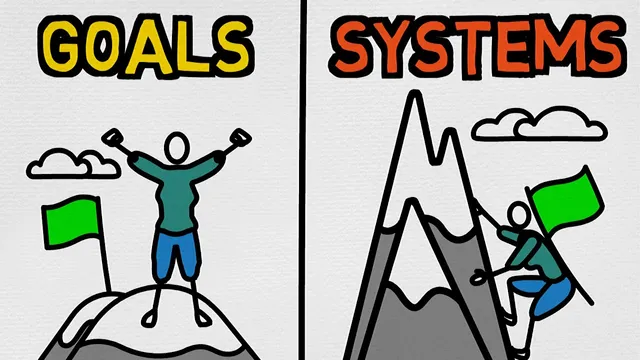
Goals vs Systems
Based on Better Than Yesterday's video on YouTube. If you like this content, support the original creators by watching, liking and subscribing to their content.
Treat goals as destinations and build systems as repeatable processes that create progress over time.
Briefing
Chasing goals can quietly sabotage progress by keeping people in a constant state of “not yet,” while a well-designed system turns effort into a repeatable process that steadily moves outcomes forward. The core distinction is straightforward: goals are one-time endpoints, but systems are the ongoing behaviors that produce results. A goal like “lose 20 pounds” is a finish line; the system is “eat healthy and exercise regularly.” The same pattern holds for academics (“get an A” versus “study and review notes every day”) and business (“make 1 million dollars” versus “hire employees, build the best product, and market it”). Once a strong system is in place, the goal becomes less necessary as a motivational crutch because the daily work already points in the right direction.
The frustration comes from how goal-focused thinking feels in practice. When someone is pursuing a specific target, any gap between current reality and the desired outcome reads as failure. If the target is losing 30 pounds and only 10 are gone, the person is “failing” against expectations; even at 20 pounds, the goal still hasn’t been reached. Over time—especially with long-term goals—those repeated feelings of falling short can breed misery and increase the odds of quitting. That emotional drag also explains why people who focus on process often outperform in the long run: they measure progress through actions they can control rather than through distant milestones.
There’s also a psychological trap after success. Many people expect a goal to trigger a life-changing moment, but the high tends to fade quickly. After reaching a financial target—say $100,000—life may not feel dramatically different from $90,000. Soon the mind upgrades the target again: $200,000, then $300,000, and so on. Each achievement brings a brief satisfaction, followed by the next, bigger demand. The result is a cycle where the feeling of accomplishment never lasts.
A system-based approach aims to break that cycle. If the underlying system is sound, results still arrive even without obsessing over the exact goal. The video’s example centers on “Mike,” who wants to write a book. He starts with a simple system—write every day—but quickly runs into predictable obstacles: low motivation, and low energy after a day job. He responds by asking better questions and experimenting. He shifts writing to mornings to avoid post-work exhaustion, creates a dedicated writing space to make starting easier, and uses the “2 minute rule” when motivation disappears. Instead of measuring the day by whether the book is finished, he measures it by whether he starts writing at 7am at his desk for at least two minutes, then reviews weekly what worked and what didn’t.
The takeaway is practical: build systems by choosing a direction, asking how to get there, then testing and adjusting. The system becomes personal—what works for others may not work for Mike, and vice versa. With that framework, goals stop acting like emotional deadlines and start acting like destinations that the system naturally carries someone toward. The message ends with a sponsorship pitch for Skillshare, positioning it as a way to learn proven processes from experts and adapt them into one’s own system.
Cornell Notes
The central claim is that goal-chasing can reduce follow-through because it creates ongoing “failure” feelings until the endpoint is reached, and the satisfaction from hitting a goal fades quickly. Systems—repeatable processes—shift attention to controllable actions that steadily move someone toward the destination. The transcript distinguishes goals as one-time endpoints (e.g., lose 20 pounds) from systems as ongoing behaviors (e.g., eat healthy and exercise regularly). It then illustrates system-building through Mike’s book-writing plan: he starts with daily writing, identifies obstacles (motivation and energy), and iteratively adjusts with morning writing, a dedicated space, and the 2 minute rule. Weekly review and daily minimums keep the process stable while it evolves.
Why can focusing on goals lower the odds of achieving them?
What’s the key difference between a goal and a system?
How does the transcript explain the “success doesn’t last” problem?
How did Mike build and improve his book-writing system?
What does “following the system” look like day to day in the example?
What are the three steps everyone should follow to create a system?
Review Questions
- Think of a goal you have. What would the corresponding system (daily/weekly behaviors) look like if it were designed to reduce “failure” feelings?
- In Mike’s case, which specific obstacle led to which adjustment (time of day, dedicated space, or the 2 minute rule)?
- How would you set a weekly review process so that your system improves without turning the goal into an emotional deadline?
Key Points
- 1
Treat goals as destinations and build systems as repeatable processes that create progress over time.
- 2
Goal-focused thinking can generate persistent “failure” emotions until the endpoint is reached, especially for long-term targets.
- 3
Success often triggers a quick desire for a harder next goal, so the satisfaction from hitting milestones may not last.
- 4
If the system is strong, outcomes can still be achieved even without obsessing over the exact goal.
- 5
Create a system by choosing a direction, asking how to get there, then experimenting and adjusting based on results.
- 6
Use minimum daily actions and weekly reviews to keep the process consistent while it evolves.
- 7
Design the system to fit personal circumstances; what works for others may not work for you.