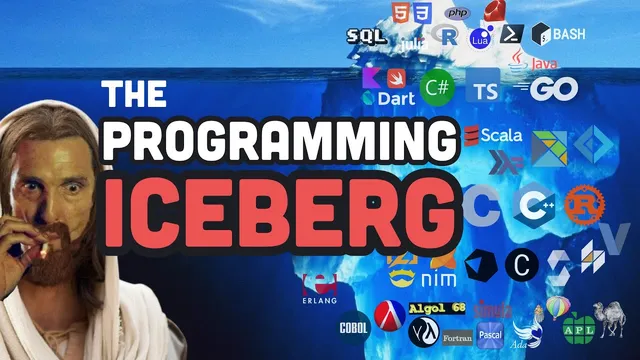
God-Tier Developer Roadmap
Based on Fireship's video on YouTube. If you like this content, support the original creators by watching, liking and subscribing to their content.
Start with languages that teach programming logic with minimal syntax overhead, then graduate to languages that match real-world job requirements.
Briefing
A practical “god-tier” roadmap for becoming a junior developer in 2023 isn’t about chasing a single “best” language—it’s about moving down an iceberg of programming languages by purpose, abstraction level, and job relevance. The core message: beginners should start with languages that make programming thinking easy, then progressively add the skills that show up in real production work—especially static typing, web/database basics, and eventually low-level systems knowledge—before detouring into niche and esoteric languages for breadth.
The climb begins at the shallow end with Scratch, created at MIT, where coding is drag-and-drop “blocks” that represent variables, control flow, and operators. The point isn’t to become a Scratch developer; it’s to build intuition for programming without syntax friction. Historically, the transcript contrasts this with BASIC, released in 1964 from Dartmouth, which dominated beginner computing for decades thanks to simple commands like print and go to.
Next comes the mainstream “dynamic high-level” tier. Python is positioned as the default starting language because it avoids curly braces and semicolons, using indentation to structure code. JavaScript follows as a career requirement for web development, with the claim that any application written in JS eventually ends up in JS. From there, the roadmap branches into scripting and web foundations: Bash and PowerShell for automating terminal workflows; HTML and CSS for website structure and styling; and SQL for reading and writing data in relational databases.
As projects grow, the transcript shifts toward dynamic languages with different strengths—PHP for server-side web apps, Lua for speed and embedding (including Roblox and World of Warcraft), Ruby with the Rails framework, R for statistics and data visualization, and Julia for scientific computing. A key commonality is dynamic typing, but the narrative warns that complex software often demands a more rigid structure.
That leads to the “static type system” tier, described as the bulk of production code. Java is highlighted for the Java Virtual Machine approach: compiling to bytecode that runs on the JVM across architectures. C# is framed as a similar, widely loved option tied to .NET and Unity. TypeScript is presented as JavaScript plus a type system for large codebases. For mobile, Kotlin (Android), Swift (iOS), and Dart (Flutter) are named. Go is added as a Google-built, concise systems language with garbage collection.
Deeper still, functional languages appear as a response to heavy object-oriented patterns. Haskell emphasizes immutability and side-effect-free functions, while F# blends functional and imperative styles for approachability. Scala and Clojure expand the mix with JVM compatibility and different trade-offs in typing and dynamism. The transcript also spotlights OCaml, Elixir, and Elm (which compiles to JavaScript and targets front-end UIs with zero runtime errors).
At the heart of the iceberg are low-level systems languages—C, C++, and Rust—where manual memory management and performance dominate. C is praised for relative learnability but criticized for requiring deep algorithm and architecture knowledge, plus the need to build data structures manually. C++ is portrayed as powerful but difficult, while Rust is framed as the modern “memory-safe” alternative using borrow checking instead of garbage collection.
Finally, the roadmap dives into newer or specialized systems languages (V, Zig, Nim, Carbon, Solidity, Hack) and then into historical and esoteric languages—from COBOL’s continued banking footprint to Intercal, Brainfuck, and emoji-based lolcode—before ending at the lowest level: assembly and machine code. The transcript closes by turning the iceberg inward, suggesting that after mastering everything technical, the hardest question becomes epistemology—what knowledge and reality even mean.
Cornell Notes
The roadmap treats programming languages like an iceberg: start with tools that make core programming concepts easy, then move toward languages that match real job needs and production constraints. It begins with Scratch (drag-and-drop logic) and BASIC (early beginner-friendly syntax), then advances to Python and JavaScript for general-purpose work and web requirements. As complexity rises, it shifts to static typing with Java, C#, TypeScript, Kotlin, Swift, Dart, and Go, which dominate large codebases. It then goes deeper into functional languages (Haskell, F#, Scala, Clojure, Elixir, Elm) and finally into low-level systems languages (C, C++, Rust) where memory management and performance matter. The journey ends with assembly/machine code and a philosophical detour into epistemology.
Why does the roadmap start with Scratch instead of jumping straight to Python or JavaScript?
What are the “must-have” web and data basics that sit alongside Python/JavaScript?
What triggers the move from dynamic languages to static typing in this roadmap?
How does the roadmap position functional languages relative to object-oriented ones?
Why are C, C++, and Rust treated as the “heart of the iceberg”?
What does the transcript mean by going “one level deeper” into assembly and machine code?
Review Questions
- Which language tier in the roadmap is most directly tied to web development, and what supporting languages are named alongside it?
- What trade-offs does the transcript highlight between Haskell’s purity and F#’s approachability?
- How does Rust’s memory model differ from C and C++ in the roadmap’s framing?
Key Points
- 1
Start with languages that teach programming logic with minimal syntax overhead, then graduate to languages that match real-world job requirements.
- 2
Python and JavaScript are positioned as the mainstream entry points, with JavaScript treated as a web-development necessity.
- 3
Automation and fundamentals matter early: Bash/PowerShell for scripting, HTML/CSS for structure and styling, and SQL for relational data.
- 4
Static typing becomes increasingly valuable as projects scale, with Java, C#, TypeScript, Kotlin, Swift, Dart, and Go presented as common production choices.
- 5
Functional languages offer a different abstraction model (immutability and side-effect-free functions), but concepts like monads can be a major learning hurdle.
- 6
Low-level systems languages (C, C++, Rust) are where memory management and performance dominate, making them both powerful and demanding.
- 7
The learning path ultimately reaches assembly/machine code, tying software behavior back to CPU architecture and binary logic.