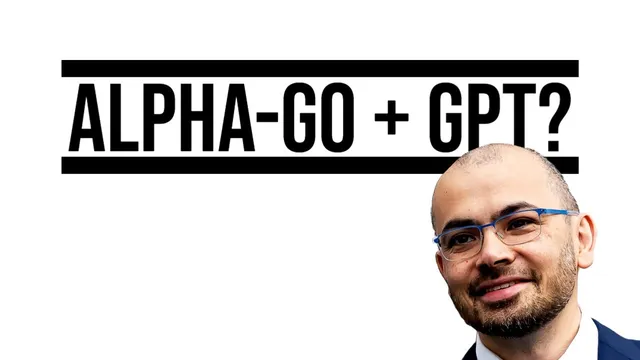
Google Gemini: AlphaGo-GPT?
Based on AI Explained's video on YouTube. If you like this content, support the original creators by watching, liking and subscribing to their content.
Hassabis claims Gemini, releasing as soon as this winter, is intended to surpass ChatGPT in capability by combining language modeling with AlphaGo-style planning and search.
Briefing
Demis Hassabis, head of Google DeepMind, says Gemini—planned for release as soon as this winter—will be more capable than OpenAI’s ChatGPT, aiming to merge AlphaGo-style strengths with the language power of large models. The core pitch is that Gemini won’t just generate fluent text; it will also improve how it searches, plans, and solves problems by borrowing techniques from DeepMind’s game-playing systems, where long-horizon decision-making and systematic exploration mattered.
Google’s broader messaging frames Gemini as a “next generation foundation model” still in training, with early signs of multimodal ability that go beyond prior generations. Hassabis ties those capabilities to a deliberate architecture: Gemini is built from the ground up to be multimodal and efficient, with tool and API integrations designed to support future features like memory and planning. He also points to a training approach that may extend beyond text—reporting suggests Gemini’s multimodality is supported in part by training on YouTube content, not only transcripts but also audio, imagery, and likely other signals.
The transcript connects Gemini to DeepMind’s track record in systems that learn from scratch and then generalize. DeepMind’s AlphaGo and AlphaZero demonstrated that reinforcement learning and search can master complex domains, while AlphaFold and AlphaFold 2 have already produced real-world scientific impact. That history matters because the Gemini plan is presented as more than scaling language: it’s about combining a model that predicts likely next steps with a search process that can systematically explore alternatives when the first guess fails.
Hassabis describes the AlphaGo “tree search” idea as guiding exploration through a branching structure: the model proposes probable moves, and the system searches through the resulting tree efficiently until time runs out, returning the best plan found. The transcript argues this “AlphaGo-guided search” can be generalized beyond games—swapping game states for other structured spaces such as chemical compounds in drug discovery—so the same search-and-evaluate loop can help tackle problems where backtracking and systematic exploration are essential.
That framing is linked to recent research themes: language models often struggle with search and planning, while methods that sample multiple paths or enforce consistency can outperform single-shot decoding. The transcript also references “Tree of Thoughts” as a way to explore alternative branches rather than committing early to the most probable answer, and it notes that theorem-proving work has begun to use language models to prove math results—suggesting that stronger search could unlock more reliable reasoning.
Risk and safety sit alongside capability. Hassabis says the biggest challenge is determining what risks a more capable system will actually pose, which requires urgent evaluation research to measure both capability and controllability. He rejects the practicality of a mandated pause, arguing it would be hard to enforce, while still calling for bold progress toward benefits in science, health, and climate. The transcript further highlights calls for a CERN-like alignment effort—pairing academia, industry, and governments—to accelerate solutions to control problems, echoing similar remarks attributed to Satya Nadella.
The closing tension is time: Hassabis warns that if progress continues at the current pace, safeguards may not be ready soon enough. The transcript ends by questioning whether enough researchers are devoted to evaluations and preemptive safety work, implying that the credibility of safety commitments depends on the scale and focus of that effort.
Cornell Notes
Gemini is positioned as more than a larger chatbot: it’s meant to combine large-model language ability with AlphaGo-style search and planning. Hassabis describes a system where a model proposes likely moves, then a tree-search procedure systematically explores alternatives to avoid getting stuck on an unpromising path. The transcript links this approach to broader research showing that language models can improve when they sample multiple reasoning paths or use structured search rather than single-shot decoding. Safety remains central, with Hassabis emphasizing urgent evaluation work to measure capability and controllability, while arguing that pausing AI development is impractical. The stakes are framed as a race between accelerating capability and building reliable safeguards.
What does “AlphaGo-GPT” mean in practical terms, beyond a catchy comparison?
Why does the transcript repeatedly stress “search” and “planning” as a weakness of current LLM behavior?
How does multimodality fit into Gemini’s goals?
What does Hassabis say about safety, and what kind of work does he think is most urgent?
Why does the transcript mention a CERN-like alignment project?
What uncertainty does the transcript highlight at the end regarding safety commitments?
Review Questions
- How does tree search change the way a model arrives at an answer compared with single-shot decoding?
- What evaluation capabilities would be necessary to judge both the risk and controllability of a more capable foundation model?
- Why might multimodal training data (beyond text) matter for planning and tool use in systems like Gemini?
Key Points
- 1
Hassabis claims Gemini, releasing as soon as this winter, is intended to surpass ChatGPT in capability by combining language modeling with AlphaGo-style planning and search.
- 2
Gemini is described as a multimodal foundation model built for efficiency and future features like memory and planning, with tool and API integrations baked in.
- 3
AlphaGo-style systems use a model-guided tree search: probable moves narrow the search, while systematic exploration prevents getting stuck on early, unpromising choices.
- 4
The transcript links improved reasoning to methods that sample multiple paths (e.g., Tree of Thoughts, self-consistency) rather than relying on the single most likely output.
- 5
Safety priorities center on urgent evaluation research to measure capability and controllability, not just broad promises of safeguards.
- 6
Hassabis argues a mandated pause is impractical to enforce, while still pushing for rapid development of AI benefits in science, health, and climate.
- 7
A CERN-like alignment effort is proposed to coordinate academia, industry, and governments on control and alignment engineering at scale.