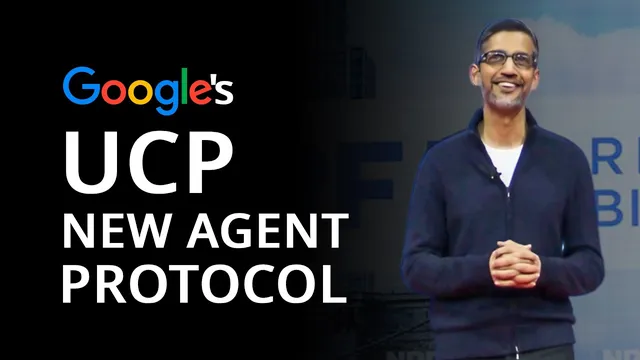
Google's New Universal Commerce Protocol
Based on Sam Witteveen's video on YouTube. If you like this content, support the original creators by watching, liking and subscribing to their content.
UCP is a retail-focused open standard meant to connect AI agents to businesses and payment providers for agentic commerce.
Briefing
Google’s Universal Commerce Protocol (UCP) is positioned as the missing retail layer in agentic commerce: a shared standard that lets AI agents discover products, add items to a cart, and complete checkout across many retailers and payment providers. The practical payoff is straightforward—retailers can expose what they sell once, and agents operating in chat and search experiences can reliably route shoppers to a purchase flow without building a separate integration for every platform.
UCP was announced at the National Retail Federation conference by Sunda Pashai, with the emphasis squarely on retail use cases rather than agent builders. The scenario described is less about fully autonomous shopping and more about “background” agent activity: a shopper chats in Google’s AI search mode (and potentially other platforms), an agent finds relevant products, presents options in the same environment, and then enables payment without forcing the user to jump through multiple sites. Google’s pitch targets businesses already comfortable with Google’s ecosystem—retailers that run ads and use Google services—making adoption feel less like a leap and more like an extension.
The protocol’s goals build on earlier agent-era standards. MCP focused on tool access, A2A enabled message passing between agents, AP2 centered on payments, and AGUI supported dynamic user interfaces. UCP is framed as an extension that connects agents to commerce systems: it’s an open standard (not a Google-only product) designed for agent-to-business and agent-to-payment-provider communication. Product discovery is highlighted as the most valuable component, since today’s agent shopping often relies on brittle web browsing and inconsistent search results. UCP aims to make product and service listings more “agent-readable,” so businesses can be found and presented without custom work for each agent or platform.
Checkout is the second major pillar. UCP is set up to support cart actions and payment handling, though the transcript leaves open whether it always relies on AP2 or can function independently. Google also claims UCP was co-developed with major commerce players including Shopify, Etsy, Target, Walmart, and Wayfair, and it has attracted additional retail partners—an intentional signal that this is meant to be broadly interoperable. Amazon’s absence stands out, but Google’s strategy appears to lean on its distribution advantage: UCP is expected to power a new checkout feature in Google products such as AI mode in Search and the Gemini app.
Beyond transactions, Google announced “business agents,” described as a way for shoppers to chat with brands directly in search—essentially a virtual sales associate that can answer questions in a brand’s voice. That move could also shift how brands handle customer inquiries and potentially support, while Google monetizes the flow by placing commerce and offers inside its answer surfaces.
The core problem UCP targets is discoverability and integration sprawl. Without a universal standard, every platform and retailer needs custom connections, and agent-driven shopping multiplies that complexity. Even with today’s app ecosystems, it’s unclear how systems decide what to recommend—whether quality, user fit, or commercial incentives dominate. UCP’s promise is universal compatibility: expose inventory and offers once, then let the protocol carry them into agent experiences.
For developers, Google has published the protocol at ucp.dev with documentation, schema references, and a playground. The open question is adoption: whether UCP becomes a widely used building block for agent developers or mainly a retailer-facing mechanism that powers Google’s AI commerce features in AI mode and Gemini. Either way, the announcement fits a broader 2026 trend—moving from experimenting with agents to monetizing them through real commerce flows inside major platforms.
Cornell Notes
Google’s Universal Commerce Protocol (UCP) is designed to standardize how AI agents interact with retail businesses and payment providers. Its biggest promise is improved product discoverability: agents should be able to find and present items reliably without relying on fragile web browsing. UCP also supports commerce actions like adding items to a cart and handling checkout, aiming to reduce the integration burden retailers face across many platforms. Google ties UCP to its distribution advantage, expecting it to power checkout in AI mode in Search and the Gemini app. Co-development with major retailers and platforms suggests the goal is broad interoperability rather than a single-vendor solution.
What problem in agentic shopping does UCP target first—discovery, checkout, or both?
How does UCP fit into Google’s broader stack of agent protocols (MCP, A2A, AP2, AGUI)?
Why does Google’s retailer strategy matter for adoption?
What does “universal compatibility” mean in practice for retailers and platforms?
What uncertainty remains even with a universal protocol like UCP?
What additional commerce-related capability did Google announce alongside UCP?
Review Questions
- How does UCP’s approach to product discovery differ from agent behavior that relies on browsing the open web?
- What integration burden does UCP aim to reduce, and why does that matter more as AI agents expand into more platforms?
- What open questions remain about how agents decide which products or apps to recommend, even if checkout and discovery are standardized?
Key Points
- 1
UCP is a retail-focused open standard meant to connect AI agents to businesses and payment providers for agentic commerce.
- 2
Product discovery is the central use case: UCP aims to make products easier for agents to find and present than ad-hoc web browsing.
- 3
UCP supports commerce actions such as adding items to a cart and handling checkout, with payment integration details still emerging.
- 4
Google positions UCP as interoperable across platforms so retailers can expose inventory/offers once instead of building many custom integrations.
- 5
UCP is co-developed with major commerce and retail partners including Shopify, Etsy, Target, Walmart, and Wayfair.
- 6
Google plans to monetize UCP through checkout and offers inside AI mode in Search and the Gemini app, leveraging Gemini’s large user base.
- 7
The biggest remaining challenge is not just standardization but how agents rank and choose among competing options when multiple retailers participate.