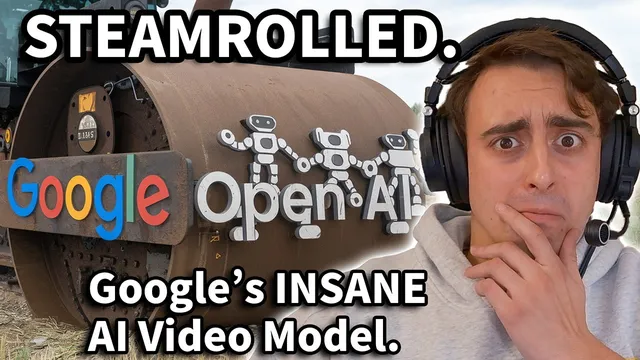
Google's New Video AI puts SORA to Shame...
Based on MattVidPro's video on YouTube. If you like this content, support the original creators by watching, liking and subscribing to their content.
Google V2 is repeatedly credited for temporal consistency, keeping key objects aligned and reducing morphing across short clips.
Briefing
Google’s new V2 video generator is being pitched as a major leap in temporally consistent, high-detail AI video—so strong that it’s frequently compared to OpenAI’s Sora and, in many demos, said to look more “pristine” over time. The standout theme across examples is stability: objects keep their shape, faces don’t morph mid-motion, and physics cues (like goggles staying aligned on a dog, or headlights behaving consistently on a car) hold up across short clips. That matters because most current text-to-video systems still struggle with continuity—faces, limbs, and key objects often warp as the camera or subject moves.
On Google’s own V2 project page, the demos emphasize realism and motion coherence. A woman in a yellow lab coat peering into a microscope is presented as a case where complex details don’t immediately betray AI generation. A dog diving into water with goggles is used to highlight temporal consistency: the goggles remain where they should, ears and tail motion look physically plausible, and the video avoids the “face morphing” and drifting attachments that often show up in other generators. Flamingos floating in a pool are framed as another continuity win, with slow, believable curvature and no obvious background instability.
Resolution and control are also positioned as differentiators. Google claims outputs up to 4K and “extensive camera controls,” while Sora is described as publicly available up to 1080p. In practice, the transcript’s reviewer argues that some 4K clips appear closer to upscaled 1080p—skin and clothing textures look smooth in the right places, but hair detail is singled out as a common casualty of upscaling. Even so, the overall impression is that V2 preserves fine cues better than many alternatives, producing cleaner backgrounds with fewer distracting artifacts.
Physics-heavy scenes—syrup draped over pancakes, bubbles in coffee, bees swarming around a beekeeper, and vehicles moving through a city—are treated as stress tests. The syrup example is said to be mostly convincing, with the main issues concentrated where syrup piles up. The beekeeper demo is described as imperfect but notably capable given the complexity of many moving agents. For cars, the transcript claims strong consistency over time, including smoke and drifting effects, plus headlights that reappear correctly as the vehicle turns.
Prompting and evaluation are another pillar. A benchmark described in the transcript uses human preference across more than a thousand prompts at 720p, with participants favoring V2 in roughly 50–60% of cases. The reviewer also notes that pushing toward 4K can introduce more artifacts, suggesting a tradeoff between maximum resolution and visual stability.
Access remains constrained: V2 availability is described as a waitlist tied to a Google sign-up flow, with country limitations and early-access users possibly required to meet with Google about their generations. Community testing adds nuance. A tomato-slicing comparison is used to argue V2 handles “hands doing the right thing” far better than Sora turbo in that specific scenario. Other community experiments—blueberries splashing into water, strawberries in macro slow motion, and a wide range of stylized “potato universe” clips—reinforce the message that V2 is unusually good at maintaining coherence, even when the subject matter is absurd.
Still, limitations persist. A skater demo is cited where the board and body lose consistency mid-air, and some motion artifacts appear in certain scenes. Overall, the transcript frames V2 as the closest thing yet to convincing, temporally stable video generation—good enough to feel “almost real” in many cases, while still not solving every continuity failure.
Cornell Notes
Google V2 is being credited with a step-change in text-to-video quality, especially temporal consistency—key objects and faces stay aligned and don’t morph as often as with earlier generators. Demos emphasize stable physics (goggles on a dog, syrup dribbling, bees swarming, vehicles moving through a city) and unusually clean backgrounds. Claimed output reaches up to 4K with camera controls, though some clips are argued to look like upscaled 1080p, with hair detail often the first casualty. Human evaluation at 720p reportedly favored V2 in about half to three-fifths of cases, supporting the claim of broad improvement. Access is limited via a waitlist and appears country-restricted, with early users potentially required to coordinate with Google.
What feature is treated as V2’s biggest advantage over competing generators?
How do resolution claims (up to 4K) translate into perceived image quality?
Which kinds of scenes are used to stress-test V2’s physics and motion?
What does the transcript say about human evaluation and benchmarks?
How does community testing compare V2 with Sora turbo in a concrete task?
What access constraints does the transcript describe for trying V2?
Review Questions
- Which specific demo types (e.g., multi-agent, fast motion, close-up textures) best illustrate V2’s temporal consistency—and what failure modes still appear?
- How does the transcript reconcile V2’s 4K claim with the observation that some clips may look like upscaled 1080p?
- What does the tomato-slicing comparison suggest about where V2 and Sora turbo differ most: prompt understanding, physical plausibility, or continuity?
Key Points
- 1
Google V2 is repeatedly credited for temporal consistency, keeping key objects aligned and reducing morphing across short clips.
- 2
Claimed 4K output is presented alongside evidence that some results may resemble upscaled 1080p, with hair detail often degrading first.
- 3
Physics and motion stress tests—syrup, bubbles, bees, and city driving—are used to argue V2 holds up better than many alternatives.
- 4
Human evaluation at 720p reportedly favored V2 in about 50–60% of comparisons across over a thousand prompts.
- 5
Access to V2 is constrained by a waitlist, appears country-limited, and may involve coordination with Google for early users.
- 6
Community comparisons suggest V2 can outperform Sora turbo on certain “hands doing the right thing” tasks, such as tomato slicing.
- 7
Despite improvements, continuity failures still occur for some dynamic subjects (e.g., a skater where the board and body lose consistency mid-air).