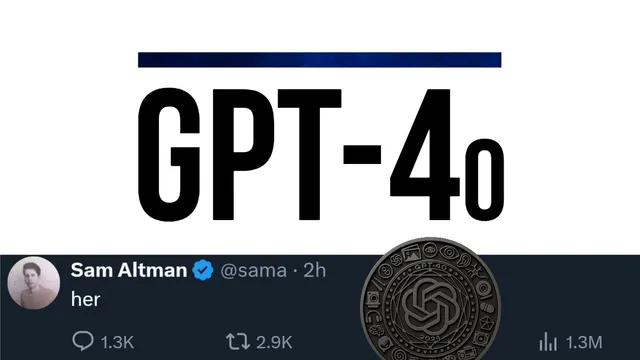
GPT-4o - Full Breakdown + Bonus Details
Based on AI Explained's video on YouTube. If you like this content, support the original creators by watching, liking and subscribing to their content.
GPT-4o (“Omni”) is positioned as a multimodal model optimized for faster, more natural real-time interaction, with low latency treated as a core differentiator.
Briefing
GPT-4o (“Omni”) is positioned as a faster, cheaper, and more capable multimodal model—able to take in and respond with multiple formats—while OpenAI leans on low latency to make interactions feel closer to real-time conversation. The central pitch is practical: it’s free for users, it handles text and images with high accuracy, and it’s built to deliver more natural, expressive responses than earlier GPT models. That combination matters because it lowers the barrier to using advanced AI at scale, not just for researchers but for everyday tasks like coding help, content creation, tutoring, and accessibility.
Beyond the headline “smarter,” the transcript highlights several under-the-radar capabilities. Text generation is described as unusually accurate, including details like punctuation and capitalization. In an image-to-poster workflow, GPT-4o is shown taking researcher-provided photos and producing a movie poster that improves the original text—crisper typography, bolder colors, and a more dramatic overall look—while maintaining strong fidelity to the input photos. OpenAI also teased a release window (“next few weeks”) for a set of multimodal features, including a proof-of-concept that mimics an agentic workflow: an AI “customer service” interaction that requests an email address, then triggers a follow-up check to confirm the “shipping label and return instructions” were received. The transcript frames this as a hint toward future agents rather than a finished product.
The practical product layer gets a spotlight too: a desktop app functions like a live coding co-pilot. In the described setup, the app can listen to voice while a user shares code on-screen, then produce a one-sentence explanation of what the code does—fetching daily weather data, smoothing temperatures with a rolling average, detecting significant events, and plotting results. The transcript also lists quick bonus ideas that didn’t make the main demo: generating caricatures from photos (Lensa-style), text-to-new-font creation, meeting transcription for multi-speaker audio, and video summarization. Video output isn’t claimed as a core capability in the same way audio is, but the model is described as supporting video understanding and summarization.
On performance, the transcript mixes strong wins with caution. A “human-grade leaderboard” is cited where GPT-4o is preferred over other models, especially for coding, with a win-rate gap likened to earlier GPT-4 improvements. Math performance is described as a marked step up from original GPT-4, even if it still fails many math prompts. In a key adversarial reading comprehension benchmark (DROP), GPT-4o edges past original GPT-4 but falls slightly behind Llama 3.0 400B, with the caveat that Llama 3.0 400B is still training. Vision understanding is described as a clear improvement—about 10 points better than Claude 3 Opus on the cited mmMU evaluation—while translation and multilingual efficiency are framed as a major advantage due to tokenizer improvements that reduce token counts for languages like Gujarati, Hindi, and Arabic.
Pricing and availability are treated as part of the technical story: GPT-4o is listed at $5 per 1M input tokens and $15 per 1M output tokens, with a 128k context window and an October knowledge cut-off. The transcript contrasts this with Claude 3 Opus pricing and subscription requirements, arguing that GPT-4o’s combination of cost, speed, and multimodal interaction could drive broader adoption even if it isn’t a clean “AGI” leap. The overall takeaway is that GPT-4o’s biggest shift is not just raw capability—it’s the immediacy of interaction, which could make advanced AI feel usable at human conversational speeds.
Cornell Notes
GPT-4o (“Omni”) is framed as a major step forward in multimodal AI that emphasizes speed, lower cost, and more natural real-time interaction. The transcript highlights strong text and image accuracy, improved poster/text refinement from photo inputs, and an agent-like proof-of-concept that performs multi-step tasks (requesting info, “sending” it, and verifying receipt). Coding performance is described as notably better than competing models, while reasoning benchmarks show mixed results—stronger than original GPT-4 on some tests but not uniformly ahead (e.g., DROP vs Llama 3.0 400B). Pricing ($5/M input, $15/M output) and a 128k context window support the argument that GPT-4o’s accessibility could drive much wider use, not just incremental research gains.
What does “Omni” mean in GPT-4o, and why does it matter for everyday use?
Which examples in the transcript are used to demonstrate accuracy and creative control?
How does the transcript connect GPT-4o to “agents,” and what is the proof-of-concept?
What performance claims are made for coding, math, and reasoning—and where do the results look mixed?
Why are latency and pricing treated as central to the model’s impact?
What multimodal product features are highlighted beyond the main demos?
Review Questions
- Which transcript examples best support the claim that GPT-4o improves multimodal accuracy (text and images), and what specific improvements were described?
- How do the transcript’s benchmark results differ across coding, math, and DROP, and what caveats are mentioned for interpreting those comparisons?
- Why do latency and token pricing appear to be treated as as important as raw benchmark performance in the transcript’s overall assessment?
Key Points
- 1
GPT-4o (“Omni”) is positioned as a multimodal model optimized for faster, more natural real-time interaction, with low latency treated as a core differentiator.
- 2
Text generation is described as unusually accurate, and photo-to-poster workflows show improved refinement of typography and overall visual drama.
- 3
A proof-of-concept customer-service interaction demonstrates early agent-like behavior: multi-step requests followed by verification of outcomes.
- 4
Coding performance is highlighted as a standout area, while reasoning benchmarks like DROP show only incremental gains over original GPT-4 and not a universal lead.
- 5
Vision and multilingual efficiency are framed as major strengths, including tokenizer improvements that reduce token counts for languages such as Gujarati, Hindi, and Arabic.
- 6
GPT-4o pricing is cited as $5 per 1M input tokens and $15 per 1M output tokens, alongside a 128k context window and an October knowledge cut-off.
- 7
The transcript argues that free access plus multimodal capability could expand adoption far beyond prior GPT usage, even if AGI remains uncertain.