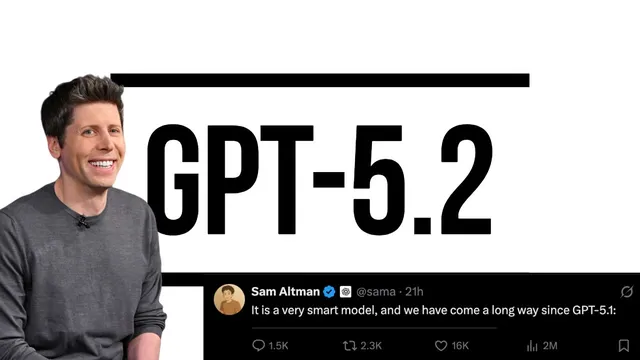
GPT 5.2: OpenAI Strikes Back
Based on AI Explained's video on YouTube. If you like this content, support the original creators by watching, liking and subscribing to their content.
GPT 5.2’s GDPvow “expert-level” headline depends on a benchmark design that restricts to predominantly digital jobs, selected task subsets, and provided task context.
Briefing
OpenAI’s GPT 5.2 is being pitched as a step toward expert-level performance on real, digitally oriented professional work—yet the broader takeaway is less about a single score and more about how “thinking time” and benchmark design increasingly shape what looks like progress. The release claims GPT 5.2 “thinking” reaches a new state of the art on GDPvow, and is the first model to perform at or above a human expert level. In expert-judge comparisons, it beats or ties top industry professionals on 71% of cases, with the benchmark framed as an evaluation of well-specified knowledge-work tasks across 44 occupations.
That headline, however, is easy to misread. GDPvow questions are written by industry experts, but the tasks are restricted to work that is predominantly digital, and only selected subsets of tasks from each occupation are used. Crucially, the full task context is provided to the model beforehand, and the benchmark is designed to reflect the impact of catastrophic mistakes—something that’s hard to quantify in other settings (like rare failures that could wipe a user’s files). In practice, GPT 5.2’s strengths show up in tasks such as producing spreadsheets after web research, and the transcript cites an example where it generated a football-themed interaction matrix with results checked for accuracy and corroborated by other models.
Still, the comparison landscape is getting messier. OpenAI’s GPT 5.2 release reportedly doesn’t include head-to-head results against some rival top models (like Claude Opus 4.5 or Gemini 3 Pro), prompting “cheeky” community comparisons—such as multimodal segmentation of the same motherboard image—where Gemini 3 Pro is claimed to outperform on tighter segmentation. Similar issues appear in spreadsheet-like tasks: GPT 5.2 can produce the needed outputs, but the transcript attributes failures to smaller token budgets and less time to think in lower-tier access.
A central argument emerges from these examples: benchmark performance is increasingly driven by “test-time compute”—the amount of tokens and compute a model is allowed to spend solving a question—rather than raw capability alone. The transcript points to OpenAI’s own reasoning-effort settings (including “extra high”) and to benchmarks like ARC-AGI1 and ARC-AGI2, where results tend to rise as more tokens or dollars are spent. That makes it difficult to declare one model “better” without controlling for compute budgets.
Even when models are evaluated on the same named task, different benchmarks can yield different winners. The transcript contrasts MMU Pro (table and chart understanding) where Gemini 3 Pro edges GPT 5.2 on one metric, with a newer “charive reasoning” benchmark where GPT 5.2 jumps to 88.7%—despite the benchmark still aiming at realistic chart understanding. For well-known knowledge-and-reasoning tests like Humanity’s Last Exam and GPQA Diamond, the transcript notes that results can be close, and that benchmark authors have warned about contamination risk and noise in a fraction of questions.
To reduce the cheating problem, the transcript describes a private “SimpleBench” built to exploit known weaknesses, with GPT 5.2 Pro scoring 57.4% versus a human baseline around 84% and Gemini 3 Pro at 76.4%. The transcript also highlights GPT 5.2’s long-context recall, citing near-100% accuracy on OpenAI’s “four-needle” challenge across up to ~200,000 words, with continued strength up to 400,000 tokens and claims that Gemini 3 remains stronger up to a million tokens.
Overall, GPT 5.2 is framed as a solid incremental advance—especially for professional digital tasks and long-context recall—while the industry’s real challenge is making fair comparisons when compute budgets, benchmark selection, and evaluation noise can all swing the scoreboard. The transcript ends with an analogy: instead of a single “flash” breakthrough, progress may come from steadily “counting sheep” (human tasks) one benchmark and one capability at a time until automation reaches everything that can be tackled digitally or physically.
Cornell Notes
GPT 5.2 is marketed as reaching expert-level performance on GDPvow, a benchmark built from well-specified digital knowledge-work tasks across 44 occupations. Expert judges reportedly found GPT 5.2 “thinking” beats or ties top professionals in 71% of comparisons, but the transcript stresses that GDPvow’s setup (digital-only tasks, provided context, and selected task subsets) can make headlines misleading. A major theme is that benchmark scores increasingly depend on test-time compute—how many tokens and how much “thinking time” a model is allowed—so direct model comparisons can be unfair without controlling for token budgets. The transcript also highlights GPT 5.2’s long-context recall (near-100% on the four-needle challenge up to ~200,000 words) and notes that different benchmarks can crown different winners, even when they claim to test similar skills.
Why does GPT 5.2’s GDPvow “expert-level” claim need context to interpret correctly?
How does “thinking time” (test-time compute) complicate comparisons between models?
What example shows how two models can swap rankings depending on benchmark choice?
What does the transcript claim about GPT 5.2’s long-context recall?
How does SimpleBench aim to reduce benchmark cheating and why does that matter?
What is the transcript’s bottom-line view of GPT 5.2’s progress?
Review Questions
- Which parts of the GDPvow benchmark design (task selection, context provided, and task type restrictions) could make it easier for models to score highly than real-world work?
- Explain how test-time compute can change the outcome of an evaluation even if two models have similar underlying capability.
- What evidence in the transcript suggests that benchmark choice can reverse which model appears strongest?
Key Points
- 1
GPT 5.2’s GDPvow “expert-level” headline depends on a benchmark design that restricts to predominantly digital jobs, selected task subsets, and provided task context.
- 2
Benchmark scores increasingly track test-time compute: more allowed tokens and “thinking time” often produce higher results, making single-number comparisons misleading.
- 3
Head-to-head comparisons matter; missing comparisons against certain rival models can lead to informal community tests that may not be apples-to-apples.
- 4
Different benchmarks that claim similar abilities can still rank models differently, as shown by chart understanding results varying across MMU Pro versus “charive reasoning.”
- 5
Private or carefully controlled benchmarks like SimpleBench are used to reduce contamination risk, but they still reflect specific question formats and constraints.
- 6
GPT 5.2 is highlighted for long-context recall, including near-100% performance on the four-needle challenge up to roughly 200,000 words and continued strength toward 400,000 tokens.
- 7
The transcript frames progress as incremental “task counting” rather than a single leap, with evaluation fairness as the key challenge for interpreting improvements.