Gradient descent, how neural networks learn | Deep Learning Chapter 2
Based on 3Blue1Brown's video on YouTube. If you like this content, support the original creators by watching, liking and subscribing to their content.
Neural-network learning is framed as minimizing a cost function that averages squared output errors over labeled training examples.
Briefing
Gradient descent is the engine behind neural-network learning: it repeatedly nudges thousands of adjustable weights and biases to reduce a single number called the cost. That cost measures how wrong the network’s outputs are across a large labeled training set—so “learning” becomes the practical task of finding a low point (a local minimum) in a very high-dimensional landscape. The method matters because it turns pattern recognition into an optimization problem that can be carried out with calculus, even when the model has around 13,000 parameters.
The setup starts with a digit classifier trained on MNIST-style images: each 28×28 grayscale image becomes 784 input values feeding a network with two hidden layers (16 neurons each) and 10 output neurons. For any image, the network produces 10 activations; the brightest output neuron is interpreted as the predicted digit. Before training, weights and biases are initialized randomly, producing outputs that look like noise and yield a high cost. The cost function is defined as the average, over all training examples, of the squared differences between the network’s output activations and the desired one-hot target (0 for most digits, 1 for the correct digit). Minimizing this average cost is meant to improve performance not only on the training set but also on new, unseen labeled images.
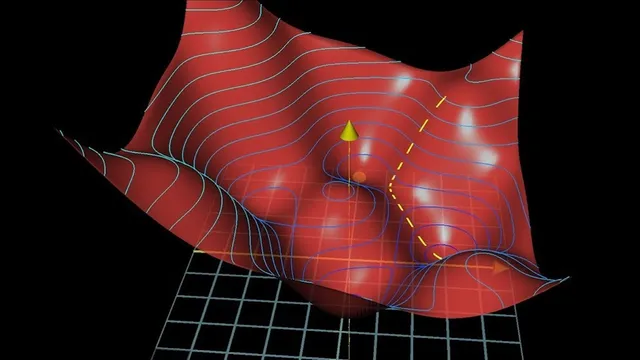
To reduce the cost, the process uses the gradient: in simple terms, the gradient points in the direction of steepest increase, so moving in the opposite direction decreases the cost fastest. For a function with many inputs—here, the entire vector of weights and biases—the negative gradient becomes a gigantic direction in parameter space. Each component of that gradient indicates both the sign (whether a particular weight should increase or decrease) and the relative magnitude (how much that weight change matters). With a small step size, repeated downhill moves shrink as the slope flattens near a minimum, helping avoid overshooting.
The computational work of obtaining these gradients efficiently is attributed to backpropagation, which will be unpacked next. A key conceptual requirement is that the cost surface should be smooth enough for small steps to reliably lead toward a minimum—one reason neural networks use continuously valued activations like sigmoid and ReLU rather than binary on/off units.
After training, the described “plain vanilla” architecture reaches about 96% accuracy on new MNIST images, with tuning of hidden-layer structure pushing performance toward roughly 98%. Yet the internal representations don’t match the earlier hope that early layers would clearly detect edges and later layers would assemble them into loops, lines, and digits. Visualizing the learned weights from the first to the second layer reveals patterns that are close to random, suggesting the network can find a workable local minimum without learning the intuitive feature hierarchy.
That tension—good accuracy versus unclear “understanding”—leads into modern research questions. One line of work shows that when labels are shuffled, a sufficiently large network can still memorize random mappings, achieving training accuracy comparable to structured training. Follow-up results at ICML suggest the optimization dynamics differ: accuracy drops more slowly on random labels, while structured labels allow faster descent into useful regions of the loss landscape. Related findings argue that the local minima reached by these networks can be “equal quality,” implying that structure in the dataset makes the right minima easier to find. The takeaway is that gradient descent is effective, but what it learns—and why it generalizes—depends on the geometry of the optimization landscape and the structure of the data.
Cornell Notes
Learning in this framework reduces to minimizing a cost function. The cost is computed as the average squared error between the network’s 10 output activations and the correct one-hot digit target across the training set. Gradient descent updates all weights and biases by repeatedly stepping in the direction of the negative gradient, which encodes both which parameters should move and how strongly they matter. Backpropagation is identified as the mechanism for computing these gradients efficiently. Even when the network reaches about 96%–98% test accuracy on MNIST, the learned hidden-layer weights may look far less like clean edge-and-shape detectors than expected, raising questions about memorization versus structure in the optimization landscape.
How is the “cost” for a single digit image defined, and why does it matter?
Why does gradient descent tell the network which way to change its weights?
What role does backpropagation play in this learning process?
Why are smooth activation functions emphasized in the discussion of optimization?
How can the network reach high accuracy while its learned features look “random”?
What do the label-shuffling and ICML results imply about memorization and optimization?
Review Questions
- In the described MNIST setup, how is the cost function constructed from the network’s 10 outputs and the one-hot digit target?
- Explain how the negative gradient’s sign and magnitude determine parameter updates during gradient descent.
- Why might a network achieve high test accuracy even if its hidden-layer weights don’t resemble edge-and-pattern detectors?
Key Points
- 1
Neural-network learning is framed as minimizing a cost function that averages squared output errors over labeled training examples.
- 2
Gradient descent updates all weights and biases by stepping repeatedly in the direction of the negative gradient of the cost.
- 3
The gradient’s components indicate both whether each parameter should increase or decrease and how strongly each should change.
- 4
Backpropagation is identified as the efficient method for computing gradients needed for gradient descent.
- 5
Smooth, continuously valued activations (e.g., sigmoid, ReLU) support gradient-based optimization by making the cost landscape more navigable.
- 6
High MNIST accuracy does not necessarily mean hidden layers learn intuitive edge-to-shape feature hierarchies; learned weights can look nearly random.
- 7
Research on shuffled labels highlights a distinction between memorization capacity and the optimization dynamics created by structured datasets.