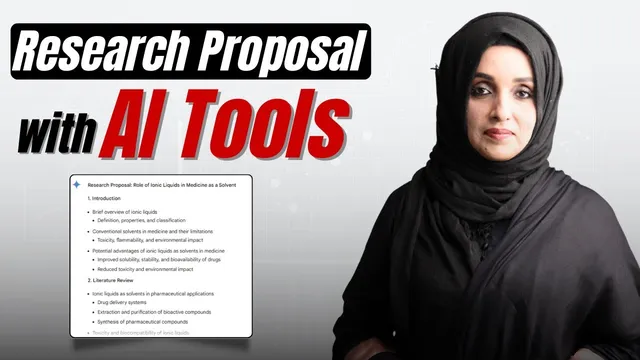
Grant Winning Research Proposal Writing With Ai Tools | 10x Fatser Research Proposal Writing
Based on Dr Rizwana Mustafa's video on YouTube. If you like this content, support the original creators by watching, liking and subscribing to their content.
Clarify topic, research gap, research problem, research questions, aims, and objectives before asking AI to draft proposal sections.
Briefing
AI tools can accelerate grant- and PhD-level research proposal writing by turning a messy set of early ideas—topic selection, research gap, problem statement, questions, aims, objectives, and even rough methodology—into a structured outline and then a chapter-by-chapter draft that’s checked for completeness. The core workflow is less about “writing from scratch” and more about feeding the right inputs in a clear, repeatable way so the tool can generate an organized proposal structure and then flag missing elements.
The process starts before any drafting. Once a researcher has chosen a topic and clarified the research gap, defined the research problem, and aligned research questions with aims and objectives, the next step is building a proposal structure. AI can help at this stage in “few clicks,” but only if the researcher is specific about what they already know—especially the methodology they plan to use. Without that clarity, the tool may produce generic sections that require substantial revision.
A key practical point is how to prompt AI effectively. Prompts should be well structured in three parts: (1) define the role the tool should play (for example, “act like a pro researcher”), (2) assign the task with clear boundaries using commas around the specific instruction, and (3) specify the output structure desired. Instead of requesting a full proposal immediately, the workflow can begin with an outline—headings and subheadings for the introduction, literature review structure, research objectives, methodology, expected outcomes, contribution, and a timeline.
The tutorial then demonstrates two tool categories. One is a Gemini-based approach used to generate an initial outline and proposal components after the user provides a topic and initial notes. A sample topic is used—ionic liquids in medicines, including their role as solvents—showing how the tool can return an introduction breakdown (advantages, limitations of conventional solvents, potential benefits), a literature review structure, research objectives, and a methodology section that reflects commonly used options in the literature rather than random choices. The emphasis is on using the tool to surface relevant literature-informed ideas, then refining them.
The second tool is positioned as more of a “proposal builder” and reviewer than a purely generative writer. It uses templates by chapter (such as the introduction) and provides targeted checks and recommendations. For example, it can suggest what a strong introduction should include: a brief overview of ionic liquids, advantages as a solvent in medicines, limitations of conventional solvents, unresolved questions, clarity on potential knowledge contribution, and—importantly—research questions. The tool’s value is framed as iterative quality control: it can run multiple checks per section (described as roughly 11 steps per chapter, scaling to many checks across the proposal), then recommend edits so the final draft is submission-ready.
Overall, the message is that AI can meaningfully improve proposal quality when researchers treat it like a structured assistant—feeding specific research problem details and methodology assumptions, generating outlines, and then using chapter-level review features to ensure nothing critical is missing before submission.
Cornell Notes
AI tools can speed up research proposal writing by converting early research decisions—topic, gap, problem statement, research questions, aims, objectives, and a rough methodology—into a structured outline and then a chapter-by-chapter draft with completeness checks. Effective results depend on prompt structure: assign a role, specify the task clearly, and request the output format you need (often headings/subheadings first). A Gemini-based workflow can generate literature-informed proposal components such as introduction structure, research objectives, methodology options, expected outcomes, contributions, and timelines. A separate “proposal builder” approach uses templates and runs multiple checks per chapter (e.g., introduction) to flag missing elements like unresolved questions, knowledge contribution, and research questions. This combination helps produce a more submission-ready proposal rather than a generic draft.
What early research inputs should be clarified before using AI to draft a proposal?
How should prompts be structured to get useful proposal outlines instead of generic text?
What does the Gemini-based step produce in the proposed workflow?
How does the “proposal builder” tool differ from a purely generative AI approach?
Why does the tutorial emphasize chapter-level checks and iterative corrections?
Review Questions
- What three-part prompt structure is recommended, and how does it change the quality of outputs?
- Why is having a rough methodology plan before drafting important for AI-assisted proposal writing?
- In the introduction review example, which missing elements were flagged as necessary for a stronger proposal section?
Key Points
- 1
Clarify topic, research gap, research problem, research questions, aims, and objectives before asking AI to draft proposal sections.
- 2
Use well-structured prompts: define the AI role, specify the task clearly (with comma-delimited specifics), and request the exact output format needed (often outlines first).
- 3
Start with an outline (headings/subheadings) rather than demanding a full proposal in one step.
- 4
Feed rough methodology expectations so AI can propose literature-aligned methodology options instead of generic approaches.
- 5
Use a proposal builder/reviewer tool with chapter templates to run completeness checks and catch missing elements like unresolved questions and research questions.
- 6
Iterate section-by-section: apply recommendations from the tool’s checks to move toward a submission-ready draft.