Graph Analysis - Co Citations
Based on Obsidian Community Talks's video on YouTube. If you like this content, support the original creators by watching, liking and subscribing to their content.
Co-citation turns Obsidian’s link graph into a relationship engine by listing concepts that co-occur in the same snippets.
Briefing
Co-citation analysis is positioned as a practical way to answer “relationship” questions inside an Obsidian vault—without forcing users to manually restructure notes. The core idea: when a single note cites two concepts, those concepts become co-cited, and a dedicated panel can surface the exact snippets where both appear together. That turns scattered daily-note facts into a searchable map of second-order connections—useful for questions like “What does Biden think about global tax?” or “What’s the relationship between Biden and Macron?”
The talk starts with a problem many Obsidian users face: where to store factual snippets so they remain retrievable later. Facts can be anything from life events and news to descriptions of systems, story events, or tabletop RPG happenings. Using a news example about the G20 approving a global tax on October 30, the speaker models the information as a graph of entities (global tax, Joe Biden, Macron, G20, the EU, and so on). The key retrieval needs go beyond “What happened on that date?” People also want to understand why certain entities matter, and—hardest of all—what the relationship is between two concepts.
Daily notes seem like the obvious place to put time-stamped facts, because they minimize “where should I put this?” decisions. But daily-note backlinks don’t naturally reveal relationships between entities. If a daily note links to many people and topics, the backlinks list becomes a long, date-heavy trail with no direct links between the concepts themselves. Even if users can navigate from one entity to the daily note, they still have to sift through many entries to reconstruct why two concepts are connected.
The proposed fix is co-citation. Instead of asking users to traverse backlinks manually, the co-citation panel for a target concept (like “global tax”) lists other concepts that appear together in the same source snippets. This is described as a “second order backlinks” view: the information is stored in the original date-based note, but the panel re-indexes it so relationships become immediately visible. The workflow becomes: open the concept node, expand the co-citation list, and jump straight to the snippets where both concepts co-occur.
A major technical emphasis is scoring strength. Simply knowing two entities appear in the same note isn’t enough; the plugin assigns higher scores when the concepts occur in the same sentence, lower scores when they’re in the same paragraph, and even weaker scores as distance increases (down to cases where connections are considered too weak to matter). The algorithm also incorporates structure signals like headings and outline hierarchies, and supports unresolved links, files, images, and decks.
Demos show how this helps with real vault navigation: expanding a Biden node reveals clusters of co-cited entities (including other politicians) with numeric relevance scores, and a “freeze” option lets users keep a co-citation view stable while exploring tangential notes. Additional examples include browsing conceptual relationships (humans to brain-related ideas, happiness to personality and cited works) and applying the same mechanism to research topics like the bias–variance tradeoff. The overall message is that co-citation turns Obsidian’s link graph into a usable relationship engine, reducing manual overhead while keeping the underlying note structure simple.
Cornell Notes
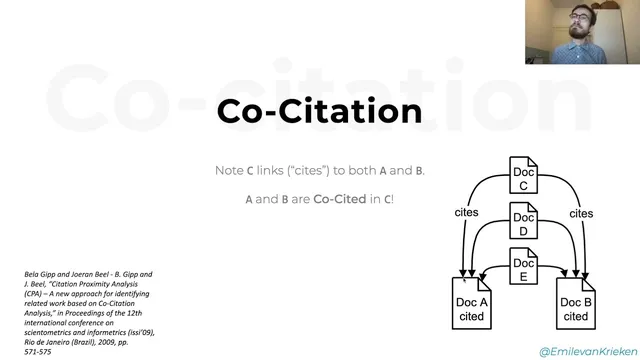
Co-citation analysis in Obsidian is built to answer relationship questions between concepts. When a note contains links to both concept A and concept B, those concepts are treated as co-cited, and a co-citation panel lists the snippets where they appear together. This creates a “second-order backlinks” workflow: users open a concept node and immediately see other entities strongly connected to it, then jump to the exact supporting sentences. Relevance is ranked using a scoring scheme that favors same-sentence co-occurrence, then same-paragraph, then weaker structural proximity. The result is faster retrieval of “what connects these ideas?” compared with scanning daily-note backlinks or building complex query views.
Why are daily notes alone a weak tool for relationship questions between entities?
What does “co-citation” mean in this system, and how does it answer relationship questions?
How does the plugin decide whether two co-cited concepts are strongly or weakly related?
What structural signals beyond sentences can improve co-citation scoring?
How does the “freeze” option change the research workflow?
How can co-citation help with non-news, research-style knowledge?
Review Questions
- When you store a factual snippet in a daily note, what specific limitation prevents backlinks from directly answering “relationship between two concepts” questions?
- Explain the scoring logic for co-citation strength. Why does same-sentence co-occurrence matter more than same-note co-occurrence?
- Describe how “freeze” supports exploratory research without breaking the relationship view you started with.
Key Points
- 1
Co-citation turns Obsidian’s link graph into a relationship engine by listing concepts that co-occur in the same snippets.
- 2
Daily notes minimize placement effort but create high overhead for relationship questions because they don’t directly connect entities to each other.
- 3
A co-citation panel provides a second-order backlinks workflow: open a concept node, expand co-citations, and jump to the exact supporting sentences.
- 4
Relevance scoring ranks connections by textual proximity—highest for same-sentence co-occurrence and lower as distance increases (sentence → paragraph → weaker proximity).
- 5
Headings and outline hierarchies are used as additional structure signals to strengthen meaningful connections.
- 6
The system supports more than text links, including unresolved links, files, images, and decks, enabling relationship browsing across media and references.
- 7
A “freeze” option preserves the co-citation view while users explore tangential notes, supporting iterative research.