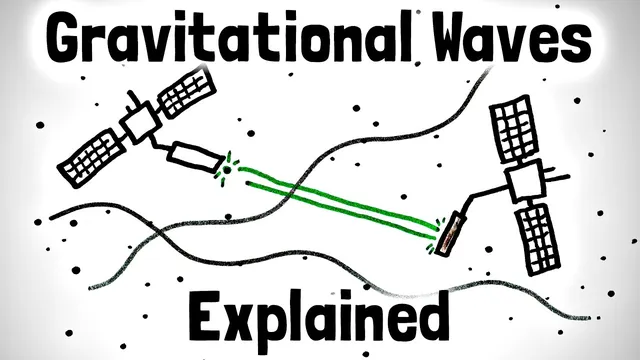
Gravitational Waves Explained Using Stick Figures
Based on minutephysics's video on YouTube. If you like this content, support the original creators by watching, liking and subscribing to their content.
Gravitational waves form because changes in the gravitational field propagate outward over time rather than instantly.
Briefing
Gravitational waves are ripples in the gravitational field produced when gravity’s influence propagates at a finite speed rather than instantly. If the Sun’s position or mass distribution changed abruptly, the gravitational field would not adjust everywhere at once; instead, the altered field would spread outward over time. A steady back-and-forth motion—like a source that keeps “shaking” rather than giving a one-time shove—generates a continuous gravitational-wave signal.
The “waving” shows up as tiny, time-varying changes in the strength of gravity at a given location. That’s analogous to how water waves raise and lower the water level, sound waves raise and lower air pressure, and electromagnetic waves strengthen and weaken electric and magnetic fields. For gravitational waves, nearby objects respond to the changing gravitational field: a bobbing motion is expected in principle, but gravity has a subtle twist—free-floating test masses don’t feel like they’re being pushed back and forth in the usual way. The practical signature is instead a changing separation between objects.
Physicists measure that changing distance using precision interferometry rather than relying on freely floating “cats” or planets. The core idea is to compare the distance between test masses by sending laser light between them and timing how long it takes to return. When a gravitational wave passes, the space between the mirrors stretches and squeezes, shifting the interference pattern of the laser beams.
Detecting those effects is extraordinarily difficult because gravitational waves are feeble. Even though accelerating electrons in a radio antenna create both electromagnetic waves and gravitational radiation, the gravitational component is unimaginably small. The transcript gives a concrete scale: a 200 watt radio transmitter produces roughly a quadrillionth of a quintillionth of a quintillionth of a quintillionth of that power as gravitational radiation. With such weak signals, only the most violent cosmic events generate gravitational waves strong enough to detect on Earth.
That limitation explains why observations have focused on extreme sources such as superfast spinning neutron stars, merging black holes, and the early universe. So far, detections have come from black hole collisions, underscoring how rare and powerful the events must be for gravitational-wave detectors to pick them up.
Cornell Notes
Gravitational waves arise because gravity changes propagate outward at a finite speed, not instantly. A sudden shift in a massive object would create a pulse; ongoing back-and-forth motion produces a continuous wave. As the wave passes, the local gravitational field strength oscillates slightly, which changes the distance between nearby test masses even if they don’t feel like they’re being pushed. Measuring that tiny distance change requires extremely sensitive setups—laser interferometers using mirrors suspended on pendulums or attached to satellites. The signals are so weak that only the biggest astrophysical events, like black hole mergers, have been detected so far.
Why do gravitational waves exist at all, instead of gravity adjusting instantly everywhere?
What is the “waving” quantity for gravitational waves, and how is it analogous to other wave types?
How do scientists infer that a gravitational wave has passed if free-floating objects don’t feel like they’re moving normally?
Why aren’t gravitational waves detected using ordinary vibrating matter like a radio antenna?
What kinds of astrophysical events can produce gravitational waves strong enough for detection?
Review Questions
- What physical assumption about gravity’s propagation speed leads directly to the existence of gravitational waves?
- How does a gravitational-wave interferometer detect a passing wave if test masses don’t behave like they’re being pushed in the usual way?
- Why does a radio transmitter produce gravitational waves that are effectively undetectable compared with signals from black hole mergers?
Key Points
- 1
Gravitational waves form because changes in the gravitational field propagate outward over time rather than instantly.
- 2
A one-time displacement of a massive object would create a pulse; sustained back-and-forth motion produces continuous gravitational waves.
- 3
The wave’s measurable effect is a slight oscillation in gravitational field strength and, crucially, a changing distance between nearby test masses.
- 4
Laser interferometry detects gravitational waves by measuring how the round-trip time of light changes the separation between mirrors.
- 5
Free-floating objects can respond in counterintuitive ways, but the distance-change signature remains the practical observable.
- 6
Gravitational radiation from ordinary sources like radio antennas is extraordinarily weak, making detection feasible only for the most extreme astrophysical events.
- 7
So far, detected gravitational-wave events have come from black hole collisions.