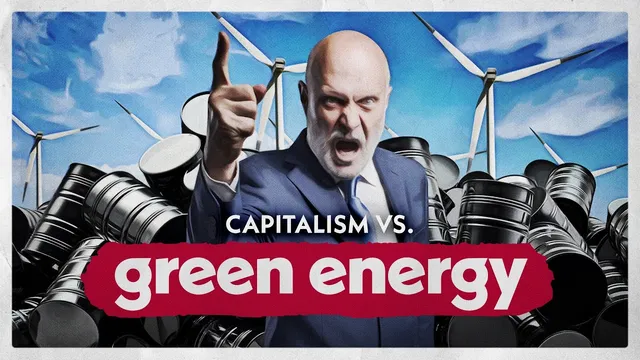
Green Energy Is Cheaper…So Why Aren’t We Using It?
Based on Second Thought's video on YouTube. If you like this content, support the original creators by watching, liking and subscribing to their content.
Solar and wind have become far cheaper, but deployment and investment can still stall when investor returns remain too low.
Briefing
Solar power has become dramatically cheaper over the past half-century—so cheap, in many places, that it undercuts oil, gas, nuclear, and even coal. That price collapse, driven by technology improvements, subsidies, and massive manufacturing scale (especially in China), fits the standard economic story: lower prices should attract more demand and accelerate the energy transition. Yet deployment and investment in renewables have repeatedly stalled, suggesting that “cheap” alone does not translate into a rapid climate solution.
A key reason is profitability. Even as solar and wind costs fell, the returns available to investors did not rise enough to sustain large-scale private investment. The International Energy Agency reported that renewable deployments began stagnating in the late 2010s despite nearly a decade of falling prices and government measures meant to spur adoption. The gap between falling costs and stalled buildout points to a deeper constraint: investors still need attractive margins, and renewable projects often fail to deliver them.
That profitability problem is reinforced by how major fossil-fuel companies frame their “net zero” commitments. Shell, for example, publicly signaled a transition to renewables but attached conditions that effectively preserve investor control: progress depends on undefined societal follow-through on Paris Agreement goals, the venture must be self-funded, and—most importantly—renewables will be scaled only if they deliver an 8–12% return on investment. The argument is that such returns are unlikely under current market conditions, so the commitments function as flexible promises rather than binding investment plans.
The transcript contrasts this cautious posture with continued expansion of oil and gas. It cites Shell announcing new projects globally and BP adding substantial new oil and gas production between 2016 and 2021, while low-carbon investment shares were small. The same pattern is extended beyond oil majors to asset managers. BlackRock, Vanguard, and State Street—collectively described as controlling enormous pools of capital—have adopted ESG language and climate-focused messaging, but a 2022 study found they more often oppose environmental shareholder resolutions than support them. Voting behavior is described as narrow and piecemeal, and the overall effect is framed as slowing or preventing stronger environmental governance.
The core claim becomes structural: under capitalism, profit—not price—drives investment. Cheap solar can benefit consumers, but it does not automatically create the margins that private capital requires. The transcript argues that renewable energy markets increasingly face narrow margins, making them unattractive for investors and contributing to stalled deployment.
Finally, the discussion ties the economics back to exploitation. Even if solar helps reduce greenhouse gases, the supply chain still depends on rare-earth mineral extraction and manufacturing, which can involve violence, pollution, and labor exploitation—especially in peripheral regions where regulation and enforcement are weaker. The transcript argues that these “ugly” costs persist because the system demands continuous growth and profit, and because collective social action has not purged exploitation from the transition. The conclusion is blunt: solar and renewables may be necessary for climate mitigation, but a transition that requires profit from the process is unlikely to deliver climate justice quickly or fairly enough, and there is “no capitalist path” to that outcome.
Cornell Notes
Solar power has fallen sharply in price, but cheaper energy has not produced a smooth renewable takeover. The transcript links stalled renewable deployment to weak investor profitability: even with falling costs, renewables often cannot deliver the returns private capital demands. Fossil-fuel companies’ “net zero” pledges are portrayed as conditional—scaled only when renewables can meet high profit targets—while oil and gas investment continues. Asset managers with massive influence also appear to resist stronger environmental shareholder resolutions, reinforcing the idea that profit incentives dominate climate messaging. The result is a transition constrained less by technology than by the economics of margins and the exploitation embedded in parts of the supply chain.
Why doesn’t lower solar price automatically lead to faster renewable adoption?
What role do “net zero” conditions play in slowing renewable investment?
How do the transcript’s numbers compare fossil-fuel expansion with low-carbon investment?
What do asset managers’ voting patterns suggest about climate governance?
How does the transcript connect renewable supply chains to exploitation?
What is the “detour” about the Industrial Revolution meant to show?
Review Questions
- What specific profitability threshold (and company example) is used to illustrate why renewables may not attract sufficient investment?
- How does the transcript use evidence about renewable deployment stagnation to challenge the “cheap means good” economic expectation?
- According to the transcript, where does investment in renewables tend to flow when overall renewable margins are thin, and why?
Key Points
- 1
Solar and wind have become far cheaper, but deployment and investment can still stall when investor returns remain too low.
- 2
The transcript ties renewable stagnation to profitability constraints rather than to technical limits alone.
- 3
Shell’s “net zero” framing is presented as conditional, especially on achieving an 8–12% return on investment for renewables.
- 4
Fossil-fuel expansion continues alongside climate pledges, with low-carbon investment shares described as small.
- 5
Asset managers with large market influence (BlackRock, Vanguard, State Street) are described as opposing or undermining environmental shareholder resolutions more often than supporting them.
- 6
The transcript argues that profit incentives under capitalism shape where money goes and what kinds of climate action actually scale.
- 7
Even with lower emissions, the renewable supply chain can involve exploitation and pollution, which the transcript links to the profit-driven structure of the transition.