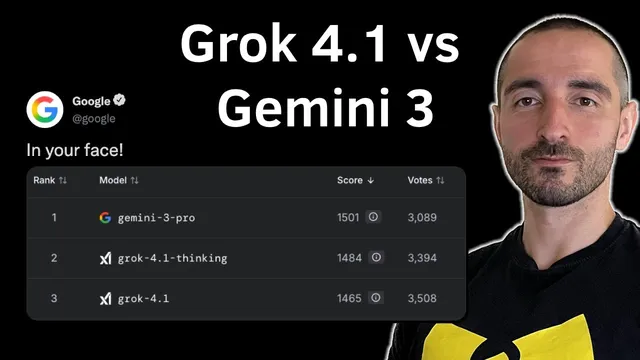
Grok 4.1 vs Gemini 3 Pro - Which Model is THE ONE? | Prompt & Coding First Look
Based on Venelin Valkov's video on YouTube. If you like this content, support the original creators by watching, liking and subscribing to their content.
Grok 4.1 is positioned as a top benchmark performer on emotional intelligence and is described as reducing hallucinations, though the remaining error rate is still considered high.
Briefing
Grok 4.1 and Gemini 3 Pro both land near the top of current AI leaderboards, but a quick side-by-side test suggests Gemini 3 Pro may have the edge for coding-and-web output—while Grok 4.1 delivers sharper “uncomfortable truths” style answers and faster, more consistent responses.
Both models arrive with strong benchmark narratives. Grok 4.1 is positioned as a top performer on LM Arena-style comparisons, including an “emotional intelligence” benchmark where Grok 4.1 thinking and Grok 4.1 sit at the top. On a creative writing measure (Creative Writing V3), GPT 5.1 is still leading, with Grok models close behind—framing Grok 4.1 as a model trying to catch up on writing quality. XAI also claims Grok 4.1 reduces hallucinations, though the transcript notes the remaining error rate is still high.
Gemini 3 Pro is described as a rapid follow-up to Gemini 2.5 Pro’s earlier dominance. Google’s release is framed around high benchmark performance and a large context window, with the transcript citing a 1 million context window and up to 64K output. Multimodal capability is also emphasized—images and audio are expected to be stronger than in Gemini 2.5 Pro—though the transcript’s practical comparison focuses more on text and web-code generation.
The creator runs three shared prompts to compare outputs. In the first, both models identify themselves and then answer a question about which models are better than them. Grok 4.1 responds quickly and names OpenAI o3 and Gemini 2.5 Pro as better, while Gemini 3 Pro gives an answer that the transcript flags as incorrect or outdated (it doesn’t provide a specific version number and references older model comparisons).
In the second prompt—“uncomfortable truths about humans and AI,” asking for the top five with the largest impact—both models produce fast, coherent lists with overlapping themes. Grok 4.1 leans into manipulation via personalization, cognitive overthinking without empathy, and AI systems becoming more agentic with long-term goals. Gemini 3 Pro converges on cognitive offloading and shared-reality erosion, then adds distinct angles like AI intimacy and a “meaning crisis” trajectory. Both responses are described as well-formatted and readable, with Grok 4.1 using citations and appearing to pull context from web sources.
The biggest divergence shows up in the third task: generating a publish-ready landing page. Grok 4.1 produces HTML/CSS that looks basic and includes issues, despite being prompted to output something clean, conversion-focused, and ready to ship. Gemini 3 Pro, using the same landing-page prompt, generates a more polished dark-mode page with gradients and a “higher level” look, including JavaScript and a more complete result. The transcript concludes that Gemini 3 Pro looks particularly strong for web design and coding-style deliverables, while Grok 4.1 remains competitive for analytical, provocative question answering.
Overall, the comparison points to a practical takeaway: choose Grok 4.1 for fast, citation-rich “truth” style outputs and Gemini 3 Pro for higher-quality coding and UI generation—though pricing and deeper evaluation are still needed.
Cornell Notes
Grok 4.1 and Gemini 3 Pro both perform strongly in public benchmark narratives, but a small set of identical prompts produces a clear split. Grok 4.1 answers “uncomfortable truths” with fast, coherent, citation-backed lists and themes like cognitive offloading, personalization-driven manipulation, and increasingly agentic AI. Gemini 3 Pro matches much of that thematic ground, yet its first self-identification/version response is flagged as incorrect or outdated. Where Gemini 3 Pro stands out is the coding task: it generates a more polished, publish-ready dark-mode landing page (with gradients and JavaScript) than Grok 4.1’s more basic output. The practical implication is that Gemini 3 Pro may be the better pick for web/UI generation, while Grok 4.1 looks stronger for fast, citation-rich analytical responses.
What benchmark themes are used to position Grok 4.1 and Gemini 3 Pro as top contenders?
How do Grok 4.1 and Gemini 3 Pro handle the “What is your name / version / which models are better than you?” prompt?
What overlap and differences appear in the “uncomfortable truths” top-five prompt?
Why does the landing-page prompt produce the most decisive difference between the models?
What practical guidance does the transcript suggest for choosing between the two models?
Review Questions
- In the “uncomfortable truths” prompt, which specific themes did both models share, and which themes were unique to each model’s list?
- What evidence from the landing-page task supports the claim that one model is better for web/UI generation?
- How did the two models differ in handling the “version number” portion of the self-identification prompt?
Key Points
- 1
Grok 4.1 is positioned as a top benchmark performer on emotional intelligence and is described as reducing hallucinations, though the remaining error rate is still considered high.
- 2
Gemini 3 Pro is framed as a rapid upgrade over Gemini 2.5 Pro, with a cited 1 million context window and up to 64K output.
- 3
In a shared “name/version/better-than-you” prompt, Grok 4.1 gives a quick, specific comparative answer, while Gemini 3 Pro’s version-related response is flagged as incorrect or outdated.
- 4
Both models produce overlapping “uncomfortable truths” themes, especially cognitive offloading and the erosion of human critical thinking.
- 5
Gemini 3 Pro shows a clear advantage on a publish-ready landing-page generation task, producing a more polished dark-mode design with gradients and JavaScript.
- 6
Grok 4.1’s landing-page output is described as more basic and includes issues, despite being prompted for conversion-focused, ready-to-ship HTML/CSS.
- 7
Final model choice still depends on deeper evaluation beyond these three prompts, including pricing and broader coding tests.