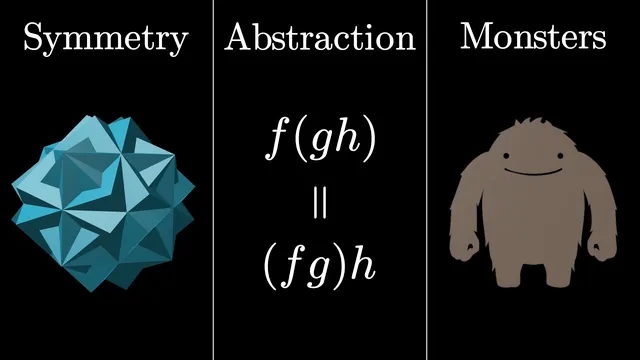
Group theory, abstraction, and the 196,883-dimensional monster
Based on 3Blue1Brown's video on YouTube. If you like this content, support the original creators by watching, liking and subscribing to their content.
Group theory models symmetry as a set of actions closed under composition, including the identity action (doing nothing).
Briefing
The monster group’s defining “size” is so specific—tied to a 196,883-dimensional structure—that it feels less like a random curiosity and more like a deep fingerprint of symmetry itself. After building up group theory from everyday notions of symmetry (snowflakes, cubes, permutations), the discussion pivots to the classification of finite groups: all finite symmetry systems can be decomposed into simpler “atomic” pieces. That classification culminates in a finite list of fundamental building blocks called the finite simple groups, and among them sits an outlier so large and so irregular that it has become a central mystery in modern mathematics.
Group theory begins with symmetry as an action: you can rotate or reflect an object and still preserve what matters. Those actions form a group when they include doing nothing and when combining actions (performing one after another) stays within the same set. The size of a group depends on how much structure is preserved. Rigid geometric symmetries of a cube yield 24 rotations (or 48 if reflections are allowed), while unconstrained permutations of points explode in size—S_n has n! elements. Yet sheer size alone isn’t the point; the key is that group structure encodes hidden constraints.
That constraint shows up in algebra. By studying how a polynomial’s roots can be permuted, mathematicians can read off what kinds of exact formulas are possible. The classic result is that general quintic equations cannot be solved by radicals: the permutation group on five roots, S_5, has an internal structure that blocks any “radicals-only” expression. More broadly, symmetries connect to physics through Noether’s theorem, where conservation laws correspond to symmetry groups.
The narrative then shifts from concrete symmetry actions to abstract groups, emphasizing that groups are defined by how elements combine—not by what they act on. This abstraction enables an important idea: two seemingly different symmetry systems can be the same “up to isomorphism” if their multiplication tables match. With that lens, the central question becomes classification: what are all finite groups, up to isomorphism?
The breakthrough is that finite groups can be built from finite simple groups, just as numbers factor into primes. After decades of work—tens of thousands of pages and heavy computer assistance—the finite simple groups were fully identified by 2004. The result is “absurd” in a different sense than size: there are 18 infinite families plus 26 exceptional sporadic groups. The sporadic groups are the patched-together leftovers that don’t fit the family patterns, and the largest of them is the monster group, named by John Conway. Its scale is extraordinary: the monster is associated with a 196,883-dimensional object, and even describing one element requires about 4 GB of data.
Why do these sporadic groups exist at all? No one has a satisfying conceptual explanation. The closest thing to a guiding thread comes from “monstrous moonshine.” In the 1970s, John McKay noticed that 196,883 (or a close neighbor) appears in coefficients of a series expansion tied to modular forms and elliptic functions. The pattern was formalized as a conjecture and then proved in 1992 by Richard Borcherds, who later won the Fields Medal. The monster also connects to string theory, reinforcing the sense that symmetry-driven structures can surface far from their original home—even when they look, at first glance, wildly arbitrary.
Cornell Notes
Group theory formalizes symmetry as an action set closed under composition, including the identity action. The internal structure of these groups can force surprising algebraic consequences, such as the impossibility of solving general quintic equations by radicals, because the permutation group S5 has the wrong kind of “atomic” decomposition. Classifying all finite groups reduces to classifying finite simple groups, and that classification is complete: 18 infinite families plus 26 sporadic groups. The monster group is the largest sporadic group and is tied to a striking 196,883-dimensional structure, whose appearance in modular-form coefficients led to the “monstrous moonshine” conjecture, proved by Richard Borcherds in 1992. These links suggest deep, still-mysterious connections between symmetry, number theory, and physics.
How does group theory turn everyday symmetry into a mathematical object?
Why do permutation groups get so large, and why does that matter less than structure?
How does group structure explain why quintic equations aren’t solvable by radicals?
What does it mean for two groups to be “the same,” and why is that powerful?
What is the classification of finite simple groups, and where does the monster fit?
What is “monstrous moonshine,” and who proved it?
Review Questions
- Why does treating symmetries as actions lead naturally to the group axioms (identity and closure under composition)?
- What role do finite simple groups play in reducing the classification of all finite groups?
- How does the number 196,883 connect the monster group to modular forms in the monstrous moonshine story?
Key Points
- 1
Group theory models symmetry as a set of actions closed under composition, including the identity action (doing nothing).
- 2
The size of a group depends on how much structure is preserved, but the decisive factor is the group’s internal structure, not just its magnitude.
- 3
Permutation groups S_n (with n! elements) represent the most unconstrained symmetries and serve as a central reference point in group theory.
- 4
Group structure explains algebraic limits such as the nonexistence of a general quintic formula using only radicals, tied to the properties of S5.
- 5
Groups are best understood abstractly via isomorphism: different-looking symmetry systems can share the same multiplication table and thus the same structure.
- 6
All finite simple groups are classified as 18 infinite families plus 26 sporadic groups, with the monster as the largest sporadic outlier.
- 7
Monstrous moonshine links the monster to modular forms through the appearance of 196,883-related coefficients, proved by Richard Borcherds in 1992.