Guns in Space
Based on Vsauce's video on YouTube. If you like this content, support the original creators by watching, liking and subscribing to their content.
Orbiting doesn’t remove gravity; it replaces “falling to the ground” with continuous free-fall that misses the planet due to high sideways speed.
Briefing
Orbiting in space doesn’t cancel gravity—it just changes how gravity and motion combine. Astronauts experience essentially the same gravitational pull as people on Earth, but they are in continuous free-fall. Their high sideways (angular) velocity keeps them moving forward at the same rate that Earth curves away beneath them, so they keep missing the planet rather than landing on it.
That “missing” idea traces back to Newton’s cannon thought experiment: gravity accelerates objects toward Earth at the same rate regardless of horizontal speed, so the only way to achieve a stable orbit is to fire fast enough that the Earth drops away at the same pace the projectile falls. For Earth, that requires traveling at over 17,000 mph (about 8 km/s). In practice, a real projectile fired from Earth would burn up from atmospheric friction long before it could complete an orbit—unless it started from space or used a tunnel.
The same physics scales down. On the Moon, the required speed is much lower because the Moon’s gravitational pull is weaker and the “drop away” rate is different. Henry (as referenced in the transcript) calculated that a bullet fired at the lunar horizon would need to travel about 1,600 m/s—roughly the muzzle speed of the Paris gun. The punchline is that the same orbital logic can be applied to a bullet: if the speed is right and the environment doesn’t interfere, the projectile can keep going around rather than falling back.
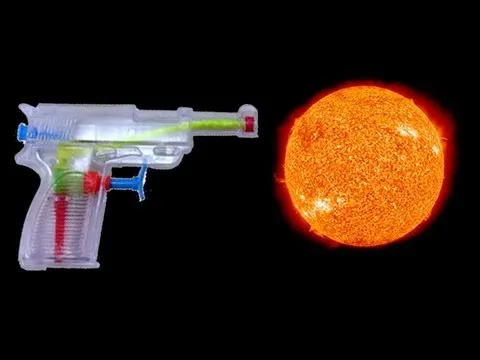
From orbital mechanics, the discussion pivots to an even more extreme target: the Sun. A hypothetical squirt gun stream of water aimed at the Sun raises a simple question—how much water would it take to put the Sun out? The answer isn’t “a lot,” it’s “it wouldn’t work the way you think,” because the Sun isn’t powered by burning hydrogen like a chemical fire. It runs on fusion, where hydrogen nuclei combine and release energy.
Fusion depends on maintaining a critical density and temperature. Adding water to the Sun would increase its mass, making it hotter and brighter, not extinguishing it—though it would shorten the star’s lifespan. The transcript estimates that adding 20 solar masses of water would cut the Sun’s expected lifetime from about 5 billion years to only a few hundred million more years. A “faster way” to stop fusion would require scattering the fuel so the density falls below what fusion needs, but either approach is framed as catastrophic—literally “turning our star against us.”
Finally, the scale of the universe is illustrated with a thought experiment in intergalactic space. Fire a bullet and it will “be forever alone” because cosmic expansion steadily increases the distance between galaxies. Even if galaxies drift apart by hundreds of kilometers per second on average, a bullet’s few km/s speed can’t catch up. The result is a humbling contrast: on cosmic scales we’re tiny, yet on Earth we’re close enough that a tunnel across the planet becomes a practical curiosity—leading into a referral to Minute Physics for what happens with a tunnel through the Earth.
Cornell Notes
Astronauts don’t escape gravity in orbit; they stay in free-fall while their sideways speed is high enough that Earth curves away beneath them. Newton’s cannon shows the required “miss the Earth” speed: about 17,000 mph (8 km/s) for Earth, while the Moon needs far less. The transcript then applies similar scaling to a “gun on the Moon” scenario, citing a required bullet speed around 1,600 m/s (comparable to the Paris gun). It shifts to the Sun, arguing that adding water won’t extinguish fusion because extra mass makes the Sun hotter and brighter; stopping fusion would require lowering density. Cosmic expansion closes the loop with an intergalactic bullet thought experiment: the universe’s expansion outpaces a bullet’s ability to reach receding galaxies.
Why do astronauts keep orbiting instead of falling straight down?
What speed does Newton’s cannon require for a stable orbit around Earth, and why is friction a problem?
How does the required orbital speed change on the Moon, and what real-world comparison is given?
Why wouldn’t adding water to the Sun put it out?
What would actually be required to stop fusion in the Sun?
Why does a bullet fired into intergalactic space never catch up to distant galaxies?
Review Questions
- What specific relationship between free-fall and sideways speed makes orbit possible?
- Compare the roles of atmospheric friction in Earth-launch scenarios versus the Moon-launch scenario.
- How does the transcript connect fusion requirements (density/temperature) to why adding water fails to extinguish the Sun?
Key Points
- 1
Orbiting doesn’t remove gravity; it replaces “falling to the ground” with continuous free-fall that misses the planet due to high sideways speed.
- 2
A stable orbit requires a launch speed high enough that Earth’s curvature keeps pace with the projectile’s downward fall.
- 3
Earth’s orbital speed threshold is about 17,000 mph (8 km/s), but atmospheric drag makes surface-to-orbit launches impractical without avoiding the atmosphere.
- 4
On the Moon, the required speed for an “orbiting bullet” is much lower; the transcript cites about 1,600 m/s, comparable to the Paris gun’s muzzle speed.
- 5
The Sun runs on fusion, so adding water increases mass and tends to make the Sun hotter and brighter rather than extinguishing it.
- 6
Stopping fusion would require reducing the Sun’s effective density below the critical level, not merely adding more material.
- 7
Cosmic expansion can outpace ordinary projectile speeds, making intergalactic “catch-up” impossible in the transcript’s thought experiment.