Gyroscopic Precession
Based on Veritasium's video on YouTube. If you like this content, support the original creators by watching, liking and subscribing to their content.
Torque equals force times the lever arm (radius from the rotation axis).
Briefing
Gyroscopic precession comes down to a simple vector rule: a torque doesn’t just “make things turn,” it changes an object’s angular momentum in the direction set by the torque. In the setup, a wheel spins while a force applied at a distance from its pivot creates a torque (torque equals force times the lever arm, the radius from the rotation axis). Using the right-hand rule, the torque’s direction is determined perpendicular to the force and radius: curl fingers from the axis toward the force, and the thumb gives the torque direction. That torque then increases the wheel’s angular momentum along the torque’s direction.
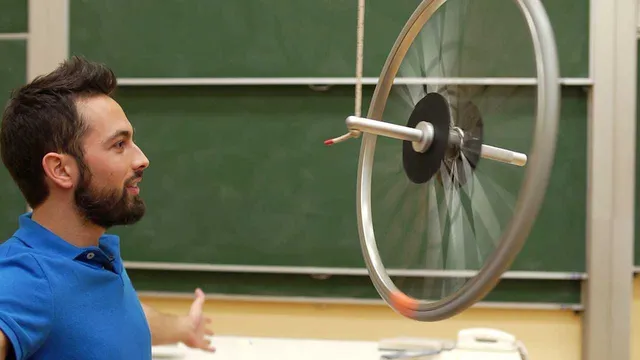
The experiment makes the distinction between “no initial spin” and “already spinning” feel immediate. When the wheel hangs from a single rope and is released without prior rotation, gravity produces a torque that points outward. That torque increases angular momentum outward, which forces the entire system to swing anticlockwise—exactly the motion expected from the torque direction.
But the behavior changes once the wheel is already spinning. After the wheel has been spun up, it already carries angular momentum pointing outward. Now the externally applied torque points in a different direction, so instead of simply increasing angular momentum along its own line, it effectively “rotates” the existing angular momentum vector. The wheel’s angular momentum gets pushed sideways, causing the system to swing in a way that reflects the torque’s attempt to redirect the angular momentum rather than overwrite it.
In other words, the key mechanism behind gyroscopic precession is not that the wheel resists turning in some vague sense; it’s that torque changes angular momentum as a vector. With a spinning rotor, the angular momentum vector can’t instantly realign to the torque direction without the system moving, so the motion appears as a sideways turning—precession—rather than a direct tilt.
The demonstration also highlights a practical limitation: friction quickly damps the effect. As the wheel spins, friction in the setup reduces the clean gyroscopic behavior, so the sideways redirection of angular momentum doesn’t last long. Still, the core takeaway remains: torque and angular momentum are linked through direction, and precession is the visible consequence of applying a torque to a spinning angular momentum vector.
Cornell Notes
Gyroscopic precession follows a vector relationship: torque changes angular momentum, and the torque’s direction determines how angular momentum is redirected. Torque equals force times the lever arm (radius from the rotation axis), and its direction comes from the right-hand rule. When a hanging wheel is released without prior spin, gravity’s torque increases angular momentum outward and the system swings anticlockwise. When the wheel is already spinning, the applied torque pushes the existing angular momentum vector sideways, producing a precession-like sideways turning instead of simply speeding up rotation in place. Friction limits how long the effect persists.
How does torque relate to angular momentum in terms of direction?
What changes when the wheel is released without spinning versus after it’s already spinning?
Why does applying a torque to a spinning wheel produce sideways turning rather than immediate alignment?
How does the right-hand rule determine the torque direction in the demonstration?
What role does friction play in observing gyroscopic precession?
Review Questions
- If a torque is applied perpendicular to an object’s current angular momentum, what kind of motion should you expect and why (in vector terms)?
- In the right-hand rule for torque, what do the curled fingers and the thumb represent?
- How would the motion differ if the wheel were released before it was spun up versus after it reaches steady rotation?
Key Points
- 1
Torque equals force times the lever arm (radius from the rotation axis).
- 2
Torque direction is determined with the right-hand rule and is perpendicular to the force and radius geometry.
- 3
Torque increases angular momentum in the torque’s direction when angular momentum starts from zero.
- 4
For a spinning wheel, an applied torque redirects the existing angular momentum vector, producing precession-like sideways turning.
- 5
Gyroscopic precession is best understood as vector redirection of angular momentum rather than resistance to motion.
- 6
Friction can quickly damp the effect, limiting how long precession remains visible.